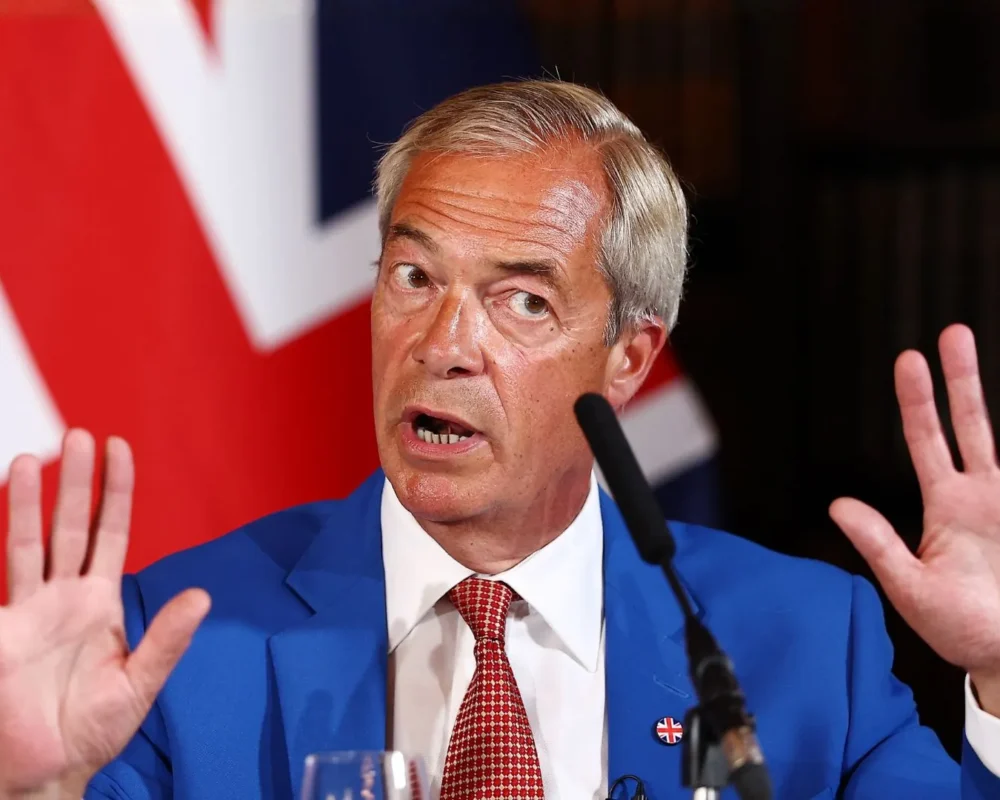
Federal Reserve Chair Kevin Warsh – Win McNamee/Getty Images
Share this article
So, this week financial markets started pricing four or even five Bank of England rate rises over the next year. On the evidence in front of me today, that is lunacy. In fact, I called it rubbish on GB News yesterday lunchtime.
Against that backdrop, the Federal Reserve raised its key interest rate by 25 basis points on Wednesday night, taking its target range to 3.75-4%. Fed chair, Kevin Warsh was clear why, saying ‘The plain fact is that inflation is too high and has been for too long’. Shortly after the announcement President Trump posted on X, ‘LOWER THE INTEREST RATES FOR THE UNITED STATES OF AMERICA, AND FAST!’ No political interference there then.
There’s simply no need to crystallise QE losses today, punishing the taxpayer, especially with the fiscal position so dire
But Britain is not America, the Bank of England is not the Federal Reserve, and Andy Burnham is not Trump. The UK labour market is not as strong as the US, in fact it’s exceptionally weak and still weakening. While unemployment at 4.9% is not terrible, the direction of travel is upwards, and my guess is we hit 5.5% or even 6% next year. Vacancies have fallen to 702,000, the lowest outside the pandemic since 2014, and payrolled employment fell by another 26,000 in August. Private-sector regular pay growth has slowed to 2.9%, its weakest since late 2020. A full percentage point of monetary tightening into this environment, with its long and variable lags, would be disastrous.
Headline inflation data, released by the ONS yesterday did rise from 2.9% to 3.1% in August, but core inflation remained at 2.6% for the fourth consecutive month and services inflation was unchanged at 3.4%. The latest increase was driven largely by energy, petrol and air fares not surprisingly.
Traders and policymakers would be wise to remember that an external oil shock does not automatically lead to sustained inflation unless there is monetary accommodation. I’m not sure if the quantity theory of money – the Fisher equation – or anything related to Milton Friedman is taught much in schools or universities – captured by the Keynesian mind virus – anymore.
Clearly, if households are spending more at the petrol pump and on energy and food prices, and if firms are paying more to move goods around, both have less to spend elsewhere. Without faster growth in the money supply, an oil shock only changes relative prices; it does not generate a permanently higher rate of inflation. And that is what the traders pricing multiple rate-hikes have forgotten: UK broad money is not accelerating. M4ex growth has slowed to just over 4%. If money growth remains around this level, or weakens further, there is no monetary basis for the sort of inflation process implied by four or five Bank Rate increases. None!
For that judgement to change, oil would need to do something far more dramatic than move above $100 or $110. We would need to see a sustained move towards $180 or $200 a barrel, only then would we be facing a truly different economic set of circumstances. At such eyewatering levels, the shock to the economy would become so large, people would alter their wage-setting demands, inflation expectations would rise considerably and become de-anchored and firms pricing behaviour across the economy would change. If that was accompanied by an increase in money supply growth not matched by output, the Bank would face a genuine second-round inflation problem and be forced to raise rates. And raise them materially.
But that is not where we are today.
The market has taken an arguably unnecessary sharp energy shock and extrapolated it into a new monetary tightening cycle. To me, the domestic evidence points the other way: employment is weakening, vacancies are collapsing, private-sector wage growth is slowing and underlying inflation is high, but stable. For four or five hikes to happen requires a chain of events that has not happened. And may, we hope, never happen.
At midday today, the Bank, as expected, announced it held Bank Rate at 3.75%. Anything else would have been a shock.
It also set out its decision on quantitative tightening. The MPC has dropped the yearly haggle over a headline number for a multi-year path running to 2034, and has taken the ultra-long end out of the sales programme for good – the longest-dated gilts, those maturing from 2049 onwards, will now be held permanently, to back the note issue. Given the persistent pressure, not to mention the moron premium, already seen at the long end of the gilt market, this is sensible.
But active sales are set at £20bn, against £21bn over the past twelve months – barely a change, and what reduction there is comes from fewer gilts maturing rather than any choice by the Bank. The Bank has paused its own auctions while it reviews a model under which the Treasury would buy the gilts instead, but the MPC’s sales pace stands either way.
The right policy is to stop active selling entirely and let the remaining bonds mature and roll off the balance sheet: so-called passive QT. There really is no need for the Bank to keep offloading gilts simply to prepare its balance sheet for the next crisis. Nor does doing so become somehow non-monetary because it is labelled ‘normalisation’. If the Bank wants to tighten policy, Bank Rate is the instrument, as Warsh clearly stated last night. Active gilt sales should not be operating as a second, poorly understood tightening channel at the same time. There’s simply no need to crystallise QE losses today, punishing the taxpayer, especially with the fiscal position so dire.
Warsh’s Fed has decided that American conditions justify higher rates. That tells us nothing about what the Bank of England should do.
Stay informed with our free daily briefing.
If oil reaches something approaching $200 and remains there, if wage growth reaccelerates and if broad money begins to expand fast enough to validate a renewed inflationary process, then the policy calculation changes. After all, when the facts change, I change my mind. What do you do, sir?
Until then, four or five UK rate rises are not a realistic central case. They are pricing an inflationary economy that Britain does not currently have.
Damian Pudner is an independent economist specialising in monetary policy and the Director of GBTT.
More Economics
17 Sep 2026
Economics
Alan Hibben
Corporate welfare is Britain’s blind spot
Britain’s political class loves to talk about ‘reforming welfare’, but everyone knows the limits of that ambition. Voter Welfare – the £333.7 billion the state is forecast to transfer from taxpayers to households in 2025–26 – is politically untouchable. A population brought up on free cake is unlikely to vote for the plate being removed, […]
16 Sep 2026
Ideas
Andrew Tettenborn
Billionaire donors are good for democracy
You could almost hear the revolutionary vitriol dripping onto the Labour benches during Monday night’s Lords debate on political donations, following the announcement of Reform’s £72 million bonanza from two crypto billionaires with UK voting rights but recent residence abroad. ‘An undermining of democracy and rampant Americanisation’, one peeress spat out. A case of ‘the […]
16 Sep 2026
Economics
Mani Basharzad
After 9/11 we chose safety over freedom
If there was one event that ended Fukuyama’s ‘end of history’, it was 9/11. The growth and predominance of globalisation were followed by anti-Western intellectual movements. Many, especially on the Left, are still obsessed with rationalising the insanity of the attackers – most notoriously streamer Hasan Piker, who claimed in 2019 that ‘America deserved 9/11’. […]
Manage Consent
To provide the best experiences, we use technologies like cookies to store and/or access device information. Consenting to these technologies will allow us to process data such as browsing behavior or unique IDs on this site. Not consenting or withdrawing consent, may adversely affect certain features and functions.
Functional Always active
The technical storage or access is strictly necessary for the legitimate purpose of enabling the use of a specific service explicitly requested by the subscriber or user, or for the sole purpose of carrying out the transmission of a communication over an electronic communications network.
Preferences
The technical storage or access is necessary for the legitimate purpose of storing preferences that are not requested by the subscriber or user.
Statistics
The technical storage or access that is used exclusively for statistical purposes.The technical storage or access that is used exclusively for anonymous statistical purposes. Without a subpoena, voluntary compliance on the part of your Internet Service Provider, or additional records from a third party, information stored or retrieved for this purpose alone cannot usually be used to identify you.
Marketing
The technical storage or access is required to create user profiles to send advertising, or to track the user on a website or across several websites for similar marketing purposes.
To provide the best experiences, we use technologies like cookies to store and/or access device information. Consenting to these technologies will allow us to process data such as browsing behavior or unique IDs on this site. Not consenting or withdrawing consent, may adversely affect certain features and functions.
Functional Always active
The technical storage or access is strictly necessary for the legitimate purpose of enabling the use of a specific service explicitly requested by the subscriber or user, or for the sole purpose of carrying out the transmission of a communication over an electronic communications network.
Preferences
The technical storage or access is necessary for the legitimate purpose of storing preferences that are not requested by the subscriber or user.
Statistics
The technical storage or access that is used exclusively for statistical purposes.The technical storage or access that is used exclusively for anonymous statistical purposes. Without a subpoena, voluntary compliance on the part of your Internet Service Provider, or additional records from a third party, information stored or retrieved for this purpose alone cannot usually be used to identify you.
Marketing
The technical storage or access is required to create user profiles to send advertising, or to track the user on a website or across several websites for similar marketing purposes.