Billionaire donors are good for democracy
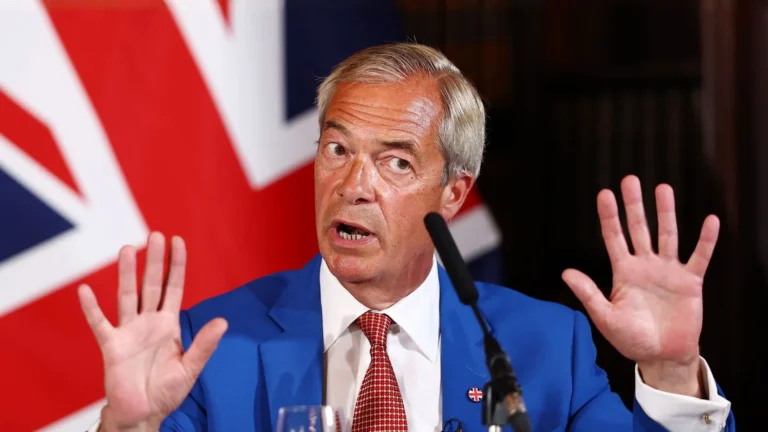
Peter Nicholls/Getty Images
You could almost hear the revolutionary vitriol dripping onto the Labour benches during Monday night’s Lords debate on political donations, following the announcement of Reform’s £72 million bonanza from two crypto billionaires with UK voting rights but recent residence abroad. ‘An undermining of democracy and rampant Americanisation’, one peeress spat out. A case of ‘the corrosive influence of rich individuals’ donating to secure their ‘private profit’, another fulminated. Hence the hints of legislation, backdated to March this year, drastically limiting how much any individual, even a voter, could give to a political party in a year, and retrospectively confiscating Reform’s new-found enrichment.
Forget the obvious hit-job aspect. Forget even the scary talk of using ex post facto legislation, and the two-tier nature of a proposal that would preserve the right of trade unions and institutions to continue to make big subventions, thus promoting business very much as usual for established parties and continual financial difficulty for upstarts. There is here a visceral anti-individual, anti-personal-wealth message from our political class. Organisational involvement in politics is all right: modest gifts from individual workers are all right. But, the narrative goes, influence from seriously wealthy individuals must be shut out. Anything else can only involve the surrender of our polity to the selfish agendas of malign actors and the malign power of naked money.
If you want to ensure effective political input comes from those likely to be motivated by genuine and passionate belief in a political ideal, it’s the individual plutocrat every time
This line will undoubtedly gratify the great and the good in the Lords, and the progressive establishment outside it. There are, however, very good reasons to think it is hogwash.
For one thing, think for a moment about a rich institution and a rich individual. Which is actually more likely to be weaponising political largesse to promote a non-public agenda? The institution, by a canter. Take a commercial corporation. Its entire raison d’être is lucre; it lacks human feelings, opinions or ideals: the diminishing marginal value of money, stipulating that an extra pound is worth more to a pauper than to a billionaire, is unknown to it. And it’s not only commercial corporations. Take a trade union. Despite the soothing image of an avuncular institution empowering many small men to pool their resources in a political fund to support a cause they believe in, unions have been the most forward of all in demanding value for money, in terms of influence on government, in exchange for the wealth they put Labour’s way. Compare that with a human donor, who while not free from self-interest, will always have his own ideals and aspirations for the society he lives in. If you want to ensure effective political input comes from those likely to be motivated by genuine and passionate belief in a political ideal, it’s the individual plutocrat every time.
Furthermore, as sagely observed by John McGinnis in his underrated book ‘Why Democracy Needs the Rich’, there is the subtle matter of political balance. There’s a sameness about institutions. It’s an unfortunate fact that, barring determined measures to keep them right-wing, they tend naturally to swing, and then stay, Left. Rich individuals, by contrast, are ideologically footloose: some incline Left, others don’t. Allowing such people not only to support political ideals they like, but to do so in the way in which they are strongest (in this case financially) is actually a boost for democracy. Electors don’t have to vote for the parties these people bankroll; but increasing their choices can only be a good thing.
Yet again, it’s a common cliché that it’s preferable for political parties to get their financial support from small donations from many, rather than big money from a few. But is it? This certainly is one model: but why should it be the only game in town? Truly radical ideas may come more readily from parties not dependent on placating a wide subscriber base onside by constant compromise, and voters have a right to this choice. Of course a party may morph into a personal benefit club for its sugar-daddy. But in that case, however loudly money may talk, voters are still perfectly capable of smelling a rat and casting their ballot for someone else.
And there’s one final point to bear in mind. It’s not only political parties and politicians who influence voters. All sorts of other organisations and institutions – think-tanks, pressure-groups, political clubs, you name them – do the same. If you so distrust plutocrats that you wish to prevent their money influencing politics, logically you’d have to bar them from giving substantial support to any of these. Indeed one Labour peer, Lord Foulkes, seemed frighteningly happy with this, explicitly calling for caps on donations to private think-tanks and the like. But constraining citizens’ rights to use their own money to set up and support what lawful organisations they like is a dark alley indeed, and no decent government should even contemplate it.
The moral is clear, however contrary it sounds. Leave the billionaires to support who they like, as generously as they like. Then leave us to make up our mind who we’ll vote for. That’s only healthy for democracy.

If there was one event that ended Fukuyama’s ‘end of history’, it was 9/11. The growth and predominance of globalisation were followed by anti-Western intellectual movements. Many, especially on the Left, are still obsessed with rationalising the insanity of the attackers – most notoriously streamer Hasan Piker, who claimed in 2019 that ‘America deserved 9/11’. […]
If you think this summer has been sticky, count yourself lucky you were not in the Cabinet in August and September 1931, in the midst of possibly the worst economic crisis the country has ever faced. It is worth looking at what happened then, because high energy and Government borrowing costs mean a crisis of […]
Margaret Thatcher is back in the news. But it is not her admirers on the Right who have put her there. It is our new Labour Prime Minister, whose diagnosis of our country’s ills seems to be that Britain was on the right path up until 1979, when the Conservatives got into power and precipitated […]