Britain is selling its debt to the wrong market

3 September 2026

Dan Kitwood/Getty Images
The ‘moron premium’ is back with a vengeance this week, with 10-year gilt yields approaching 5.30%, their highest since 2007, while the 30-year is again threatening 6%. Pantheon Macroeconomics estimates that higher borrowing costs have cut the Chancellor’s fiscal headroom from £23.6 billion to around £13 billion. Meaning almost £11bn has disappeared before the Budget on October 28, and that figure could well increase.
The current bond sell-off is global. US Treasuries, German Bunds and Japanese JGB’s have all been hit as oil prices rise, inflation proves harder to kill and governments issue increasing quantities of debt. But British bond yields remain higher than our G7 competitors. Reuters Breakingviews argued this week that the ‘moron premium’ predates the morons: political risk is part of the story, but Britain also has an unusually long debt stock and a gilt market whose buyer base has changed dramatically.
The old captive buyer is fading; the new buyer will simply demand a higher price, shorten duration or walk away
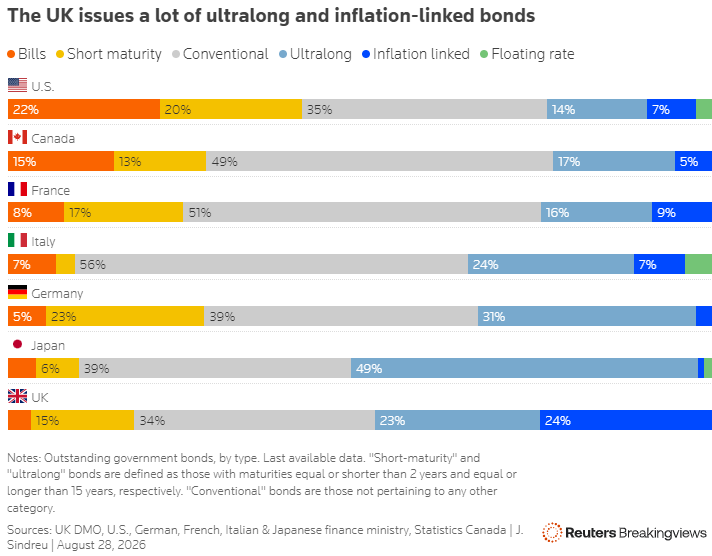
For decades Britain issued gilts around defined-benefit pension funds and insurers’ needs. They had liabilities stretching 30, 40 or 50 years into the future and wanted bonds of similar duration as a hedge. The Debt Management Office (DMO) dutifully accommodated them. At the end of 2025 the average maturity of the gilt stock was 13.4 years, far longer than most comparable advanced economies.
When long-end bond yields were sub 2%, it made sense for the government to keep issuing debt at those borrowing costs for decades. The Treasury was able to reduce its refinancing risk while pension funds obtained the liability hedge they needed. Everyone was happy.
Then the demand and buyers changed.
With defined-benefit pension schemes largely closed to new members, the amount of duration hedging they need to buy has reduced. The move to defined-contribution pensions has also weakened demand further because they do not have the same fixed long-term liabilities to hedge. This has seen the weighted-average maturity of net gilt purchases by pension funds and Liability-Driven Investment (LDI) investors fall from around 25 years in 2018 to about 14 years this year.
On a market-value basis (not nominal), the latest official sector data show overseas investors holding £737.4bn of gilts, or 33% of the market. UK insurers and pension funds hold £446.9bn, or 20%; other financial institutions and private companies £431.8bn, or 19%; the Bank of England’s Asset Purchase Facility £398.7bn, or 18%; and banks and building societies £220.4bn, or 10%.
‘Overseas investors’, however, hides an important change in the way the market now trades. Hedge funds have become much larger players in government bond markets globally. The Bank says their gilt positions have increased alongside the growth of relative-value trades, often financed through repurchase agreements. Net hedge-fund gilt repo borrowing was close to £100bn around the end of last year.
Whereas a pension fund can buy a long-dated gilt and largely ignore mark-to-market price volatility because the value of its liability moves in the opposite direction, a hedge fund, asset manager or foreign investor cannot. They will only hold the bond if they think the return compensates them enough for the extra risk involved. And that risk rises sharply the further out the yield curve you go. Take two investors each holding £10 million of gilts; one a 10-year, the other a 30-year. If the 10-year bond yield rises by 100 basis points (1%), a typical 10-year gilt at today’s yields would lose roughly £750,000 in market value. The same 100 basis point increase in the 30-year bond yield would produce a loss nearer £1.25 million. That’s the nature of the interest rate risk associated with different bond maturities.
That matters when the holder is a flighty hedge fund that only wishes to maximise returns to their investors.
The Bank estimates that price-sensitive investors – investment funds, foreign investors and households – now hold at least half of sovereign debt across the UK and other major developed markets. During the recent Middle East shock their net cash-gilt sales were about twice the cash value of pension-fund and insurer sales during the 2022 LDI crisis, although spread over a much longer period. The Bank says their repositioning amplified some moves in gilt yields.
Currently, the DMO is issuing long-dated debt into a market increasingly dominated at the margin by investors who are demanding an ever-higher price for holding it. IMF work on the UK term premium, estimates that domestic supply-and-demand effects have added around 60 basis points to the 10-year gilt yield since 2021. The increase attributed specifically to political risk is considerably smaller.
The DMO has already begun moving issuance shorter. It should move further and faster.
The traditional case for Britain’s unusually long maturity was protection against refinancing risk. That remains valuable, but there is no reason to buy that protection at any price. At the same time the Bank of England is pushing in the opposite direction. Active QT means it is still selling gilts outright while the DMO is simultaneously financing large government borrowing requirements. The distinction between monetary policy and debt management may matter institutionally; to the investor being asked to absorb the supply, it does not. None of this means Britain is heading literally back to 1976 and an IMF bailout. The IMF could hardly finance a British sovereign rescue on that scale anyway; if matters became sufficiently serious, technical assistance or externally imposed policy discipline is more plausible than another conventional bailout. Nor is Britain going to run out of pounds and default for want of sterling. We issue debt in our own currency and have a central bank capable, ultimately, of creating as many pounds as required to meet all of its debt obligations. But that does not make the constraint disappear. If the Bank is forced to monetise an increasingly unsustainable fiscal position, the adjustment comes through inflation, sterling depreciation and the debasement of the currency. Bondholders may get their pounds back; what those pounds are worth is another matter.
There is therefore no painless escape route. The Treasury has to get the fiscal position under control, while the DMO has to stop paying unnecessarily high term premia simply to preserve a maturity structure designed for a different investor base. Increasingly, Britain is selling to investors who are less predictable and have many alternatives.
That changes the balance of power in the gilt market. The old captive buyer is fading; the new buyer will simply demand a higher price, shorten duration or walk away. At 5.25% for 10 years and close to 6% for 30, that shift is already painfully visible.


When Andy Burnham arrived at No 10 in July he came with a bold message of change. 40 years of neoliberalism have left Britain hollowed out: wealth has drained from those with the least to those with the most; capital ran riot while the state stood back and watched. It’s a powerful story, and evidently […]

If you spend enough time in politics you learn to spot a familiar mistake dressed up as a novel dilemma. In the 1980s, Xerox forbade the American programmer Richard Stallman from so much as fixing a glitch in his own printer, on the grounds that the code inside it was proprietary. It was this small, […]

Alan Greenspan was always attacked by the Left because of his belief in market forces. John Kenneth Galbraith, at a White House conference, made fun of him, saying that the cure for inflation is always the same for ‘Bolsheviks and the devoted supporters of Ayn Rand’. But each and every government learns the hard way […]