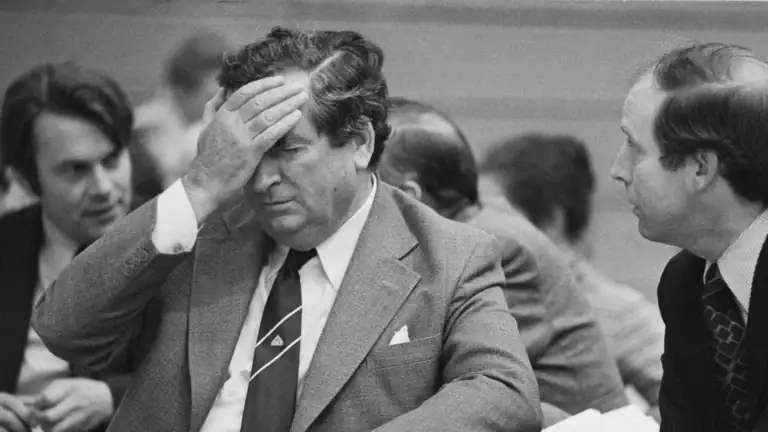
Chancellor Denis Healey – John Williams/Evening Standard/Getty Images
Share this article
On September 29, 1976, Britain’s Chancellor of the Exchequer, Denis Healey, announced his intention to apply to the International Monetary Fund (IMF) for a $3.9 billion loan, the largest ever requested. Britain, The Economist announced, was ‘bust’. This was a national humiliation, the crux of a decade of economic turmoil.
Britain before 1979 was not a social democratic paradise – even if you wouldn’t know it from this week’s Labour conference
In 1974, the Retail Price Index (RPI) rose by 16.0%, more than triple the postwar average. Arab oil producers, who cut production in 1973 to punish Israel’s supporters in the Yom Kippur War, sending prices rocketing, and trade unions, with their demands for higher pay backed by industrial action, were commonly blamed.
Milton Friedman exonerated the Arabs and the unions, blaming a surge in the money supply instead: broad money growth, averaging 6.3% from 1961 to 1971, hit 27.9% in 1972 and 27.5% in 1973. ‘[I]nflation is always and everywhere a monetary phenomenon’, he wrote, ‘in the sense that it is and can be produced only by a more rapid increase in the quantity of money than in output’. Given the lags Friedman found between money growth and inflation, this money surge explained 1974’s inflation and indicated further trouble ahead.
Conservative prime minister Edward Heath’s attempt to buy re-election in February 1974 with printed money – the ‘Barber Boom’ – failed and a minority Labour government under Harold Wilson took office in March.
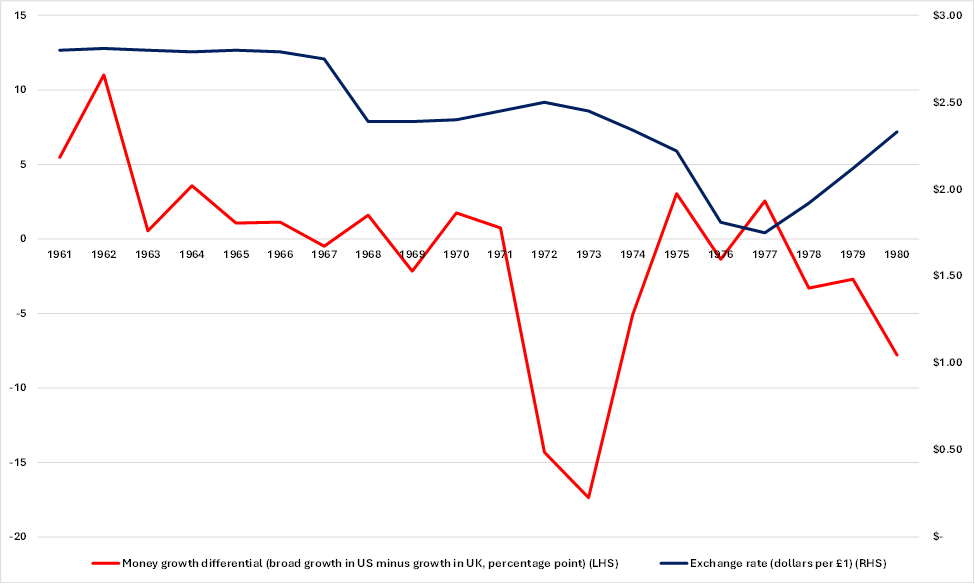
Wilson inherited an economic mess, as in 1964. The money growth of 1972 and 1973 pushed inflation to a postwar high of 24.2% in 1975. But just as the supply of sterling had increased relative to the supply of goods and services available to spend it on, it had also grown relative to the supply of other currencies, such as the dollar (Figure 1). While the former eroded sterling’s purchasing power over goods and services – inflation – the latter would erode sterling’s purchasing power over the dollar; each £1 would buy fewer dollars – currency depreciation. Inflation is a rise in prices, and the exchange rate is a price. Wilson inherited both internal and external monetary issues.
Figure 1: Sterling/dollar money growth and exchange rate
Source: World Bank World Development Indicators and Federal Reserve Bank of St. Louis
Currency and fiscal crisis
Sterling had been ‘floating’ since June 1972, but in March 1975 £1 still bought $2.42, near the official rate set in 1967 – then it began to slide (Figure 1). The Bank of England sold dollars for sterling to boost the price of the latter relative to the former, but there is an asymmetry in any exchange rate intervention; while a country can easily lower its exchange rate by producing more of its own currency, it cannot easily raise it by selling another’s currency to buy its own; it is limited by how much of the other country’s currency it has to sell; its foreign exchange reserves.
When Jim Callaghan succeeded Wilson in April 1976, Healey informed him that the ‘Bank had spent $2bn. in supporting sterling since 1 Jan. 1976’, yet £1’s purchasing power had fallen from $2.03 to $1.85. In June (£1=$1.76), a standby credit of $5.3bn was secured from a group of central banks to be repaid by the end of the year. If Britain could not repay these dollars, it would, technically, be bankrupt.
Yet sterling still fell. On September 8 (£1=$1.73), Healey warned Callaghan that they had ‘already spent £175 million defending the currency by the time they met at 10 a.m.’ Callaghan told them to stop, arguing ‘either we had a floating rate or we did not’. On the 23rd, Healey told the Cabinet committee that Britain faced a ‘very gloomy future… we should have to go to the IMF for another loan next month. Even that would only tide us over until the end of 1977… Our reserves are down to £4 billion… Sterling is at an all time low… We have record interest rates to protect sterling and finance [public borrowing].’
The Fund diagnosed Britain’s economic problems as fiscal as much as monetary. After taking office, Wilson planned for a second election to secure a working majority and, like Heath, he would buy it, but with borrowed rather than printed money. From 1973/74 to 1974/75, government spending rose by 31.6% in nominal terms and by 27.9% the following year. Nevertheless, unemployment rose from 3.7% in 1974 to 5.6% in 1977.
To prepare the Labour Party for the spending cuts and monetary restraint the IMF would require, Callaghan told its conference on September 28:
We used to think that you could spend your way out of a recession, and increase employment by cutting taxes and boosting Government spending. I tell you in all candour that that option no longer exists, and that in so far as it ever did exist, it only worked on each occasion since the war by injecting a bigger dose of inflation into the economy, followed by a higher level of unemployment as the next step. Higher inflation followed by higher unemployment.
Keynesianism was dead. The following day, it was announced that Britain would seek a loan of $3.9 billion.
Stay informed with our free daily briefing.
Negotiations began in November (£1=$1.64), with the IMF seeking £5bn in cuts, but Callaghan played his hand smartly and they accepted £2bn; £1bn each in 1977/78 and 1978/79. Still, when the Letter of Intent was signed on December 15, the country was humiliated; ‘Britain’s Shame’, cried The Sun.
Sterling’s 1976 crisis was primarily monetary in origin, and so was its resolution. The Bank of England had been quietly moving toward Friedman’s monetarism since 1973 and as money growth slowed to 7.1% in 1975, inflation slowed to 8.3% in 1978 and sterling rebounded to £1=$2.33 in 1980.
50 years later
Britain before 1979 was not a social democratic paradise – even if you wouldn’t know it from this week’s Labour conference, where Andy Burnham and John Healey nostalgically invoked it as a model for their state-directed future. The 1976 IMF debacle was, for most, just another in a string of markers on Britain’s downward postwar slope. Callaghan proved a more substantial figure than history often records and there was genuine conviction in pointing to a new direction in his speech to Labour’s conference, but it was his successor as Prime Minister – Margaret Thatcher – who would lead Britain on that path.
John Phelan is an Economist at the Center of the American Experiment.
More Economics
21 Oct 2026
Energy & Environment
Sean Ridley
Ministers must stop stalling on Rosebank
The Government has finally bowed to common sense and given the green light to the Jackdaw gas field in the North Sea. It’s the sensible move and a good start, although a decision on Rosebank is not yet forthcoming. Given the resistance both projects have faced, it’s worth setting out why Jackdaw’s approval is good […]
21 Oct 2026
Economics
Mel Stride
Healey’s Budget will be built on sand
When John Healey sits down next Wednesday, the press gallery will focus hard on his headroom against the fiscal rules. In March the OBR put this at £23.6 billion against the main rule, which requires day-to-day spending to be covered by revenue by 2029/30. A recent Reuters poll of economists suggests it has since shrunk […]
20 Oct 2026
Growth
Robert Colvile
Small firms have lost faith in Westminster – with good reason
The lifeblood of the economy. The backbone of Britain. When it comes to small businesses, it’s easy to lapse into cliché. But that’s because they really, really matter. The overwhelming majority of businesses in Britain are small businesses. They employ more than 13 million people. And it’s almost impossible to exaggerate how tough things are […]
Manage Consent
To provide the best experiences, we use technologies like cookies to store and/or access device information. Consenting to these technologies will allow us to process data such as browsing behavior or unique IDs on this site. Not consenting or withdrawing consent, may adversely affect certain features and functions.
Functional Always active
The technical storage or access is strictly necessary for the legitimate purpose of enabling the use of a specific service explicitly requested by the subscriber or user, or for the sole purpose of carrying out the transmission of a communication over an electronic communications network.
Preferences
The technical storage or access is necessary for the legitimate purpose of storing preferences that are not requested by the subscriber or user.
Statistics
The technical storage or access that is used exclusively for statistical purposes.The technical storage or access that is used exclusively for anonymous statistical purposes. Without a subpoena, voluntary compliance on the part of your Internet Service Provider, or additional records from a third party, information stored or retrieved for this purpose alone cannot usually be used to identify you.
Marketing
The technical storage or access is required to create user profiles to send advertising, or to track the user on a website or across several websites for similar marketing purposes.