Ministers must stop stalling on Rosebank
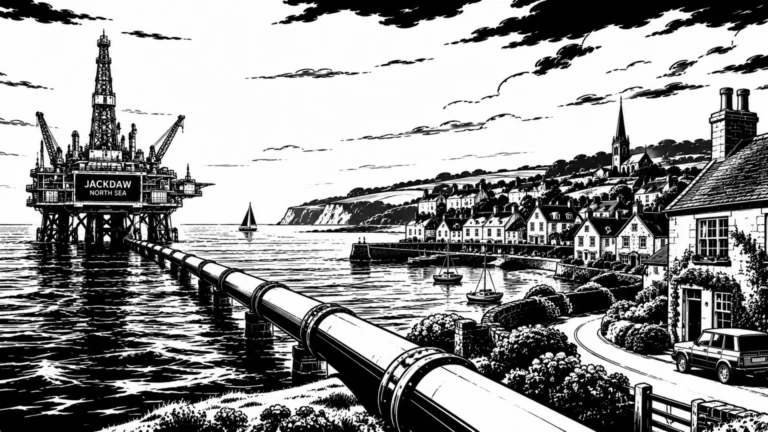
The Government has finally bowed to common sense and given the green light to the Jackdaw gas field in the North Sea. It’s the sensible move and a good start, although a decision on Rosebank is not yet forthcoming. Given the resistance both projects have faced, it’s worth setting out why Jackdaw’s approval is good news, and why Rosebank now needs to get the nod as soon as possible.
Jackdaw is one of the largest unexploited gas fields in the North Sea. The site could boost domestic gas production by around 6% at peak – enough to heat 1.4 million homes. For a declining continental shelf, such a volume is not to be sniffed at, and it will be a cleaner alternative to greater liquefied natural gas (LNG) imports – producing a third fewer emissions. Moreover, given that the UK imports most of the gas it needs, an extra domestic source of energy is certainly welcome in these increasingly uncertain geopolitical times.
The UK’s political class must realise that Britain needs to put pragmatism before ideology in its energy policy
Rosebank is a different and more controversial proposal. The field mostly contains oil – about 300-500 million barrels’ worth – with a minor share of gas. Though some of that gas will be piped to Shetland, the oil will otherwise be shipped via oil tankers to serve the global market. It would not help to reduce bills, and any energy security aspect would be fairly marginal. But that misses the point.
The argument for Rosebank, as well as Jackdaw, is an economic one. According to the sites’ owner, even if the two fields are the last in the North Sea to be approved, they will provide a £4.1 billion tax boost for the Treasury over the next decade (for the sceptics on the Labour benches, this would be roughly enough to cover their expansion of eligibility for free school meals over the same period). There are also jobs at stake: at peak, Rosebank is expected to support 1,200.
The economic argument for the two fields is clear, so why the delay? Both have been sitting in regulatory limbo, despite being approved under the previous Tory government – Jackdaw in 2022 and Rosebank in 2023. Jackdaw was originally due to begin production last year, and gas will now flow by the end of this month. Rosebank had been expected to start production in 2026–27.
The original plan ran into trouble when Greenpeace, along with another UK environmental activist group called Uplift, launched judicial reviews on the grounds that the two projects hadn’t submitted adequate environmental impact assessments (EIA). The campaigners then won in court: the judge ruled that the approvals had been unlawful.
Why? Because the EIAs had failed to consider the Scope 3, or downstream, emissions of the two fields. If you are unfamiliar with this classification, this means that should any of the oil and gas from the two end up in someone’s gas boiler or the petrol tank of their car, the emissions produced from these activities need to be included in the appraisal.
As the consents were quashed on procedural grounds, the projects were free to seek re-approval, provided that Scope 3 emissions were properly included in the EIAs (which has now been done). But by the time the court ruled, in January 2025, Labour were in power. Their manifesto promised not to revoke existing North Sea licences, but with Ed Miliband setting energy policy, re-approval was never going to be quick. The revised assessments then went out to fresh public consultation, which closed only in August. Hence the hold-up until now.
The UK’s political class must realise that Britain needs to put pragmatism before ideology in its energy policy. Jackdaw will strengthen energy security, and both fields will support jobs and tax revenues. The Government would also do well to remember that decarbonisation is meant to be a transition: the dash for Clean Power 2030 that Ed Miliband set in motion is quietly being de-emphasised by his own successor, and we will still need some oil and gas come 2050. For those worried about emissions, blocking domestic production does nothing to cut demand. It simply swaps North Sea output for imports, which often carry a higher carbon footprint. And some of the tax revenues from allowing these fields to go into production can also be used for the promotion of renewables, as the newly announced Energy Wealth Fund intends.
Jackdaw was the easy call. Now for Rosebank.


The lifeblood of the economy. The backbone of Britain. When it comes to small businesses, it’s easy to lapse into cliché. But that’s because they really, really matter. The overwhelming majority of businesses in Britain are small businesses. They employ more than 13 million people. And it’s almost impossible to exaggerate how tough things are […]
Britain was the cradle of the Industrial Revolution – where cheap, abundant coal fuelled the inventions that built the modern world. Those breakthroughs – railways, modern medicine and electricity – transformed humanity. But we often forget that it was energy, our ability to produce it and (crucially) to store it, that made all of this […]

Nobody ever built a wind farm with wind. An energy transition is always a project that uses its current energy source to build its replacement while keeping everyone fed and warm. Every turbine, panel, pylon and battery is made, moved, installed and replaced with the help of cheap oil. The question under the plan for […]