The Responsible Society: What Thatcher can still teach us

5 June 2026
Robin Laurance/Photo Researchers History/Getty Images
It’s only on the basis of truth that power should be won – or indeed can be worth winning.
Margaret Thatcher, 1996
It is a hundred years since Margaret Thatcher was born in Grantham. Fifty years since she took over the Conservative Party. Almost 35 years since she was forced from office. Today’s voters are not Thatcher’s children, but Thatcher’s grandchildren – even great-grandchildren.
So why do we still care? It would have seemed strange, in Thatcher’s day, to write a diagnosis of the country’s problems, or even the Conservative Party’s, based on the life and thought of Stanley Baldwin. Yet Thatcher resonates now more than ever.
Twenty years ago, David Cameron could win the Conservative Party leadership on a platform of, essentially, moving on from Thatcherism. But in these harder-edged times, Thatcher’s record of decisive leadership, sustained reform and national renewal looks not just far more impressive but far more relevant.
Indeed, the failures of the Starmer government – and the Conservative governments before it – have not just highlighted Britain’s descent into stasis and sclerosis, but the need for the kind of project that Thatcher embarked upon.
Today, polls of the public and academics consistently put Thatcher up there in the pantheon as one of our greatest leaders. When YouGov asked the public in 2019 which recent prime minister would have best run the Brexit negotiations, she got more votes than all the others combined.
Meanwhile, conversations in Westminster, and speeches from Kemi Badenoch, Nigel Farage or even Keir Starmer, increasingly circle back to the hard thinking done in the late 1970s by Thatcher, Keith Joseph and their allies at the Centre for Policy Studies – not least the ‘Stepping Stones’ report by John Hoskyns and Norman Strauss, which provided the blueprint for tackling the unions.. Many also draw a sharp contrast with the current government’s failure to prepare for power.
For generations on the right, Thatcher has become the Iron Lady, the indomitable leader who wrenched a broken country back on to the path to prosperity through sheer force of will. When researchers from the CPS appear in the media, there is no need for the presenters to describe where they sit on the political spectrum: the simple shorthand ‘Thatcher’s think tank’ tells the viewer everything they need to know.
Yet Thatcher’s very status can also prevent us from seeing her clearly. Too often, Thatcher – and Thatcherism – has become a collection of cliches. An icon to be invoked, a weapon to win arguments, a style to be aped. Rather than studying what she actually thought and did, politicians have ended up cosplaying as an ersatz version of Maggie, in some cases to the point of mimicking her outfit for outfit.
Some will even take issue with the fact that this essay uses ‘society’ in its title, when Thatcher famously claimed there was no such thing. But of course, her message was that society was not something that could be blamed for our problems: responsibility lay with individuals and families, to look after first themselves and then each other.
One of Thatcher’s most famous quotes was also one of the simplest: ‘I can’t bear Britain in decline. I just can’t.’Today, it is clear even to the blindest that Britain is back on the path of decline. Our economy, public services and above all public finances are in an awful state. We are now poorer than even the poorest US state.
This essay will argue that to rescue Britain from decline once again, we need to look back to Thatcher – because our core problem today is the same one she diagnosed, namely that the state has grown large and the people have grown too small.
It will argue that we need to rebuild our politics, and our economy, around the core theme of responsibility – to re-establish incentives for citizens to behave responsibly in their own lives, and for the state to behave responsibly in turn. Because when Thatcher said that there was no alternative, she was not quite right. There are plenty of alternatives. But they are all much, much worse.
Before asking what Maggie would do today, it is worth outlining why such an exercise is needed in the first place. And the fundamental truth is that it is needed because the Conservatives failed.
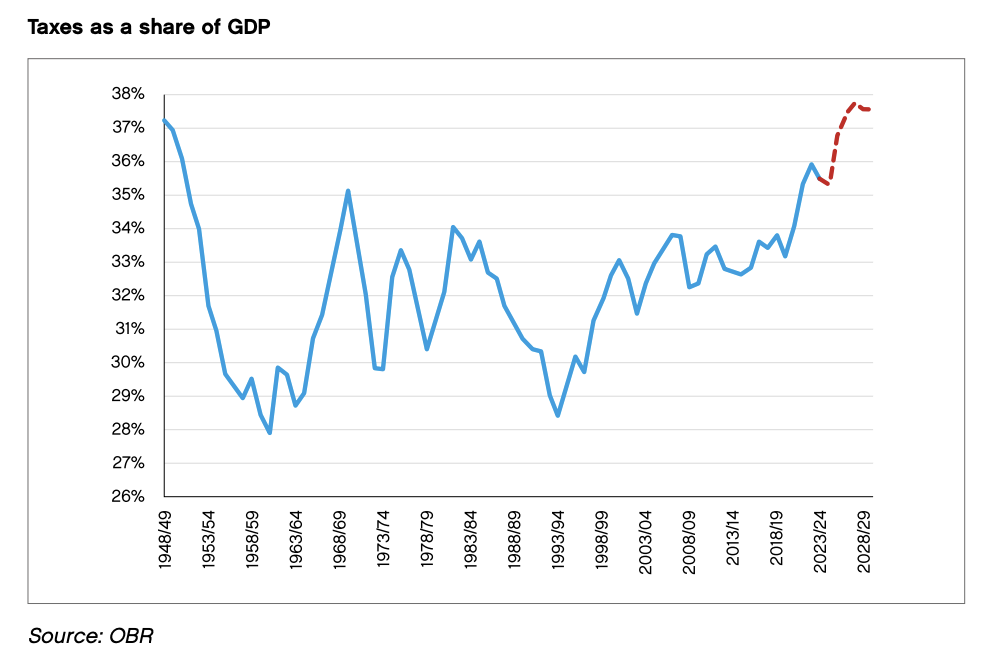
Between 2010 and 2024, the tax burden in the UK rose from 32% of GDP to 36%, the highest level since Clement Attlee was in Downing Street. So much for being the party of low taxes.
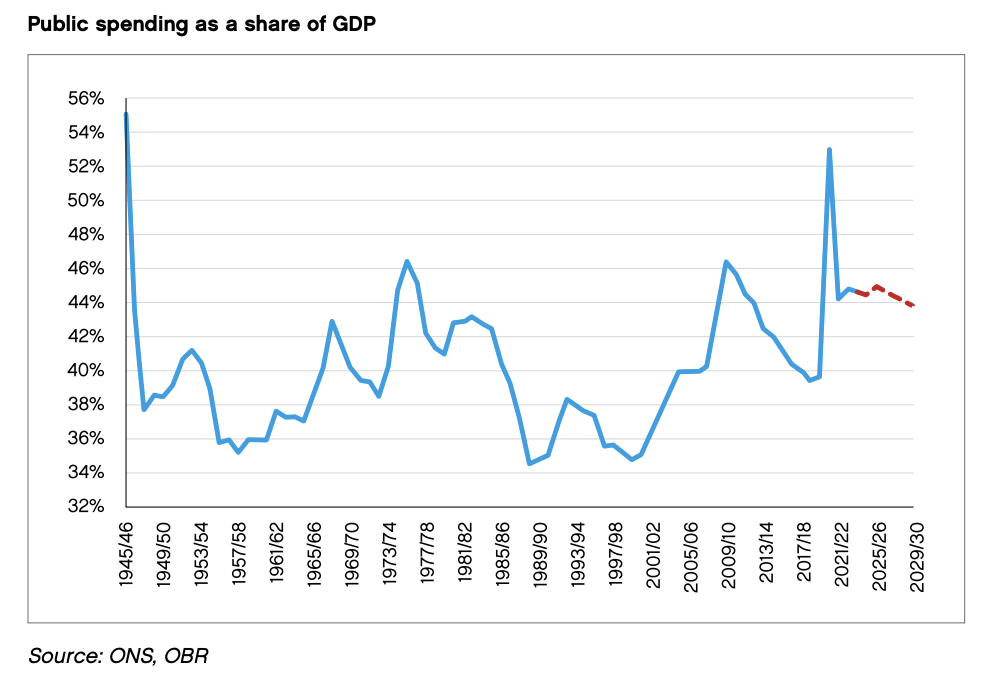
Over the same period, state spending rose to £1.2 trillion per annum, equating to almost 45% of GDP.The number of civil servants, having fallen sharply under the Coalition, has climbed back to 551,000 (who spend on average only 2.2 days in the office).So much for being the party of a small state and limited government.
The deficit has averaged 5.6% of GDP since 2010, and the national debt stood at 101% of GDP in 2024-5, up from 76% of GDP in 2010-11. So much for being the party of fiscal responsibility.
Our core problem today is the same one Thatcher diagnosed, namely that the state has grown large and the people have grown too small
The welfare bill has increased to over £300bn, and 9.1 million working age adults are economically inactive. So much for being the party of hard work and individual responsibility.
Living standards have stagnated, with both real GDP per capita and real wages growing by roughly 6% between 2010 and 2023. So much for being the party of aspiration.
The ratio of house prices to earnings in England rose from 6.8 to a peak of 9.1. The number of people aged 20-34 still living with their parents rose from 2.9 million to 3.6 million. So much for being the party of home ownership.
Over 127,000 migrants crossed the Channel on the small boats. Net legal migration, which averaged roughly 180,000 per annum under New Labour, surged after Brexit, peaking at an incredible 906,000 between June 2022 and June 2023. Cumulative legal net migration over the 2010-24 period exceeded five million people. So much for being the party of secure borders.
Electricity prices for domestic customers almost trebled between 2010 and 2023 in cash terms. Electricity prices for companies more than trebled. British companies now pay four times as much for electricity as their American competitors. So much for being the party of good housekeeping.
Between 2010 and 2019, the annual regulatory burden on business increased by at least £6 billion. So much for being the party of enterprise.
The NHS waiting list for elective treatments increased from 2.6 million to 4.5 million – before the pandemic sent it spiralling up to over 7.7 million. So much for sound stewardship of public services.
The NHS waiting list for elective treatments increased from 2.6 million to 4.5 million – before the pandemic sent it spiralling up to over 7.7 million
Birth rates have collapsed to historic lows of just 1.41, while the cost of raising a child to 18 rose from £143,000 in 2012 to £260,000 in 2024, a 40% real-terms increase.So much for being the party of the family.
Non-crime hate incidents were introduced, with the number peaking at more than 12,000 in 2021.So much for being the party of freedom of thought and speech.
Defence spending has bottomed out at around 2% of GDP, procurement remains broken and the number of full-time Service personnel is down by 21% since 2012, standing at 147,300 as of April 2025.
Crime has fallen overall. But there has been a sharp rise in knife crime in particular, and public trust in the police has fallen significantly. So much for being the party of law and order.
There are plenty of reasons why all of the above happened – the financial crisis, the Brexit wars, Ukraine and above all (judging by the pattern of many of the statistics listed above) the pandemic. It must also be acknowledged that Britain – along with many other Western countries – is on a demographic journey that imposes acute pressure on the public finances. Neil O’Brien recently calculated that turning the demographic clock back to 2004, while keeping tax and spending rates the same, would hand the Chancellor an extra £84 billion to play with.
But still. The most obvious fact about the sequence of Conservative administrations since 2010 (or since 2016, depending on your factional stance within the Tory party) is that they failed to make the country better. And they failed to make it more conservative.
Even now, more than a year after the general election, many within the Conservative Party have still not come to terms with the scale of that failure.
The failure of the Conservatives in recent years was not just a failure of policy – it was a failure of philosophy
Thatcherism, too, was born of failure. It was the failure of the Heath government that finally permitted Keith Joseph and then Margaret Thatcher to admit to themselves that they had been on the wrong course.
And, as then, the failure of the Conservatives in recent years was not just a failure of policy – it was a failure of philosophy.
Of course, the failure of the Conservatives in recent years was a failure of policy too. A failure of many, many policies. The sustained failure to raise living standards. The catastrophic decision to adopt a remarkably open and remarkably unselective immigration policy, while simultaneously failing to control illegal arrivals coming across the Channel. The repeated and wholesale surrenders on housebuilding.
But I would argue that many of those failures were the product of the fact that the government, or rather series of governments, never seemed to have a coherent idea of what and who it was for – or indeed what the Conservative Party was for.
Sunak promised to be the opposite of Truss, who promised to be the opposite of Johnson, who promised to be the opposite of May, who promised to be the opposite of Cameron, who promised to be the opposite of… well, most of his immediate predecessors. Corporation taxes were lowered, then raised. Investment allowances were slashed, then boosted. Small businesses were praised, then punished. Ministers would tell you that they were as free-market as anyone, before launching into a paean to industrial strategy. MPs and Cabinet ministers would proclaim themselves low-tax Conservatives, even while pitching for pork-barrel spending.
And throughout all of this, there was barely any attempt – let alone one that was sustained and successful – to explain to people what the Conservative Party was about, who it stood for, and why people might want to join it, let alone vote for it.
At one point, the opening video on the party’s homepage featured Patrick McLoughlin, then the party chairman, enthusing that he became a Conservative because he believed in ‘the good government can do’. At around the same time, the administration he was part of was cancelling the proposed extension of Thatcher’s right to buy to housing associations, singing the praises of council houses, condemning ‘the single-minded drive to homeownership’, embracing price controls on energy and denouncing ‘libertarians’ on the right as just as deluded as the Corbynites on the left. (‘Libertarians’, in this framing, appeared to consist of anyone who believed that taxes should be lower.)
Lord Brady of Altrincham (formerly Sir Graham Brady) has often told the story of how, as a student Conservative in the 1980s, he was holding forth confidently on the party’s various positions. A friend asked him how on earth he remembered all those different policies. He replied that he didn’t: he just knew what the Conservatives believed. ‘Quite right,’ said one veteran who heard this. ‘We used to be able to finish one another’s sentences.’
So this is the first lesson from Thatcher: the need for philosophical consistency.
MPs and Cabinet ministers would proclaim themselves low-tax Conservatives, even while pitching for pork-barrel spending
This kind of philosophical consistency is not just about message discipline, though it certainly helps. It is about having a shared analysis of the world, a framing of its problems and solutions – of the things you are trying to achieve, and the groups you are trying to help, that can cascade through your own party and, if and when you are in power, throughout Whitehall.
Tony Blair’s team, for instance, spent an enormous amount of time in opposition developing and debating theories of public sector delivery. David Cameron’s team, in response to Blair’s embrace of targets and central direction, developed a coherent account of the overly centralised state, and an agenda to disperse it – admittedly, one that largely evaporated upon taking power, but which still informed their education reforms in particular.
The core failure of the Starmer government, as many of us have argued, has been that it utterly lacks such an analysis: indeed, so complete is the absence that Wes Streeting is attempting to impose the same academy-style reforms in health that Bridget Phillipson is unpicking in education. Meanwhile, Downing Street switches from buzzword to buzzword (‘resilience’, ‘change’, ‘security’, ‘contribution’) in the hopes of filling the void.
A government without a philosophy is like a ship without an anchor – easily blown off course, not least by the endless demands for spending, regulation and intervention that spring from the well-meaning, short-sighted or self-interested. I remember one of the many recent Tory Chancellors asking what I’d thought of his Budget. I said I liked it, but he could have spent a bit less. He told me that I was pretty much the only person to have taken that position. Backbenchers had been united in their belief that he should have spent more – on their own constituencies.
Thatcherism, by contrast, was very certainly driven by a clear and consistent philosophy. That did not mean, as her biographer Charles Moore stresses, that her government was relentlessly ideological: in fact, as he and others have pointed out, she was often as tactical as she was strategic. Those who worked with her in power, such as John Redwood, stress that when the facts changed, she really would change her mind.
But her government still had a guiding star: she, her colleagues and her civil servants knew the direction she was sailing in, even if the winds occasionally made a direct journey impossible.
There is another titanic difference between Thatcher and today’s politicians. She did not just believe. She proclaimed
Indeed, the most striking contrast between Thatcher and her successors is not just that she believed in individual and economic liberty, or strong defence, or British greatness. It is that she believed, full stop.
But there is another titanic difference between Thatcher and today’s politicians. She did not just believe. She proclaimed.
Reading back over her speeches, the overwhelming impression is of a politician engaged in a constant, rolling act of evangelisation.
Of course, there were the inevitable moments of caution and conciliation. But what is most striking to modern ears is the willingness, sentence by sentence, to make arguments from principle – even if those principles might not be popular with her listeners.
Given the length of Thatcher’s career, and premiership, there are an enormous number of examples I could cite. But let’s take just a single interview – her set-piece interrogation by Sir Robin Day for the BBC, in the days before the 1987 election.
To begin with, Day challenges her as to why she deserves to be the first prime minister for more than a century to be elected to three consecutive terms of office. When she counters that the public are voting on policies, not personalities, he shoots back: ‘But you have stamped your image on the Tory party like no other leader ever has before. We never heard of Macmillanism. We never heard of Heathism. We never heard of Churchillism. We now hear of Thatcherism.’
In her early years, Thatcher had answered such questions by denying that there was such a thing as Thatcherism at all. As Dominic Sandbrook highlighted in an essay last year marking the 50th anniversary of the CPS, it began as a term of abuse, invented by her enemies to make her look like a crazed radical. In her first major speech after becoming Tory leader, she dismissed it as one of Labour’s ‘tired and silly slogans’, joking that ‘to stand up for liberty is now called a Thatcherism’. Two years later, she called Thatcherism a ‘ridiculous’ idea, an ‘ogre’ invented by her opponents.
But by 1987, she is willing to admit that there is such a thing – though ‘it is not a name that I created’.
People call those things Thatcherism; they are, in fact, fundamental common sense
‘Let me tell you what it stands for,’ she tells Day. ‘It stands for sound finance and Government running the affairs of the nation in a sound financial way. It stands for honest money – not inflation. It stands for living within your means. It stands for incentives, because we know full well that the growth, the economic strength of the nation, comes from the efforts of its people. Its people need incentives to work as hard as they possibly can…
‘It stands for something else. It stands for the wider and wider spread of ownership of property, of houses, of shares, of savings. It stands for being strong in defence – a reliable ally and a trusted friend. People call those things Thatcherism; they are, in fact, fundamental common sense and having faith in the enterprise and abilities of the people. It was my task to try to release those. They were always there; they have always been there in the British people. But they couldn’t flourish under socialism. They have now been released. That’s all that Thatcherism is.’
Here it is, in miniature: an entire political philosophy. At the core of which is, ultimately, a single proposition: that ‘having faith in the enterprise and abilities of the people’ is just ‘fundamental common sense’.
But let’s look at the rest of that interview. Because it is striking the extent to which Thatcher sticks to the framework she has laid out.
Day asks her about tax cuts. ‘Yes,’ she says, ‘I do want income tax further down.’ But, she adds, ‘that will depend on how successful our companies and businesses are. The more wealth they produce, the more income tax can come down and, of course, also the more resources we will have to put to social services.’
He asks her about crime. She promises to do more to cut it. ‘But,’ she adds, ‘in the end, let’s face it, Government isn’t a dictator – we are a free country. Everyone has freedom of choice and everyone has personal responsibility for their actions.’
He asks about healthcare. She says that she has put record money into the NHS. But she also insists: ‘Resources do not come from Government; they come from the taxpayer. In addition to the health service, they are also having to spend £55 a week – as a family of four – on social security. In addition to that, they are having to spend £23 every week in taxes to education. Money comes from the taxpayer.’
She confirms – as no politician would today – that she has paid for private health insurance. But, she adds, ‘I pay three times’. She pays for the NHS. She pays to go to a doctor. And she also forgoes 20 per cent of her salary. ‘So I hope that no one will ever accuse me of being thoughtless about the needs of other people.’
It is very hard to find a media appearance by Margaret Thatcher – very hard, in fact, to find a single paragraph – in which she was not making an argument, usually from principle
Day also asks her about the UK’s competitiveness – and then, as a follow-up question, whether wages are too high for us to compete. She agrees that they are: ‘Yes, wages here are still running too high in proportion to what we produce, although the CBI did say, and I think they have some reason to say it, that unit wage costs are not rising now as fast as our competitors… During the period of prices and incomes policy, people got used, almost as a right, to an annual increase, regardless of whether it had been earned, and we are still suffering from that. Really, you ought to have to earn your increases if you are to keep the value of your money absolutely steady.’
It’s like hearing a foreign language. Today, we live in a world where politicians – on both left and right – insist that wages can be raised by the state, by fiat, in perpetuity. Yet here is one of the most electorally successful leaders in British history making what were, even then, deeply unpopular points. Spending has to be paid for. Tax cuts – and pay rises – have to be earned. We need to be competitive with our rivals, even if it means paying workers less.
You might argue that at this point in her career, Thatcher’s position was so impregnable – even imperial – that she could afford this kind of honesty. In fact, Labour under Neil Kinnock had been ahead for much of the parliament. It was only in April 1987, two months before the election, that the Tory lead reached double figures – and even then, Day’s final questions were not about another landslide, but slashed majorities, hung parliaments, and deals with the Liberals.
More to the point, it is very hard to find a media appearance by Margaret Thatcher – very hard, in fact, to find a single paragraph – in which she was not making an argument, usually from principle. The quote at the top of this essay is taken from a memorial lecture delivered in honour of Sir Keith Joseph, her mentor and partner at the CPS. He was a man, she said, of utmost integrity. Not just in the common sense of avoiding bribes or backhanders, but the real meaning of integrity, which ‘lies in the conviction that it’s only on the basis of truth that power should be won – or indeed can be worth winning. It lies in an unswerving belief that you have to be right.’
Eighteen months into her leadership, when her position even within the Tory party was still remarkably weak, Thatcher talked to ITN’s News at Ten about the country’s economic troubles, and the launch of ‘The Right Approach’, the economic blueprint that became one of the foundational documents of Thatcherism.
The interviewer asks whether she is upset that her policy document appears to have upset union leaders. She defends herself, pointing out that the Tory proposals are similar to what union baron Jack Jones has himself proposed, and to what seems to be working in Germany – ‘where the rate of inflation is 4.5%, not 14%’ – and Scandinavia.
If the problem is you’re borrowing too much, that arises because you’re spending too much. If you’re spending too much, you must reduce your spending
But then she moves on to a principled attack on Labour’s policy of wage and price controls:
‘Everything about this government is restraint. You don’t build a new healthy economy that way. You only build it by incentives. You only build it by saying to the people who are working in a factory that’s efficient and working well: ‘Look, you’re entitled to more than the factory that’s not working well.’ That’s my idea of a Social Contract.’
The interviewer then points out that the document ‘talks of very large reductions in public expenditure being unavoidable and cuts in some public services being inescapable’.
Thatcher hits back: ‘If the problem is you’re borrowing too much, that arises because you’re spending too much. If you’re spending too much, you must reduce your spending. So that is not in issue. It’s a very silly person who says: ‘I’m going bankrupt the way I am, but I can’t afford to cut so don’t ask me.’’
She then goes on to express her horror at how Labour have caused a surge in unemployment by putting a new tax on work. Just imagine!
Again, all this is not to say that Thatcher always spoke with brunt and brutal honesty, and damn what the voters thought. In the founding documents of the CPS, there is a clause confirming that the think tank will not talk about privatisation, or ‘denationalisation’ as it was then known – not because its founders believed in public control of industry, but because they did not think the country was ready for the case to be made.
Likewise, despite Thatcher’s private doubts about the operation of the health service, her introduction to the 1987 manifesto stresses in its very first lines that record prosperity has enabled record investment in the NHS – a theme she returns to in the interview with Day.
But still. It is crystal clear what – and who – Thatcher and Thatcherism stood for. What, by contrast, were her more recent successors attempting to deliver, or argue for? What was their fundamental philosophy? Who, or what, were they for? Often, it seemed as if the answer was arrived at via focus group. Indeed, I cannot count the number of times that I was privately told, in the years of Tory government, that the CPS and I were completely right about a particular idea, but the public wouldn’t wear it – or that they knew a policy they were pursuing was wrong, but couldn’t go against the crowd.
If you spend an entire parliamentary term trying your very best not to upset the voters, you will reach the end of it without having done much of anything to help them
The Tories, and the country, were trapped in a depressing cycle. Politicians, especially on the right, lost the habit of making arguments from principle. The public stopped hearing such arguments. Then politicians would complain that they wanted to do the right thing, but there was no constituency for it.
The first great lesson from Thatcher then, is simply the importance of having principles, acting upon them and arguing for them. That may be harder in today’s attention-starved environment. But it is utterly essential. Indeed, as mentioned above, one of the great reasons for the success of Nigel Farage – and, though I hate to say it, Jeremy Corbyn – is that he and they very obviously believe in things.
This matters both electorally and practically. In practical terms, recent governments – and the current government – have shown that if you spend an entire parliamentary term trying your very best not to upset the voters, you will reach the end of it without having done much of anything to help them. And as mentioned above, Whitehall functions best when it knows instinctively what the leader wants, and that bad things await if they fail to deliver.
But it also matters politically. We are in an age when no party – especially not the traditional ones – can assume the goodwill of the voters. If you strip out the Brexit years, when Tories and Labour temporarily became transfigured into the avatars of Leave and Remain, the combined vote share for the two main parties has been declining almost in a straight line, from 97% in 1951 to just 57% in 2024. Separately, polling by Peter Kellner has shown that the number of people voting Labour or Tory because their parents did has collapsed.
In a consumer age, voters are choosing parties as consumers: they are looking for outfits that share their personal values, and will deliver the kind of society they want to see. Which means you have to have values to share. Especially if, as is the case for the Conservatives, you can no longer rely on your status as the default option for voters who don’t want to see the other lot in power.
Indeed, one of the many reasons why the Conservative Party’s membership has collapsed along with its vote share, while Reform’s has surged, is that Reform has a clear, consistent and compelling set of beliefs. The Conservatives, on the other hand, have persistently failed – almost refused – to explain to potential members what Conservatism actually is, and why should find it a compelling enough creed to spend their lives delivering leaflets on its behalf.
Having a coherent and attractive philosophy, in other words, is not just a prerequisite for effective government. It is a requirement for political survival.
One of the central failures of the Tory governments in recent years is that they never had a sense of the kind of society they wanted to create
It is all very well to argue that we need more politicians with belief. But we also need those beliefs to be of the right kind. As mentioned above, Jeremy Corbyn is a man of deep beliefs. But had he won power, those beliefs would have done incalculable damage to the country.
One of the central failures of the Tory governments in recent years is that they never had a sense of the kind of society they wanted to create. Instead, a succession of leaders imposed their own personal preferences, priorities and in some cases peculiarities on to the governing agenda, sometimes – or even often – in direct opposition to whatever their predecessors had been doing.
So here is the second great point about Thatcher. She knew what kind of society she wanted to create (although of course, she famously and rightly rejected the idea of ‘society’ as a phenomenon in its own right). She also knew what kind of nation she wanted to build. And by and large, they are the same type of society and nation that we should be trying to create today.
Let’s go back to that summary of Thatcherism, delivered off the cuff to Robin Day – though again, there is speech after speech that could be substituted.
What does Thatcherism stand for? Sound finance. Honest money. Living within your means. Incentives for people to work as hard as they possibly can. The wider and wider spread of ownership. Being strong in defence. Having faith in the enterprise and abilities of the people. Nigel Lawson would later offer a similar but more policy-focused summary: a ‘mixture of free markets, financial discipline, firm control over public expenditure, tax cuts, nationalism, ‘Victorian values’ (of the Samuel Smiles self-help variety), privatisation and a dash of populism’.
In other words, Thatcher is often accused of having created a selfish society. And perhaps she did. But what she was really trying to create was a responsible society. One in which the individuals and families whom she defined as ‘society’ acted responsibly, yes. But above all, one in which the state did so as well.
Because in some ways her core argument, or certainly what she later presented as such, was that the growing size and power of the state had created an irresponsible society – one in which people did not take charge of their own lives, were not free to flourish.
The mission of the CPS, she said in one of two great speeches paying tribute to Keith Joseph, had been ‘to redefine the principles and policies which would restore the richness of life by liberating the genius of the people and limiting the powers and role of government’. In her second speech, the first of the CPS’s Keith Joseph Memorial Lectures, she expressed a similar view: the central task of the state was not to direct people’s lives, but ‘to allow the distinctive talents of individuals to flourish’.
The means of delivering this, she argued, was via limited government – ‘in which the State is servant not master, custodian not collaborator, umpire not player’.
For Thatcher, a small state was not just an economic and political necessity, but a moral one
‘Just ask yourself,’ she said in words that will ring true to many readers today, ‘is it because the Government has not spent, borrowed and taxed enough that people are discontented? Or is it that we have gone too far towards increasing government spending, borrowing and taxation?
‘The answer is obvious. We are unpopular, above all, because the middle classes – and all those who aspire to join the middle classes – feel that they no longer have the incentives and opportunities they expect from a Conservative Government.’
For Thatcher, a small state was not just an economic and political necessity, but a moral one. In October 1979, her notes for a key speech argued that the case for economic freedom was consistent with ‘certain fundamental moral principles of life itself. Each soul and person matters. Man is imperfect. He is a responsible being. He has freedom to choose. He has obligations to his fellow men… to talk of social justice, social responsibility, a new world order may be easy but it does not absolve each of us from personal responsibility.’
It is important to highlight this element of Thatcher’s philosophy because it is both the single most important element of her political thought, at least by her own analysis, and the single element of Thatcherism that has been most thoroughly eradicated from the political debate.
Yes, politicians today talk about how wonderful tax cuts are – though it’s rarer that they get around to actually delivering them. But even on the right, they also hymn the virtues of public spending.
Cameron and George Osborne did shrink the state. But when they introduced austerity, they did so with a tone of explicit regret: we apologise for this interruption to your scheduled spending increases. Normal service will be resumed shortly.
Thatcher, by contrast, argued that a state that crowds out private initiative, and private enterprise, is not just misguided but actively immoral. Assuming that the state can and should solve any problem, and cover any cost, impedes not just economic flourishing but human flourishing full stop. And she framed it all as simple common sense. No wonder the Left hated her so.
So the most important part of developing a new version of a Thatcherite agenda is also the simplest: to look at the state of the nation, and in particular the size of the state, and the direction of travel. Because the results are utterly horrifying.
Tax and spending, as we all know, are now at historic highs, and set to get higher. Tax, as a share of GDP, is at its highest point since 1948.
Spending, meanwhile, has settled at record highs in the wake of the pandemic. True, it is forecast to subside slightly. But those forecasts are essentially fictional, since they bake in a quite extraordinary level of restraint once Labour’s initial splurge is over. As of 2026-7, annual spending increases are forecast to fall from more than 4% a year in real terms to 1.7%, 1.2%, 0.8% and 0.9%. Since this includes substantial increases for the NHS, the result – according to the Health Foundation – is that day-to-day spending on the rest of government will fall by 4.5% a year in real terms by 2028-9. Given the mood on the Labour backbenches, such projections are catastrophically implausible.
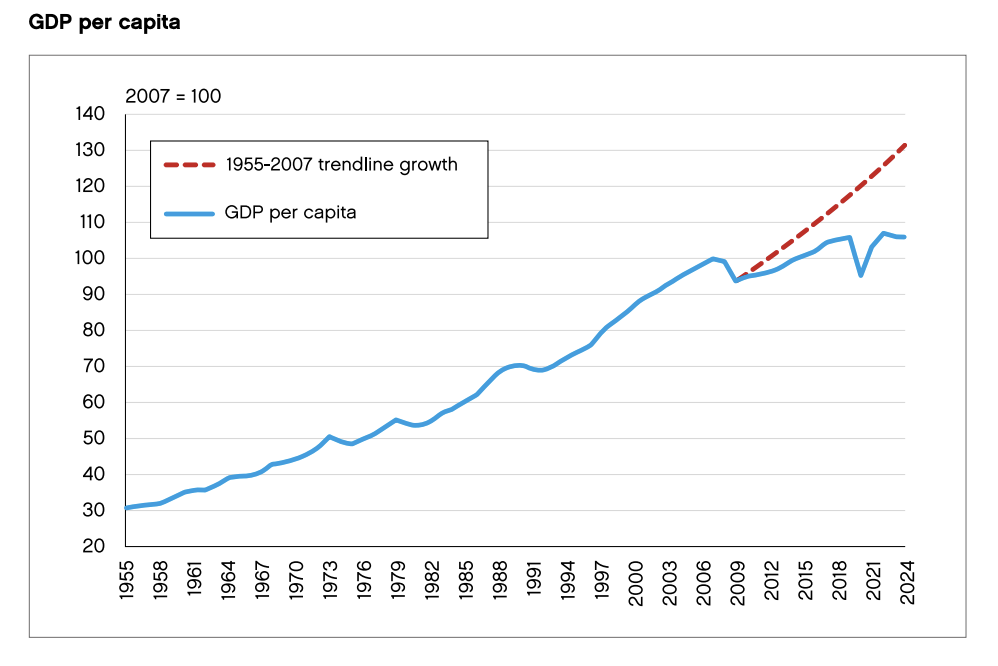
These rises in taxes and spending have obviously been exacerbated, and necessitated, by the UK’s truly appalling performance on growth, wages, productivity and living standards. As Gerard Lyons noted in his recent CPS paper ‘Breaking the Cycle’, Britain is now a low-growth, low-productivity, low-wage economy, with a high-spend, high-tax, high-borrowing state.Indeed, Thatcher would doubtless argue that the two are not unconnected.
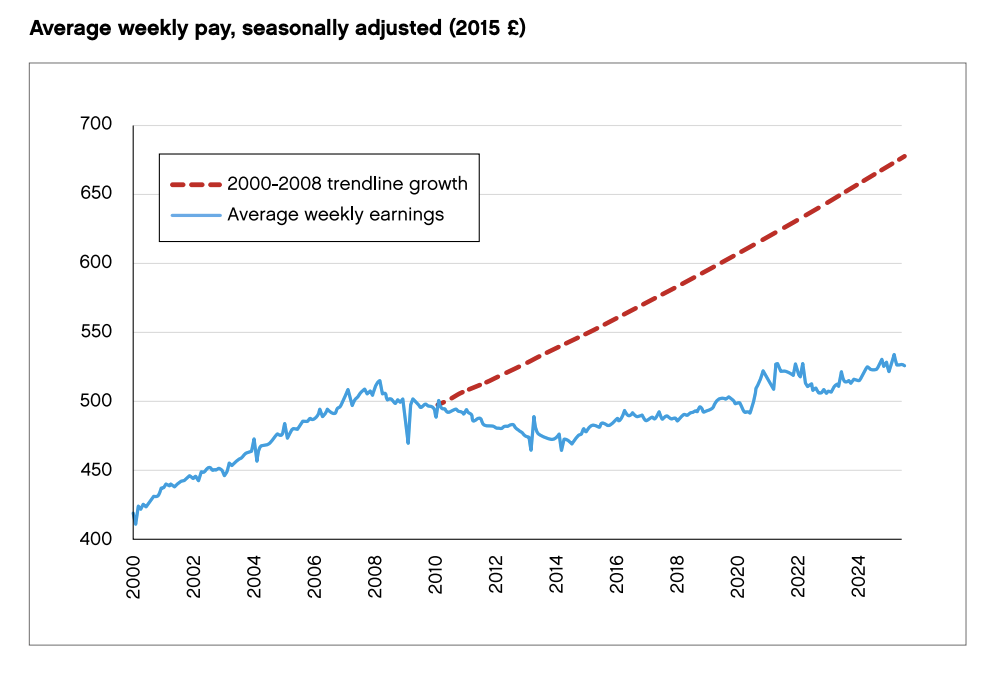
To see the impact of these trends, consider a couple of simple calculations, set out by Dr Lyons. From 2000 to 2008, wage growth in the UK averaged 2.5% per year. Since 2008 it has averaged just 0.03%. If growth had continued at the same rate, the average worker would have an additional £320 per week in today’s money – over £16,600 per year. Likewise, had the economy grown at the same rate as the average from 1955-2007 (2.3% per year), the overall economy would be 36% larger – roughly equal to a trillion pounds in extra wealth being generated and distributed every year.
The comparisons with nations that are actually growing are increasingly grim. It is not just, as mentioned above, that Britain is poorer than America’s poorest state. Today, 34% of US families take home more than $150,000 (£115,000) each year, compared to just 2-3% of British households.
But it is when we look to the future that the picture becomes even worse. The Office for Budget Responsibility’s long-term fiscal projections are increasingly taking on the air of a horror movie, with debt, taxes and borrowing set to soar into the stratosphere.Britain is steadily becoming, as the CPS has relentlessly argued, an elderly care system with a state attached.
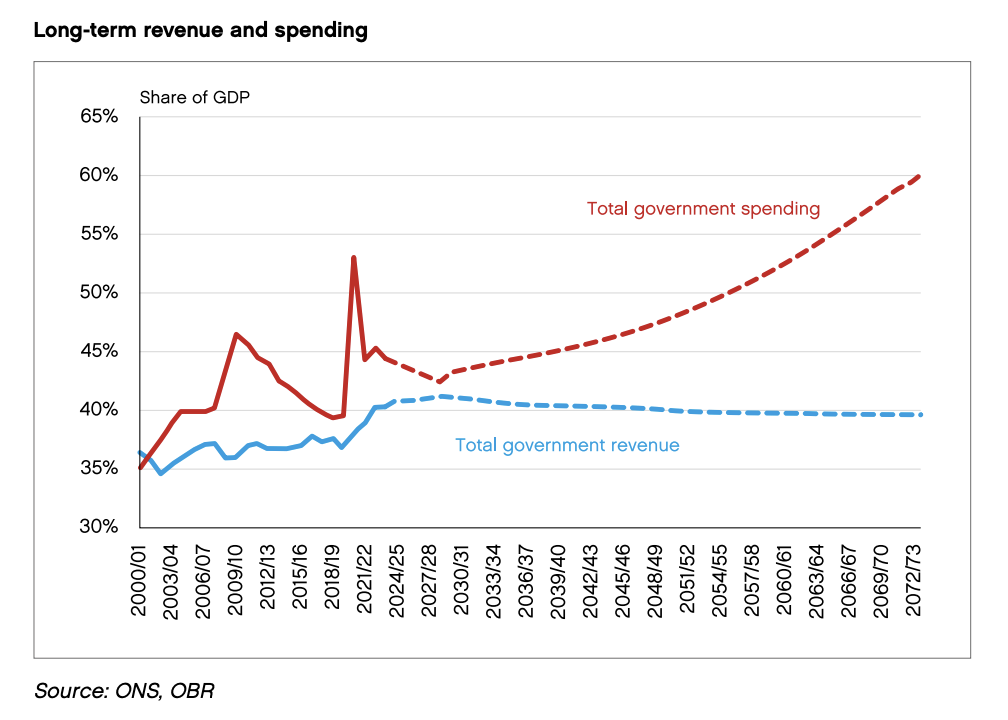
As Karl Williams and Tom Clougherty showed in our essay collection ‘Justice for the Young’, spending on the elderly is set to rise by 11% of GDP over the next half-century – the equivalent of doubling the level of income tax. The pace of demographic change is such that, in order to keep spending on the elderly at the current level of GDP, we will need growth of 2.9 per cent per year, every year, for the next 50 years.
To put it another way, if we look at public spending as equivalent to a household budget – as Thatcher, with her focus on good housekeeping, always recommended – the first thing we notice is the major spending items: health (roughly 18% of the total), pensioner benefits (12%), working-age and child benefits (10%), education (9.1%), debt interest (8.4%), and defence (4.8%).
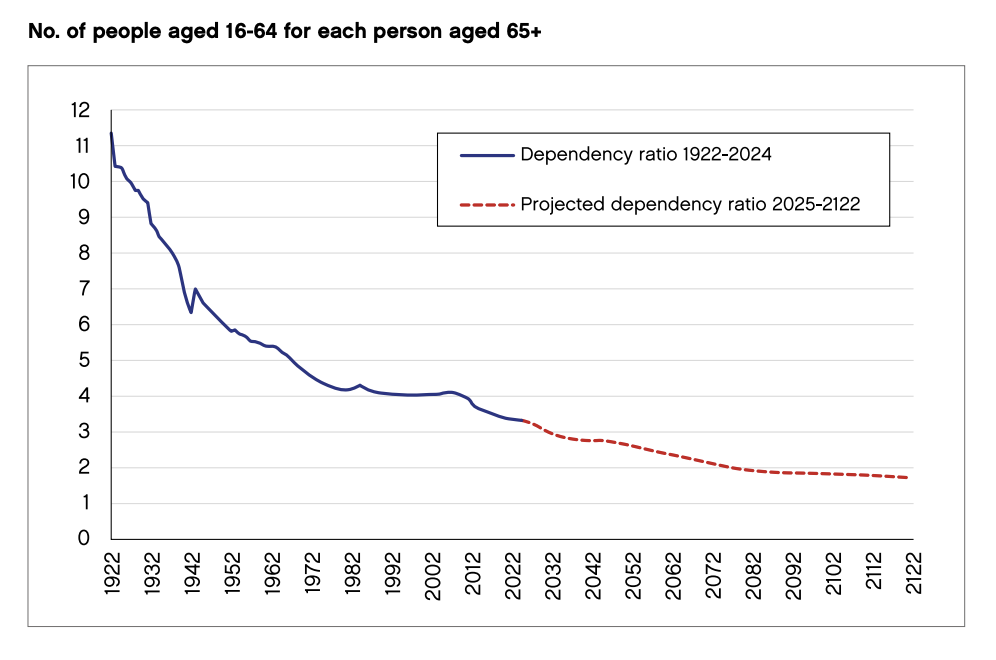
Remarkably, every single one of these, with the exception of education, is growing more quickly than the economy. Indeed, under the triple lock, one of the most substantial is legally mandated to do so.
Let’s go back to that Thatcher quote from 1976: ‘If the problem is you’re borrowing too much, that arises because you’re spending too much. If you’re spending too much, you must reduce your spending. So that is not in issue. It’s a very silly person who says: ‘I’m going bankrupt the way I am, but I can’t afford to cut so don’t ask me.’’
If you’re spending too much, you must reduce your spending. We are spending too much. We must reduce our spending.
And yes, of course we need more growth. But ultimately, we cannot grow faster than the spending bill is rising. Not least given the enormous tax rises needed to keep up with the spending.
But here, of course, is where the politics comes in.
A recent poll found that at the moment, balancing the books by cutting spending is twice as popular as doing so via tax rises.By 56% to 7%, those polled also believed that Rachel Reeves should run a surplus rather than a deficit.
The CPS found similar support for fiscal frugality when, with Public First, we carried out a major post-election autopsy in 2024. By 62% to 38%, voters agreed that ‘As far as possible, the Government should stick to balanced budgets each year, even if that means we need to make occasional sharp cuts in spending in difficult times’, rather than ‘The Government should not worry about balancing budgets each year, because sharp spending cuts badly hurt people, and we should just try to balance budgets when we can’. Among Conservative voters, this support was even stronger.
By 56% to 7%, those polled believed that Rachel Reeves should run a surplus rather than a deficit
But there is obviously a reason why British governments have run such surpluses only five times in the last 55 years. As Thatcher’s predecessor Anthony Eden noted, ‘everyone is always in favour of general economy and particular expenditure’.
This phenomenon was perfectly encapsulated recently on the front page of The Sunday Telegraph. ‘Reeves ‘heading for IMF bailout’,’ warned the main story, with economists ‘warning of a 70s-style debt crisis’ unless the Chancellor changed course. The second headline on the page? ‘Winter fuel cut will hit 600,000 disabled pensioners’. Lord, make us chaste. But not that chaste.
Britain cannot grow with such a superstructure of spending erected on top of the productive parts of the economy. So what would Thatcher’s answer be?
The solution that many Tory MPs came to during the last Parliament, and Liz Truss most certainly came to, was tax cuts.
Thatcher certainly wanted lower taxes. But she was utterly scornful of those who ignored the fact that they had to be paid for.
Another solution is to cut spending. This would definitely have Thatcher’s seal of approval. But there are four big problems.
The first is that cutting spending is politically fraught – especially when, as mentioned above, politicians refuse on principle to confront voters with anything that might cause them pain. (The key moment here came in 2017, when Theresa May ran on a manifesto built around the principle that an ageing society had to be paid for, and got an absolute thumping for her pains.)
The second problem is that cutting spending is not just about, well, cutting spending. Spending was cut during the Coalition years, but it has since grown back: the size of the Civil Service, for example, fell sharply thanks to Francis Maude’s reforms, but has been climbing vertiginously since. And as Stephen Webb has pointed out, this has been accompanied by very significant grade inflation, particularly within the senior ranks.
Britain cannot grow with such a superstructure of spending erected on top of the productive parts of the economy. So what would Thatcher’s answer be?
It is absolutely right – and utterly necessary – that government should live within its means. But unless you address the fundamental drivers of rising spending, you are simply trimming the topiary: sooner or later, it will grow back.
Indeed, to extend the metaphor further, in the absence of proper incentives, the very act of pruning may lead to more vigorous growth down the line. Witness the changes to disability payments in the 2010s that were intended to make people choose between activity and inactivity, and saw hundreds of thousands plump for the latter.
But there is a third problem, which is that much of the Government’s control of the economy is not about spending at all.
Thatcher, remember, did not object to state spending purely on fiscal terms. Her supreme worry was that a swollen state constrained the liberty of the individual, in ways that were invidious for both the citizen and the country. She came to office, she said, ‘with one deliberate intent: to change Britain from a dependent to a self-reliant society – from a give-it-to-me, to a do-it-yourself nation. A get-up-and-go, instead of a sit-back-and-wait-for-it Britain’.
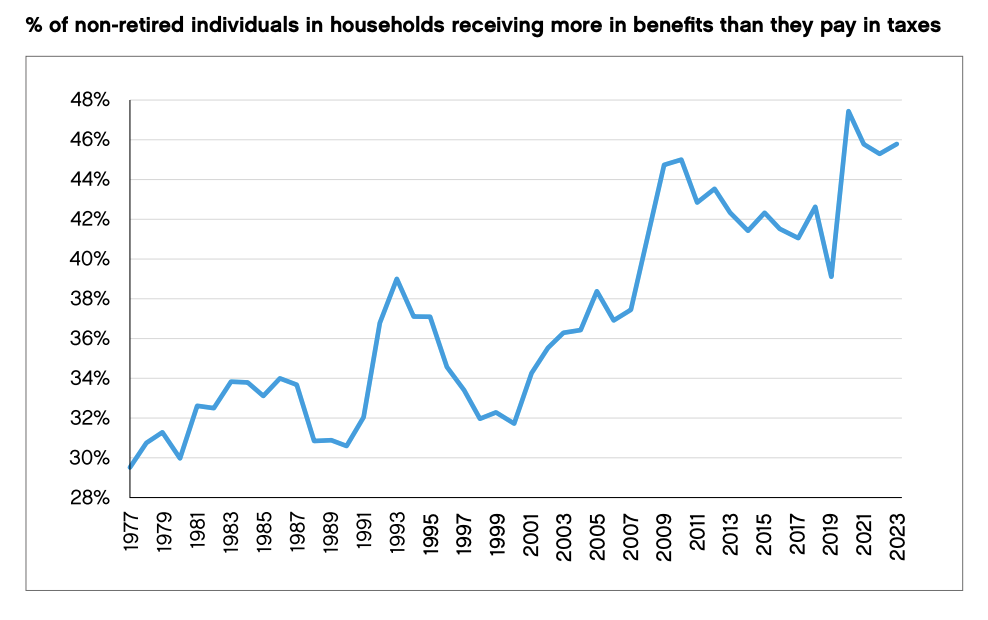
And over the last few decades, Britain has become a dependent country in every sense. Dependent on government handouts, yes: as of today, more than half of individuals (53%) are in households that receive more from the state in benefits and services than they contribute in taxes. Remarkably, this includes 25.5 million people of working age – 45% of the total. And the numbers have grown by 50% since 1997, far outpacing even the increase among pensioners.
But Britain, and Britons, have also become hugely dependent on the government’s advice and instruction.
Compared to the situation in 1979, the state owns much less but dictates much more. In housing, a policy area the CPS has done a huge amount of work on, the amount of regulation, direction and taxation involved in building a house has grown to an extraordinary extent. In financial services, we estimated that the ratio of regulators to workers had roughly quadrupled within a decade. Quangos – set up by Thatcher to bring private sector expertise to government – have instead become tools for the lanyard classes to dictate to firms and individuals without the pesky intrusion of political pressure.
And as my colleague Alex Morton has highlighted, in his work on the ‘bureaucratic class’, this is only scratching the surface. There are now not just huge numbers of quangos and regulators dictating behaviour, but huge numbers of people within companies, in sectors like compliance, who are effectively answerable to the state rather than their employer – and whose ultimate concern is with preventing rather than producing.
And again, there is the topiary problem. For a CPS paper published last year, my then-colleague Tom Clougherty and I asked the think tank’s policy team to evaluate the impact assessments attached to every single piece of legislation produced during the 2010s. We found that even under a government which was explicitly and vocally committed to reducing the regulatory burden, costs to business had continued to rise. But we also found that those costs were severely underestimated.
In the most notorious example, we showed that the MiFID II financial regulations had been assigned a net cost of £105.2 million per year. Every single person I have spoken to in the financial services sector agrees that this estimate is out by an order of magnitude, at the very least: some even believed the impact could be measured in fractions of GDP. But in fact, the net cost given was not £105.2 million. Because no one cared enough to fill in the form correctly, the Government’s official position was that MiFID II would bring a net benefit to the economy of £105.20 per year.
Our system of government is built not around trade-offs but a series of legalised absolutes, which have relentlessly expanded in scope and meaning
But then there is a fourth problem – one which has received a great deal of attention recently, and yet still not nearly enough.
Politics, like economics, is ultimately about trade-offs. There will never be enough money to do everything you want to do. There will always be winners and losers. You can never make everybody happy, no matter how hard you try.
But our system of government is currently designed to ignore this truth. It is built not around trade-offs, but a series of legalised absolutes. Equality. Environmental protection. Carbon reduction. Safeguarding. A whole series of rights, codified by judges decades ago but relentlessly expanded in scope and meaning.
These principles are not laws, but what I have called ‘meta-laws’. They permeate every act of government, creating unbreachable barriers to many of the things it might like to do. Build a road? You need to prove biodiversity net gain. Build a railway? Bat tunnel. Nuclear power station? Fish disco. Building some houses? God help you.
These meta-laws crop up across government – usually where spending is exploding. They are there in the benefits system. In the huge rise in spending on school transport for SEND children. They are there when Natural England insists that it is legally prohibited from considering the socioeconomic impacts of its decisions, as it grabs what was meant to be the town centre of what was meant to be our first new town in decades, in order to protect some spiders that would need to have evolved jetpacks in order to reach the designated site. When the courts block attempt after attempt by the government to deport people who should not be here. Meta-laws are a recipe for literally infinite government.
Thatcher understood, very deeply, that you don’t simply have to tackle the symptoms. You have to find a cure. Indeed, that principle was at the heart of much of the painstaking work that the CPS did for her in Opposition, not least in terms of the fundamental need (as diagnosed by the ‘Stepping Stones’ project) to curtail the power of the unions as a prerequisite of turning the economy round.
So how do we stop the state swelling simply because it is the easiest solution? How do we make Britain a responsible society once again?
Thatcher understood, very deeply, that you don’t simply have to tackle the symptoms. You have to find a cure
Today’s problems are not those of the Thatcher era. For obvious reasons, she had an awful lot to say about curbing inflation and fixing unproductive industry, and rather less to say about reversing the consequences of uncontrolled mass migration. Though she was accused of racism, in a fashion that would be very familiar today, for saying in 1978 that the numbers arriving had to come down. And did get very exercised, in that 1976 interview with ITN, about the fact that so many new arrivals were able to bring dependants with them, when we had no proper picture of either the numbers of the costs – arguments that the CPS is making afresh today.
This is also not the place to provide a laundry list of specific policies, Thatcher-inspired or not. There are all manner of issues vital to Britain’s future that I simply have not had space to mention in detail.
Instead, I want to make a simple argument. Thatcher said that Thatcherism ‘stands for incentives’. I would argue that the reason the state has grown and growth has evaporated is that that is where incentives have led us.
To see what I mean, let’s look at a few examples.
The triple lock is an awful policy. It is awful not because it gives more money to pensioners: there was actually, at its inception, a solid argument for doing so. It is awful because it gives more money to pensioners in a way that is guaranteed to become more and more exorbitantly expensive, not just because it is explicitly designed to outgrow the economy but because the number of people who benefit from it increases every year. The OBR’s central projection is that this dynamic will drive pension spending up to more than 7% of GDP in the coming decades, even as other bills for the elderly surge too.
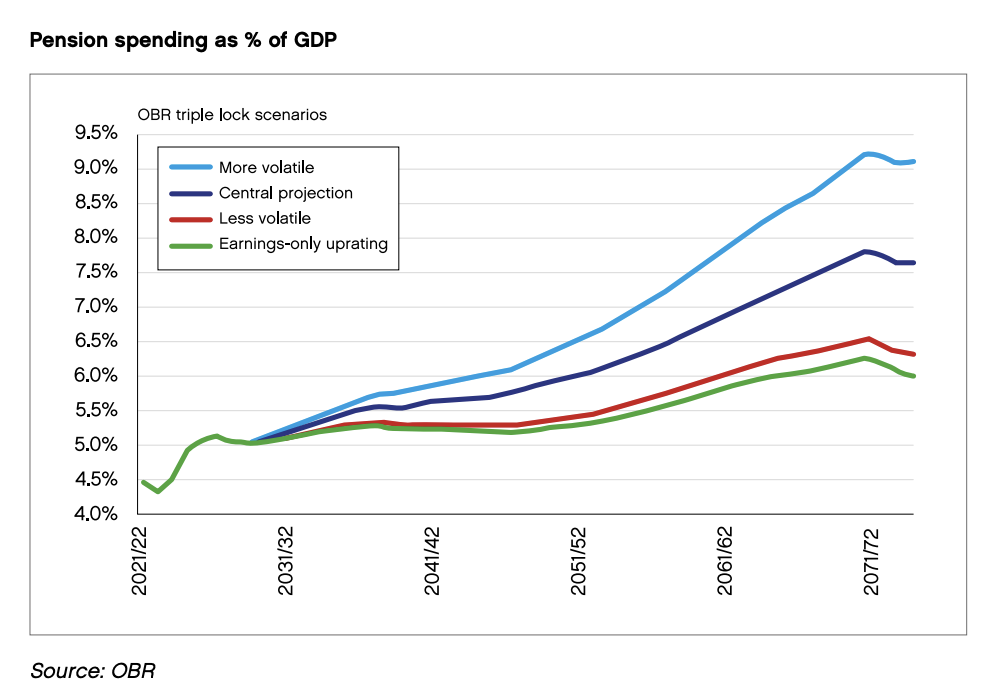
But what is particularly striking about the triple lock is that it was so thoughtless.
During the 1970s, the state pension rose by what would now be called a dual lock: the highest of inflation and earnings. In 1980, Thatcher’s government broke the link with earnings. This was deeply controversial, not least because Thatcher had personally pledged to maintain the value of the state pension. Ministers even feared it could provoke riots. But Geoffrey Howe, the Chancellor, argued that if the government had to make cuts – as it absolutely did – then the social security budget could not be exempted. And if social security was being cut, the elderly must take their fair share of the pain.
Over time, a consensus grew that the value of the state pension had, as a result of this measure, fallen too far. As a result, in 2010, the Conservatives went into the election promising to restore the link with earnings. The Lib Dems promised the same – but buried in the detail, pages away from the headline commitment, was that this would be accomplished via the triple lock. According to one of those involved in the coalition negotiations, the Tories accepted the idea because Civil Service staff working with both parties told them the cost would be £50 million a year. It is currently £15.5 billion and counting.
The triple lock, in other words, was a bad policy not just because it embedded escalating spending – but because there was no way to get rid of it. Indeed, it rapidly became clear that it would be political suicide to try. Not least because, as the CPS has shown, those aged over 55 now make up the majority of voters, adjusting for turnout, in the majority of constituencies.
Compare and contrast with an episode from the Thatcher years. The Labour government in the 1960s had set up a private final-salary pension scheme called SERPS. The problem was that the state did not take enough off higher earners to cover what it had promised them. Thatcher, unusually, was nervous about closing the scheme (albeit only to new members), asking her policy staff – led by John Redwood – why she should take a politically painful decision whose benefits would only be felt decades down the line. The argument that persuaded her was simple: it was the right thing to do.
The triple lock was a bad policy not just because it embedded escalating spending, but because there was no realistic way to get rid of it
Now, let us consider the story of full expensing.
In the late 2010s, interest grew among economists in the impact of investment allowances. For example, a comparison of US states by Eric Ohrn of Grinnell College suggested that more generous policies in terms of depreciation had outsized impacts on levels of capital investment.
These findings were picked up by think tanks in the US, in particular the Tax Foundation, and by a small handful of thinkers in the UK, including Tom Clougherty at the CPS and Sam Bowman of the Adam Smith Institute. The CPS worked with the Tax Foundation to model the potential economic impacts. Steadily, others were persuaded: by the time Jeremy Hunt announced in autumn 2023 that full expensing would be made permanent, he could cite the support of the CBI, Make UK, Energy UK and 200 other business who collectively agreed that this would be the ‘single most transformational’ thing he could do for business investment and growth. He could also have cited the support of the Institute for Fiscal Studies, the Resolution Foundation, and indeed the Labour Party.
Full expensing was a policy built on incentives: the entire point was to incentivise companies to invest more, something the British economy badly needed. But it also exploited political incentives. Corporation tax rates can be yanked up and down: indeed, the Government was in the process of doing so. Even the name, ‘corporation tax’, suggests something paid only by large corporations, which we all know are evil incarnate.
Full expensing is a more complicated, even nerdy, issue – not least because of the inordinate complexities involved in categorising particular types of investment. It is certainly not the most obvious choice for a government to spend a substantial amount of money to introduce, in the face of so many competing demands. But what it shares with the triple lock is that once introduced, it is very hard to unpick. Who wants to be the politician who introduces a tax on businesses for doing the one thing we most desperately want them to do?
Yet what almost killed full expensing before it was even introduced was another form of incentive: those embedded in the government’s accounting rules. Investment is, almost by definition, a long-term process. If you want to build a new factory, say, that is a commitment of many, many years – especially given how long it will take the British planning system to actually approve it. Yet the Treasury’s financial forecasting cuts off after five years, after which the books must be balanced. Hence the Conservatives introducing a series of short-term incentives, or a temporary form of full expensing, even though the obvious impact on incentives would be to bring forward planned investment rather than amplify it.
When you look at the failures of the British government, you will always find warped incentives at the heart of them
When you look at the failures of the British government, you will always find warped incentives at the heart of them. There has, for example, been an extraordinary rise in claims for incapacity benefit of various kind – claims which, as the Institute for Fiscal Studies has shown, appear to be driven not by medical need, but the design of our welfare system. Because, as Fraser Nelson has remorselessly chronicled, the financial incentives point people in that direction, just as the bureaucratic incentives within the welfare system point towards a culture of near-automatic approval.
Or consider two more examples (of dozens) from the CPS archives. We showed, in a paper with Damian Green, that the Thatcher government’s decision to shift the funding of social care from a national to a local level had resulted in a collapse in care home construction. Why? Because old people became a direct cost to councils, so councillors did their very best to avoid attracting more elderly residents.
Or consider the issue of second staircases, introduced after the Grenfell Tower fire. The Government’s own impact assessment, notoriously, admitted that the cost:benefit ratio of doing this was 294:1. In fact, as Tom Clougherty and I showed, this was an underestimate by an order of magnitude. The calculation ignored the residential space lost to make way for the enlarged building core, on the grounds that developers could make good the loss by making the buildings wider or taller – an argument that suggests the authors had never actually encountered the British planning system.
Strikingly, there was also no evidence at all that any lives would be saved. The Grenfell inquiry had not called for second staircases. Fire brigades could not find a single example of how they would have saved lives in the past, not least because mass evacuation via the stairs is ‘an extremely rare occurrence’. And in other countries that have such limits, they are generally far, far higher than the 18m chosen seemingly arbitrarily by the UK government.
Why, then, could the Government introduce this measure – which has, along with the introduction of the new Building Safety Regulator, contributed to an extraordinary and deeply damaging fall in housebuilding in London?
Because the incentive was not to introduce the right policy, but to be seen to do the most well-meaning thing. Because when it comes to regulation, there are effectively no institutional checks and balances: ministers are rewarded for making and taking decisions, not for triple-checking that those decisions are the right ones.
When it comes to regulation, there are effectively no institutional checks and balances: ministers are rewarded for making and taking decisions, not for triple-checking that those decisions are the right ones
Of course, I do not mean to suggest that the Thatcher government was faultless. There are plenty of examples of areas where it, too, ducked the hard decisions, or made bad ones. In addition to planting the first seeds of today’s social care crisis, the Thatcher government (and even more so the Major government that followed it) saw a huge expansion in the numbers on incapacity benefit, partly in order to keep the headline rate of unemployment down. Similarly, Nicholas Ridley became the first in a long series of Tory housing ministers to propose ambitious, liberalising planning reforms, and then retreat in the face of overwhelming hostility. Indeed, this led the CPS to publish the first in an equally long line of papers denouncing Britain’s failure to build, under the title: ‘NIMBYism: The Disease and the Cure’.
But it is still the case that, though necessarily imperfect, the Thatcher governments tried – arguably more than any before or since – to do the right thing by the country, and in particular to take a necessarily radical approach on what they saw as the great problems of the age. So what would a similar agenda look like today?
When Britain does get a properly reforming government – whatever party it comes from – that government will need to do an enormous number of very difficult things.
It will above all need a leader driven by the right philosophy, and unapologetic about explaining and evangelising for it – though perhaps using rather different communication tools from those of the Thatcher era.
But a single leader is not enough. Especially since no one can rely today on having a length of tenure to match Thatcher, or even Cameron.
To fix Britain, we do not just need the right policies – or a thorough overhaul of Whitehall, or of the legal blockages on housebuilding, border control and so much more, though we very obviously need those things.
To paraphrase Tony Blair, we need to be tough on spending, but tougher on the causes of spending.
To paraphrase Tony Blair, we need to be tough on spending, but tougher on the causes of spending
That means we need policies that are the opposite of the triple lock. Policies that embed the right incentives – ideally with a minimum of up-front pain, but with benefits that compound over time. Policies that push both the people and the government to act responsibly.
For example, there has been much talk since Brexit of ‘Singapore-on-Thames’. Very often, this has come from people wishing to decry the idea of Britain re-embracing a free-market, low-tax approach, not least by pointing out that Singapore has a strong and frequently coercive central state.
Yet the real secret to Singapore’s growth is not that it has a small state, or an effective state, but that it has a responsible state. Most famously, it goes to extraordinary lengths to incentivise its citizens to behave responsibly, not least via mandatory contributions to the Central Provident Fund, which supports people to save for housing, medical bills, disability provision, pensions, education and insurance. But it also forces the state to act responsibly.
Singapore does not mess around with ever-changing fiscal rules, which always push the day of reckoning to the future. It does not mortgage the future to pay for the present. Instead, each government must balance the budget over its parliamentary term. It cannot borrow to fund its operating expenses. And save in extraordinary circumstances, it cannot draw upon the surpluses accrued by previous governments – which are instead put to productive use (not least via the state-owned investment firm Temasek).
What would an agenda for responsibility look like here? As argued above, it would mean tackling the fundamental drivers of rising spending. That includes abandoning or ameliorating the triple lock. It includes retooling the welfare system so that if you are able to work, it is always more rewarding to do so than to sit at home, especially if you have a mental health condition.
But it also means doing more within the welfare system to recognise contribution: in a major piece of work a few years ago, the CPS and Public First showed that public attitudes to the fairness of Britain’s welfare system had been soured above all by a sense that it had completely broken the link between effort and reward, between doing the right thing and being recognised for it. (For example, by forcing people who had worked hard all their lives to pay down their savings before they could receive unemployment support.)
Singapore does not mess around with ever-changing fiscal rules, which always push the day of reckoning to the future
But there is much more we can, and probably will have to do. We need to re-embed the fundamental connection between what the state can afford and what it is spending. Remember: ‘If the problem is you’re borrowing too much, that arises because you’re spending too much. If you’re spending too much, you must reduce your spending.’
This could be done by pegging particular benefits to a given share of GDP. Or dividing the money available to spend on them by the number of people claiming. Or, as Iain Mansfield of Policy Exchange has suggested, bringing in the equivalent of NICE (the NHS body that decides which treatments and drugs are appropriate value) to tackle the surge in SEND spending, which as he outlines is disastrously unconnected to better outcomes for those pupils, due to the ‘meta-laws’ outlined above.
On tax, an agenda built around incentives and responsibility would mean prioritising reforms that incentivise people to work more, and reward them for doing so, rather than seeing them run headlong into the ‘Manhattan skyline’ of sky-high marginal rates and abrupt benefit withdrawal (a problem at both ends of the income scale). The CPS some years ago proposed a guarantee that you would always get to keep at least half of every extra pound you earned – a policy that our polling found was enormously popular.
Likewise, the CPS has also highlighted the extraordinary unfairness of our system of family taxation, which almost uniquely in the Western world treats parents as if they are merely atomised individuals, meaning (among other iniquities) that single-earner families can pay vastly higher tax bills on the same income than dual-earners.
And of course, one of the reasons why education spending is the only major line item in the Government’s budget that is not growing faster than the economy is that people are not having as many children as they hope to, or having children at all – which is in large part about how staggeringly expensive it is to do so. Which is why we should also match our rules on childcare ratios to those in every other European country, rather than making parenting it even more unaffordable for families.
On that note, a responsibility agenda would very certainly include tackling the housing crisis via large-scale housebuilding, and stripping away stamp duty. But it would also include systems of local taxation that incentivise local councils to approve housing rather than block it; systems of compensation for infrastructure that do the same for those living nearby; and embracing ‘street votes’ and other ways to let people say yes to housing rather than no.
We should permit, and encourage, those working in the public sector to swap unaffordable final sector pensions for salary rises right now
The list goes on. We should permit, and encourage, those working in the public sector to swap unaffordable final sector pensions for salary rises right now. We should cut back the insane amount of regulation and administration that afflicts small businesses as they grow. Given the high number of university courses that produce no benefit for their students, and land the state with billions of losses in debt defaults, we should align incentives by making universities responsible for the lending issued in their name: they would share the upside when their students flourished, and carry the can when they did not.
We also need to embed incentives within government. A senior business leader I know was asked to join the board of a major public company. He discovered, on examining the board papers, that more than half of their time was spent discussing initiatives from government, rather than the state of the company. Inside government, there is every incentive to regulate and mandate, and almost none to hold back.
Indeed, Keir Starmer has recently given the perfect example of this dynamic: promising to cut the regulatory burden for business by 25% even as his government brings in an Employment Rights Bill that will add to that burden hugely (and whose regulatory impact assessment was denounced by the watchdog as utterly inadequate). Even this ambition was then downgraded to cover only the ‘administrative costs’ of regulation, rather than the full impact on business – which in turn was converted into a target for red tape reduction of just £5.6 billion. And as I pointed out in a briefing for the CPS, this target was based on an extremely slipshod calculation of the scale of the regulatory burden – one which assumed, among other things, that the cost per hour of a senior director or company owner’s time is equal to the average wage.
To properly confront the growth of regulation, we need to embed powerful, independent regulatory scrutiny within the Whitehall regime: to make regulating something there is an insuperable case for rather than a first resort.
And of course, beyond all this, we need to incentivise people in the private sector to make profits, and to make the argument that it is good and decent for them to do so – because it is from profit that we get investment, from investment that we get growth, and growth that we all get to lead better lives.
I said above that I did not want to set out a laundry list of policies. But it is easy to see how thinking in terms of incentives – thinking as I believe Thatcher would have – leads to a host of conclusions about how to run government differently, and better. On the NHS, for example, the responsibility agenda should definitely include incentivising people to pay for health insurance, rather than taxing it. (A classic case of discouraging good behaviour.) It might also consider how we change the incentives regarding the NHS which see finite resources having to meet effectively infinite demand. And it should also involve having politicians actively engage with the findings of Dr Penny Dash’s review of patient safety, which found that endless disasters, reviews of disasters and recommendations for new targets and mechanisms have not actually made the NHS any safer.
Keir Starmer has recently given the perfect example of this dynamic: promising to cut the regulatory burden for business by 25% even as his government brings in an Employment Rights Bill that will add to that burden hugely
But on the principle of incentivising people to act responsibly, we can be more ambitious. There has been a lot of discussion, over the years, about the lunacy of Britain having two separate income taxes that function in a near-identical fashion. For all the talk of the ‘fund’ that people are ‘paying into’, there is nothing insurance-like about National Insurance: it is simply income tax with a false moustache.
For tax experts, the obvious choice – as set out in the IFS’s Mirrlees Review, and many, many other places – is to combine the two into a single tax. But there is an alternative. We could, like Singapore, move to a system which actually encourages people to behave responsibly. What if we turned National Insurance into a genuine system of insurance, restoring the link between contribution and reward? Like the Singaporean system, it could act as a pot of savings to be used to pay for the essential or desirable things in life – a deposit on the first home, health insurance, retraining, even university degrees – before being redeployed at the end of life to cover insurance and care costs. Under almost every plausible assumption, this would leave almost everyone who chipped in far better off, not least due to the miracle of compound interest.
Of course, this is currently a distant dream. For starters, it would involve a very large amount of money being redeployed from the state’s immediate needs to its citizens’ future benefit. Yet in the long run, it is one of the few conceivable pathways to reducing the inexorable rise in state spending, since it would see the welfare state once more acting as a safety net in time of need rather than trying, and inevitably failing, to cover every need.
And of course we should acknowledge the flipside of responsibility: punishment. As Thatcher said, in a free country, everyone has personal responsibility for their actions. So if you commit crime, you should go be punished. And the more crime you commit, the longer you should go to jail for – the opposite of our current system, which as Neil O’Brien has chronicled is ludicrously generous to prolific super-criminals. Likewise, when people cross the Channel illegally, the state has a responsibility to its existing citizens to send them back.
In an address to the CPS’s AGM in 1991, Thatcher warned that the great temptation in politics was to lose sight of the eternal truths and choose the popular, quick fix
If there is anything we can learn from Thatcher, it is that change is possible. Decline is not inevitable. In an address to the CPS’s AGM in 1991, Thatcher warned that the great temptation in politics was to ‘lose sight of the eternal truths and choose the popular, quick fix’. That is certainly a temptation to which Britain has often succumbed. But as she said a few years later, she and her allies had – by implementing the policies worked out by Keith Joseph and the CPS – ‘gradually restored the confidence and reputation of our country once again’. And this time, we have the great blessing that we know what worked last time.
It is only fitting, on her 100th birthday, to leave the final word to Margaret Thatcher, from her memorial lecture in honour of Keith Joseph. The pair of them, she said, had sought ‘to re-establish an understanding of the fundamental truths which had made Western life, British life and the life of the English-speaking peoples what they were. This was the foundation of our Conservative revolution. It remains the foundation for any successful Conservative programme of government.’
To which we today can only say: amen.
‘The Responsible Society’ was originally published by the Centre for Policy Studies to mark the centenary of Margaret Thatcher’s birth, in October 2025.


Elon Musk’s SpaceX has launched the largest ever public offering of stock today, selling $75 billion worth of shares. SpaceX emphasised its remarkable achievements in its IPO filing: ‘We are the primary launch provider for the US government. In 2025, we launched 11 of 12 National Security Space Launch (‘NSSL’) medium and heavy lift missions […]

September 2023: what a time that was to be alive. Aerosmith began their final ever tour, Kim Jong-Un arrived in Russia for an audience with Vladimir Putin and Rupert Murdoch stepped down from the boards of Fox and News Corp. It was a good month for news. Yet that month another turning point in world […]
June 4 marked the 37th anniversary of the Tiananmen Square massacre. It has been a long time since the China of reform and opening-up gave way to one of the strangest regimes of our age: a country with the political freedoms of the Soviet Union but economic power approaching that of the United States, capable […]