Burnham’s National Care Service is doomed to failure

30 September 2026
Ian Forsyth/Getty Images
The King of the North has spoken. In an emotive speech, Andy Burnham yesterday set out his vision for Britain.
The Prime Minister pledged to put Britain ‘on a new path’, and cursed Margaret Thatcher and the 1980s for killing ‘working-class aspiration’. What lies down this new path? A route back to the decade that preceded Thatcherism – the 1970s.
There is something late-Soviet about our veneration of the health service. Our leaders know it is broken, and as does anyone who uses it, yet it is an act of treason to point this out
Burnham announced a slew of policies that were straight out of the Old Labour handbook. He will reform Thatcher’s Right to Buy scheme – which ushered in a home-ownership revolution as council tenants were able to buy their rented homes – to make it harder to purchase council houses. Additionally, the state will be given the power to repossess property that has been left empty for a prolonged period – let’s hope none of us are selfish enough to have a long hospital visit.
Nationalisation is also on the agenda. Environment Secretary and veteran Leftie Angela Eagle will bring forward a bill to bring water into public ownership, and a new publicly owned Great British Grid will be established to compete against private companies to drive down energy costs. Most misguided of all his nationalisation drives is the new National Care Service (NCS).
The NCS will be modelled on the National Health Service (NHS), which means that it is necessarily doomed to failure. Public satisfaction in our healthcare system has collapsed. Only 26% were satisfied in 2025, a slight rise from the record low of 21% the year before and far below the historic peak of 70% in 2009. And this is all in spite of the NHS receiving record funding. The Department for Health and Social Care (DHSC) budget is £214 billion and is set to reach £246 billion by 2028/29. Including private care, healthcare spending is already around 11% of GDP. Real-terms NHS funding has risen by about 20% since 2019, yet output has grown by only around 1% a year and a large productivity shortfall is projected by 2028.
There is something late-Soviet about our veneration of the health service. Our leaders know it is broken, and as does anyone who uses it, yet it is an act of treason to point this out.
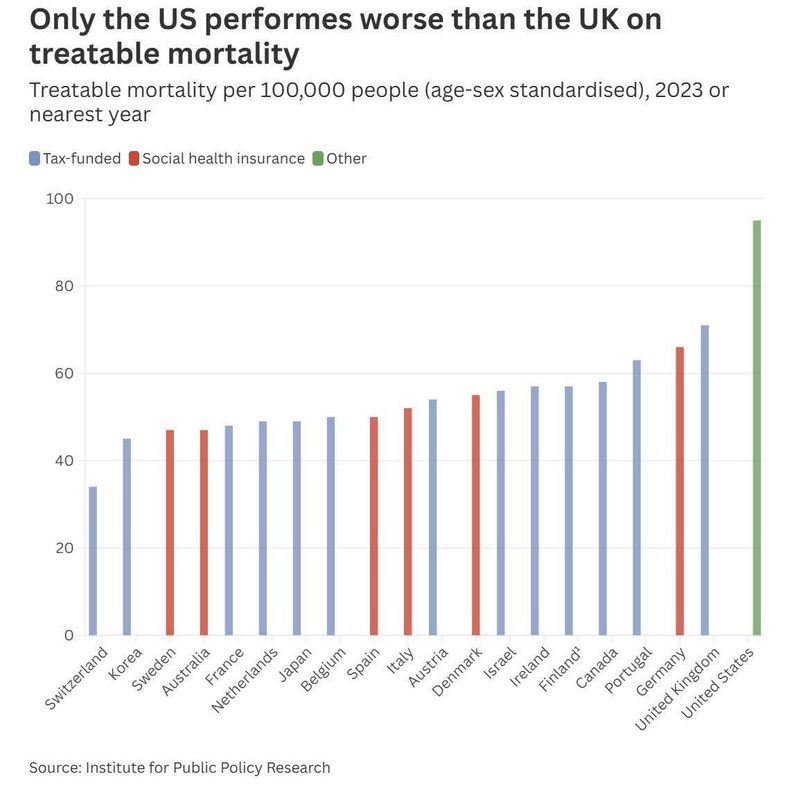
The inefficiency of the NHS isn’t just infuriating, it’s deadly. Britain ranks as the second worst on treatable mortality when compared with other high-income countries. Only the United States is worse.
Thankfully, we at the Prosperity Institute are not afraid to challenge orthodoxy, and this week published a plan for root-and-branch healthcare reform. We can have a healthcare system that delivers financial sustainability and improves outcomes, all while maintaining universal coverage. But without the introduction of private enterprise, the health service will eventually collapse.
The paper is authored by Dr Nick White, a medical professional with 25 years of experience in both the NHS and independent healthcare. He knows his onions, and proposes a number of common-sense policies that would ultimately make Britain healthier.
Take the reintroduction of tax relief for private medical insurance. It is absurd that our politicians – knowing full well the strain the NHS is under – are so hesitant to encourage those who can afford to go private to do so. I can’t have been the only one who was horrified when Keir Starmer said in 2024 that he wouldn’t use private healthcare – even if a loved one was stuck on a waiting list for surgery.
Reintroducing tax relief for private insurance would make independent healthcare more affordable for all – easing pressure on the NHS.
Similarly, we must lower barriers to entry for new medical insurance providers. Encouraging mutual, charitable, co-operative and locality-based insurers would reduce domination by a small number of incumbents, broaden the range of policies available and place downward pressure on prices through genuine purchaser competition.
As with so many of our chronic issues, quangos have played an outsized role in healthcare policy and allowed ministers to deflect difficult decisions. Bringing arm’s-length bodies back into DHSC would restore direct ministerial accountability; reduce duplicated governance and back-office functions; and allow budgets, HR, policy priorities and delivery to be managed through a single accountable departmental chain.
Burnham is right to be incensed at the standard of care offered to Britain’s most vulnerable, and as are those who have used the NHS and found the quality of healthcare abysmal. Be it in the health service or care sector, it is possible to have improved treatment which remains free at the point of use, but we won’t get there by pouring more money into the problem. Polling commissioned by the Prosperity Institute earlier this year found that 59% of Britons would prioritise healthcare reform over greater budgets. The Prime Minister has a public mandate for change. The question now is whether he is brave enough.


Picture the scene. A new Labour leader delivering his first speech as Prime Minister to the party conference, two years after a general election victory. The fiscal backdrop is poor, financial markets are not convinced by the credibility of UK economic policy and there is a deep divide between what his MPs want and what […]

It reads like a horror story. A tiny baby projectile vomiting for four feet. Sinister rashes moving across newborn skin. A shifty nurse hovering over the cot of an infant with blood around his mouth. The looming threat in these sentences: ‘Mother D could see her daughter looked better and so went back to bed. […]

Andy Burnham has made social care his early priority. After three decades and more than 20 reviews, the system remains a lottery that punishes thrift, leaves local authorities overstretched and offers no sustainable answer to rising demand driven by longevity and the growing numbers of working-age adults with complex needs. One in seven people still […]