What Britain misunderstands about Argentina and Las Malvinas
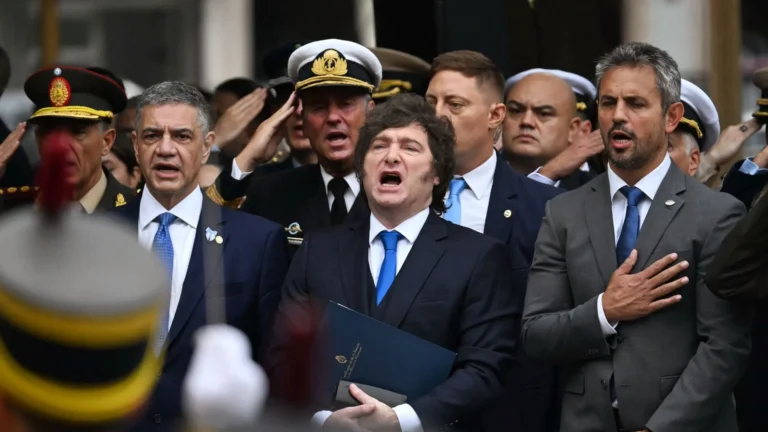
Luis ROBAYO / AFP via Getty Images
Last week, I met my friend Becky for coffee in Buenos Aires.
Becky lives on Las Malvinas and, unsurprisingly, calls them ‘the Falklands’. I never do, of course. After nearly ten years in Argentina, I have learned to discuss this particular subject in something closer to a stage whisper. Hearing the ‘F’ word spoken at the normal volume of a person ordering coffee was genuinely shocking.
Each time she said it, I glanced around the café and quietly checked our perimeter.
A few days later, President Javier Milei devoted a national television address to Las Malvinas. Never a man to discuss anything sotto voce, he promised tougher sanctions against companies involved in oil exploration around the islands, new legislation to reinforce Argentina’s sovereignty claim and a stronger strategic presence in the South Atlantic.
Argentina can adore Britain while believing passionately that Britain occupies part of its national territory. To British minds, these positions may seem incompatible. Argentines appear to manage them without difficulty
‘There are winds of change in the world that favour our claim,’ Milei said. By ‘winds’, he appeared largely to mean President Trump, who had recently suggested that America might reconsider its position on the dispute.
Milei described Britain as being on a ‘path of decline’, while Argentina was growing stronger. As an Englishman living in Buenos Aires, I was a little sorry to learn that my native country was finished, but mostly relieved to discover that I had emigrated in the right direction.
He even abandoned his customary sign-off – ‘Long live liberty, damn it!’ – and ended instead with ‘¡Viva la Patria!’
To British ears, all this may sound like a sudden escalation. From Buenos Aires, however, the striking thing is how familiar it all feels.
There can be few less controversial statements in Argentina than Las Malvinas son Argentinas.
I see the words hundreds of times a week. They are on buses, walls, road signs, T-shirts, hats, food packaging and human skin. They turn up in bathrooms, children’s playgrounds and the absolute middle of nowhere in Patagonia. Friends use maps of Las Malvinas as their phone screensavers. The other week, a young man walked into a café in Palermo wearing an expensive-looking jacket with ‘THE MALVINAS BELONG TO ARGENTINA’ stitched across the back.
In English.
There are radio programmes, podcasts and social-media accounts devoted to the cause, many of them run by clever, fashionable young Argentines. My fashionista friend Belle wears a Malvinas T-shirt around New York. This, to her, is no more aggressive than wearing an Argentina football shirt. Which she also does.
This is the context British people missed when Argentine footballers unfurled a banner reading ‘Las Malvinas son Argentinas’ after defeating England in the World Cup semi-final this summer.
In Britain, it was interpreted as a calculated insult: a political provocation directed at a country the players had just beaten. Spend enough time in Argentina and you find it very difficult to see it that way.
The banner was political, certainly, and FIFA has clear rules about that sort of thing. But in Argentina, its message was not regarded as provocative. The players had not invented a new taunt for the English. They were repeating words they had heard all their lives, expressing what Milei described at the time as ‘a feeling shared by all Argentines’.
It was once explained to me this way: the British tend to see sovereignty as a legal and constitutional question. For Argentines, it is also an emotional one, with the emotion itself forming part of the case.
Not all of that feeling fits on a banner.
A few weeks ago, I took a taxi across Buenos Aires to meet two friends who work at La Nación. The driver told me that he had fought in the 1982 war. When he discovered that I was English, he began telling me his story.
Before long, he was crying.
He told me he had never spoken to a British person about the war before. There was pain in his voice, and bewilderment, but no hatred of me or the country I came from. I mostly listened. It seemed the least, and perhaps the only, useful thing I could do.
Argentina is, in everyday life, an extraordinarily Anglophile country. That is one of the reasons I have found it so easy to live here. Argentines listen to British music, read British writers, follow British football, watch British television and ask me questions about the Royal Family that I am unable to answer. My Englishness is met not with hostility but with curiosity and affection.
Argentina can adore Britain while believing passionately that Britain occupies part of its national territory. To British minds, these positions may seem incompatible. Argentines appear to manage them without difficulty.
Milei may have turned up the volume, but Argentina already knew the words.
Sometimes they are stitched across the back of a well-dressed young man in a Palermo café or printed on the side of a bus.
And sometimes they are spoken through the tears of an old soldier to the British stranger sitting silently in the back of his taxi.

The Atlantic’s Jeffrey Goldberg asked a dying Fidel Castro in 2010 if Cuba’s economic model was worth exporting to other countries. He replied: ‘The Cuban model doesn’t even work for us any more.’ It has taken a decade and a half for the Cuban regime’s fans to catch up and they are still advocating for […]
For the past eight and a half years, I’ve lived in Buenos Aires. Which means that every day for what is now nearly a decade, someone back home has sent me a hysterical headline about the mind-boggling fluctuations of Argentina’s economy. For the longest time, these headlines were nothing but doom and gloom. ‘Peso Collapse […]

Free-marketeers are often accused of a crude anti-statism. According to our critics, we fail to understand that markets don’t exist in a vacuum, but are underpinned and supported by a functioning state. I have never seen much merit in that criticism. Anarcho-capitalists aside (and I’ve had pints with all twelve of them: I really wouldn’t […]