Hernando de Soto shows why property makes wealth
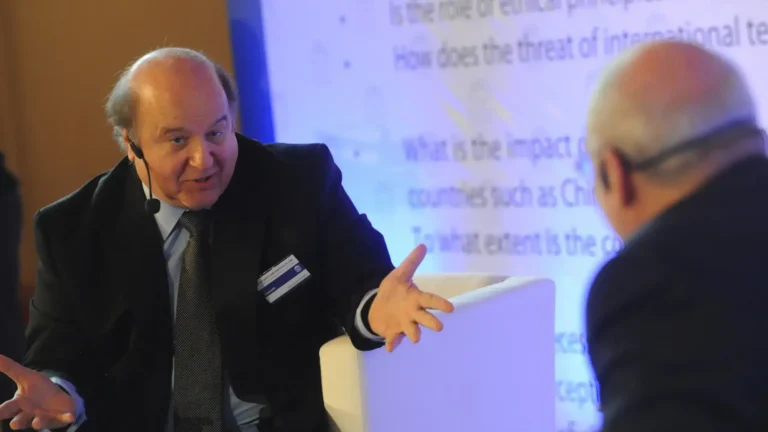
MICHAL CIZEK/AFP via Getty Images
Free-marketeers are often accused of a crude anti-statism. According to our critics, we fail to understand that markets don’t exist in a vacuum, but are underpinned and supported by a functioning state.
I have never seen much merit in that criticism. Anarcho-capitalists aside (and I’ve had pints with all twelve of them: I really wouldn’t worry about the prospect of them taking over the state and dismantling it), we understand that perfectly well. We know that property rights and contracts don’t enforce themselves. We know that functioning legal institutions are vital for economic prosperity.
It is true that we don’t usually talk about this very much. But there are two good reasons for that.
Firstly, and fortunately, at least in the West, we can largely take these government functions for granted.
Secondly, it makes sense for free-marketeers to focus on those aspects of our message where people need convincing. In a statist climate of opinion, there’s really no need to talk about how the state can sometimes be a force for good: everyone already agrees with that. The unpopular part of our message is that the state is often not a force for good, and that it currently does a lot more than it should.
There is one context, though, in which the above criticism used to have a little bit of merit, and that is in the context of development economics. For a long time, Western economists used to treat the economic problems of the developing world (or, to use the trendy term, ‘the Global South’) as simply an extreme version of the economic problems they were familiar with from their own economies. Poor countries are poor, they thought, because they do the same silly things that we do, just much, much more so, and without the redeeming features that allow us to get away with them. The ‘Washington Consensus’ was essentially the sort of medicine you would prescribe to a first-world economy with an overbearing state, such as Britain and New Zealand in the 1970s or Sweden in the 1980s: slash trade barriers, balance the budget, control the money supply, get rid of price controls, privatise state-owned enterprises, cut marginal tax rates and broaden the tax base, etc. None of these measures are wrong, quite the opposite. But they do not address the problems that are unique to the developing world.
The Peruvian economist Hernando de Soto explained this in his book ‘The Mystery of Capital: Why Capitalism Triumphs in the West and Fails Everywhere Else’, first published in 2000, as well as in subsequent research by his Lima-based think tank, the Institute for Liberty and Democracy (ILD). If the name ‘Hernando de Soto’ rings a bell, that’s probably because he has made some headlines this week: at the tender age of 84, he was announced as the interim prime minister of Peru, before being replaced by a different economist at the last minute.
I won’t pretend to know much about Peruvian politics, so I will not try to speculate what this proposed – and then rescinded – appointment might mean for the country or the region. What I will do instead is use the news about Hernando de Soto, the politician, as an excuse to talk about the work of Hernando de Soto, the economist.
To a Western visitor, developing countries often seem quite chaotic. From this impression, we wrongly conclude that these must be free-for-all economies, where everyone does as they please, and nobody cares about rules and regulations. This could not be further from the truth. Developing economies are often extremely bureaucratic. De Soto and his research team tried to legally set up a small business in Peru, without bribes and shortcuts, doing everything by the book. They then repeated the exercise in several other countries at similar or lower levels of economic development in Africa, Asia and elsewhere in Latin America. The numbers differ, but their core finding was always the same: legally setting up a business in a developing country can take years, requires hundreds of administrative steps across multiple government agencies and costs a multiple of the average annual income.
For poor people in those countries, this is simply not realistically feasible, which is why there are large informal and semi-formal sectors operating in parallel to the formal economy.
If setting up a business is already difficult, registering property is even harder. As a result, developing economies often lack an up-to-date land registry system, where you can verify who owns what. Especially in poor parts, people lack formal property titles: they have no way of proving that their home is truly theirs.
A naive libertarian may think: and what’s so bad about that? In the informal economy, at least you can concentrate on actually running your business, rather than having to organise Unconscious Bias Training seminars or prove your commitment to Net Zero. Which is true – but it also means that you are operating outside of the rule of law, and all the legal protections that it offers. You are running a business which does not officially exist.
This constrains you in several ways. For a start, you cannot raise capital to expand. Who would lend to or invest in a phantom business? Who would insure such a business? And if you do not have a property title, you cannot use your home as collateral either.
You cannot legally enforce contracts, so you will have a preference for doing business within your network, with people you know and trust. The miracle of a modern market economy, though, is that it allows us to break out of our own narrow personal circles, and gives us access to much larger, extended, impersonal business networks. It enables us to have business relations with people we will never know and have no reason to trust.
The economy of a typical developing country, according to de Soto, really consists of multiple parallel economies. The economic lives of the better-off resemble those of Westerners: they are based on contractual relations and formal property titles. The poorest operate outside of the formal economy altogether; many are somewhere in between.
What can be done to formalise these economies? De Soto argues that it cannot be the solution to fly in a delegation of economists from the World Bank, the International Monetary Fund or some Western development agency, let them design an ideal legal system, and impose it on people in a top-down way. It cannot be the solution to try to drag people into the formal sector against their will. Rather, de Soto’s solution is to lower access barriers to the formal sector, and give people a chance to formalise their existing business practices. It is about codifying what people already do rather than imposing anything on them.
This is, of course, a very Hayekian approach, which means that, for the first time ever, Latin America now came within a whisker of having two heads of government that you could reasonably describe as Hayekian classical liberals: Javier Milei and Hernando de Soto.
De Soto is not the ‘Peruvian Milei’. I suspect the two would agree on many things, but they differ radically in emphasis. Milei thinks very much like a Western economist, de Soto thinks like a developing-world economist.
This is because the two operate in very different contexts. I mentioned above that economists in the West have often implicitly treated the economic problems of the non-Western world as extreme versions of their own. Of all the Latin American economies, Argentina is the one where this description would be closest to being true. Nobody would describe Argentina as a ‘Third World country’; Argentina is a temporarily embarrassed First World country that has been held back by Peronism. Peronism, meanwhile, is essentially a blend of all the bad ideas that are being promoted by economic populists in the West as well, from Donald Trump to Zack Polanski. So unsurprisingly, when Western liberals hear Milei rail against the excesses of the Argentinian state, they can relate to it, recognising many familiar themes. Peru, on the other hand, remains a country with a huge informal economy, and this is not the kind of problem that can be solved with a chainsaw.
These are huge differences in emphasis, but there is nonetheless nothing remotely incompatible about Milei’s and de Soto’s economic visions. Milei wants to take a chainsaw to the state’s excesses, cutting it back to its core functions. De Soto wants to extend the benefits of those core functions of the state to the poor and those in precarious economic positions. I sympathise with both of those aims, and see them as quite complementary. If it were up to me, I’d have a Milei-style economist take a chainsaw to the state, and then I’d put a de Soto-style economist in charge of what’s left.


Just as there is a battle on the Right in Britain, so too is there a battle inside the Conservative Party for what the party should focus on. There are those who are concerned about the threat of political Islam, the damage to the social fabric of the Boriswave and other elements of mass immigration, […]

The Stanford Encyclopedia of Philosophy is not a publication most would be familiar with. It is meant as a repository of overviews of big topics in philosophy broadly defined, inclusive of political theory. As such, entries added to it are unlikely to generate strong responses by the experts deeply familiar with each individual entry. Every […]

In 1920 a Scottish Unionist MP Noel Skelton coined the term ‘property-owning democracy’, arguing that widening the base of property ownership among the working class would stabilise democracy and counter socialism. The term came to the forefront of political discourse when Prime Minister Anthony Eden used it at the Conservative Party conference in 1946. However, […]