What the Quakers can teach today’s political activists

12 January 2026
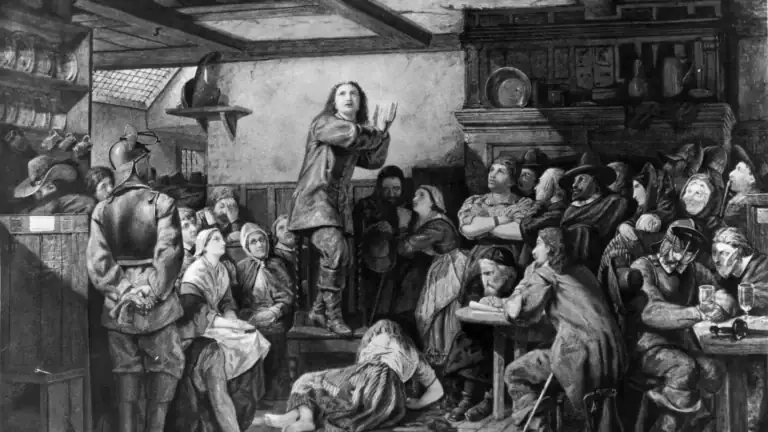
Quaker founder George Fox preaching in a tavern, circa 1650. Photo: Hulton Archive/Getty Images
Society and politics are forged by movements. The evolution of our country, and its state today, is a consequence of these movements, and their influence on our institutions. When people think of politics today, they think of parties, but parties have constraints that movements do not. Britain’s history has made this clear time and time again.
The Quakers, for example, used their extreme religious fervour to advance ambitious aims: they made disproportionately significant contributions to the Industrial Revolution, and were among the earliest and most committed abolitionists. The trajectory of Britain, based on religious movements in the 17th century, was violent and terrifying. The Quakers, in no small part, took that religiosity and transformed it into productivity, innovation and a better nation.
Other more recent movements are having a large impact on the current trajectory of our country. Regardless of the aims of the Green movement and the resulting outcomes, it is undeniable that the political world has been altered by environmentalism and social justice. We have not had a Green Party government, but we have had many green governments. The political power of the green lobby caused and influenced the Climate Change Act 2008, and persuaded Labour and Conservative governments to adopt Net Zero strategies. Indeed, the rise of the ‘social justice’ or ‘woke’ movement, which held sway throughout 14 years of Conservative government, influenced the culture of Britain’s institutions, and the policies they adopted – now, many branches of the state have these viewpoints baked in, as if they are ‘neutral’ policy decisions.
Movements make political change – and change that lasts.
Today, our stuttering economy is not delivering results the British people can feel: real earnings have been flat since 2008, and increasing numbers of people are seeing that increasing amounts of their monthly pay packet are being spent on the essentials. Society is visibly decaying – there are now security guards in most supermarkets and shops because large swathes of crime are effectively legal. What’s more, rather than solving these fundamental issues, our institutions are lurching from crisis to crisis. Only recently, the people of Tunbridge Wells have been told that running water will only be available in the mornings, while the Government has threatened to ban jury trials in most cases and welcomed a man who openly advocated for murder. The result is a crisis of confidence in government, and Westminster’s existing systems have no answer.
To solve this, to reverse the crime, grime and decline that people up and down the country see in their everyday lives, a pro-Britain, pro-growth movement is essential.
Britain will not be saved by the same political class that has failed us time and time again. It will be saved by wider movements that push our politicians to the same clear goals.
Decline is a choice. Our politicians created the system that today they claim to lament, but in reality do little to change. Our country is plagued by an army of consultants, lawyers and lobbyists, backed by a labyrinth of regulations and reviews. But it doesn’t have to be this way. Our politicians can choose to govern differently, to unleash Britain, and to let our talented people build, invent and innovate. We have done things differently before. We can do things differently again. Just as the Quakers shifted the dial, we can change our politics to deliver for Britain once more.


Britain’s higher education system, long heralded as a world leader in research and teaching, and a major export earner, is in big trouble. Yet our main political parties do not seem to be aware, or are turning a blind eye. The trouble is economic, academic and cultural, as we explain in a new book from […]

My favourite place in the world is outside Bank station, where Lombard Street meets Cornhill. To your right is Lombard Street, a name macroeconomists will recognise from Walter Bagehot’s 1873 book, which popularised the idea of the central bank as lender of last resort and which Ben Bernanke leaned on heavily during the 2008 financial […]

English rock fans are understandably thrilled over the announcement that Oasis will embark on another tour, including a stop in Manchester, where the band first got started in 1991. And while that may be good news, fans are still going to have a difficult time seeing them perform live – affording it, that is. Live […]