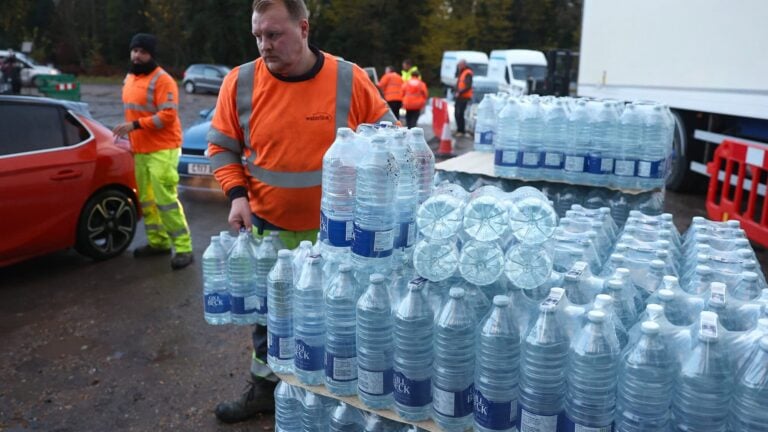
Providing clean running water for everyone is one of the most basic duties of the British state. But for six days last week, 24,000 people in Britain went without it. Pregnant women fell sick, children washed with bottled water, toilets were left unflushed and clothes couldn’t be cleaned. Schools, restaurants, pubs and hotels were all forced to shut; GP surgeries and hospitals struggled to function. Even once running water returned, residents had to boil it to ensure its cleanliness.
This is Britain in 2025. What’s more, the failure was not a freak, unforeseeable event – rather, the predictable consequence of the choices our political class have made over recent decades.
Indeed, the crisis in Tunbridge Wells was far from an anomaly. In fact, the number of water supply and quality incidents across the UK have increased by around 75% over the last 20 years. Now, Britain’s water and sewage system is creaking, and nearing breaking point.
The scandal is a microcosm of Britain today. Across the country, people feel that nothing works anymore – and they see the decline in every aspect of their lives. Whether it’s graffiti and shoplifting, or sky-high energy bills and strained public services, the British public are rightly angry at the crime, grime and decline that characterises society today – and they hold our political class responsible for not fulfilling their duties, and their promises.
Our politicians could have decided to build more reservoirs, replace Victorian-era infrastructure and upgrade water and sewage treatment plants. But they didn’t. They chose to let infrastructure decay. They chose to preside over a system where one failure at one treatment works would leave 4 million people without safe running water.
It did not have to be this way. Water did not have to be contaminated. Members of the public did not have to get sick from drinking the water coming out of their own taps. The actions taken by our politicians led to this. They decided to make it effectively illegal to build in Britain. The labyrinth of consultations, legal challenges and paperwork our politicians created led to no reservoir being built this century, and made the construction times of pumping stations and sewage treatment centres far longer than necessary.
The story is all too familiar. Like in so many other areas of our economy and society, successive governments neglected their duties. Westminster chose process over outcome, pats on the back from narrow interest groups over the welfare of millions – stagnation and decline over our prosperity.
But we can choose differently. We can build a country where we all have access to clean running water every single day. We can build enough reservoirs to ensure that we don’t have a hosepipe ban each summer. We can build infrastructure that guarantees we aren’t a leaking roof away from being forced to boil water just so we can clean ourselves.
The only solution is radical reform of the planning system, and a significant change to the procedure-driven culture permeating throughout Whitehall’s corridors. This means confronting the institutions, the perverse incentives, and the protocols that delivered failure. If we want a nation that works, we must once again become a nation that builds. The default answer needs to change to ‘yes’, not ‘no’. Governments must prioritise competency and outcomes over box ticking, and it must stimulate and encourage investment, rather than erecting barriers and needlessly increasing business costs. In short, it must actually prioritise doing its basic duties over anything else.
First, the Government must upgrade our existing water infrastructure; recent estimates suggest that around 3 billion litres of treated water are wasted daily in England and Wales due to leaks from faulty pipes and problems at treatment and pumping centres. By maximising our existing capacity, we can improve the efficiency of our current system.
But this will not be enough. Like the Victorians, we must once more build a system fit for the future. The Britain of tomorrow will demand, and expect, far more clean running water than today: with the expected requirements of data centres, we must significantly increase our storage and transportation capacity. Building numerous reservoirs, pipelines, treatment centres and pumping stations is therefore essential if we want to leave our descendants a better country.
Achieving this future for our grandchildren is possible. The Government could take the actions necessary to achieve that goal. The alternative is that we reconcile ourselves to national decline. If our politicians continue down our current path, the latest scandal in Tunbridge Wells will become increasingly common. More and more people will be forced to go days without being able to flush their own toilets, or wash in their showers. Hosepipe bans will be in place for longer each year, essential public services will strain more to get enough water, and households will face yearly pleas to conserve supplies – and all whilst we live in one of the wetter countries in the world.
We must take the former, not the latter option. What the Victorians possessed, but we now lack, is a governing culture that prized delivery above delay, and understood that the social contract can only be maintained with its citizens if the state performs its fundamental tasks competently.
We can recover that ethos. We can govern differently. And we can build a country that future generations will be proud to inherit.