The young will pay the price of the ‘Reeves recession’

Photo: Carl Court/Getty Images
When Labour took office in July 2024, Britain’s unemployment rate stood at 4.2%. Today it is 5.1%, the highest level since early 2021 and rising in a way that should trouble any Chancellor, especially one who has produced two tax-raising Budgets in succession. Ministers say the labour market is simply normalising, but the pattern now looks far more worrying, especially for the young.
Youth unemployment is now at 16%, with roughly 735,000 young people unable to find work, up 128,000 in a year. Another 946,000 are NEETs, not in education, employment or training, the highest since 2014. Economists call the consequences ‘scarring’ – weaker lifetime earnings, a looser attachment to work and higher welfare costs that endure long after the downturn has passed. A country that cannot integrate its young people into work undermines its own growth prospects and future tax base.
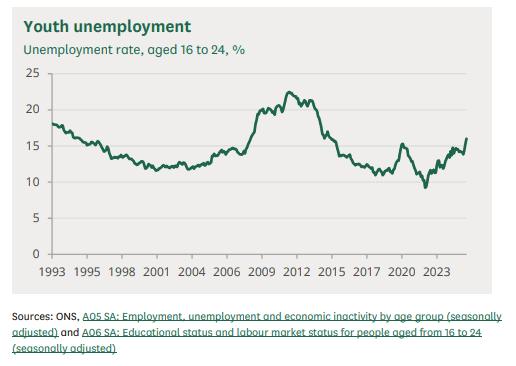
Where the jobs are disappearing matters as much as how many. The sectors now under strain are exactly those that have traditionally absorbed younger and less experienced workers. High-street retail – for decades the first rung on the jobs ladder – has been shrinking fast. Tens of thousands of retail jobs vanished last year. Claire’s Accessories and The Original Factory Shop have gone into administration just this week, putting between 2,000 and 2,500 roles at risk across almost 300 stores. Even Next, one of Britain’s best-run retailers, is warning of a significant fall in sales next year as households tighten their belts. These are the entry-level roles that ease people into work. Their disappearance has coincided with rising youth unemployment.
Ministers often respond that Britain’s unemployment rate remains below the EU average of 6%. This is true, and almost wholly beside the point. An economy can deteriorate while still performing marginally better than its neighbours. The real question is whether the labour market is strengthening or weakening. On that test, the direction of travel is clear.
Independent forecasters see the same trend. A recent survey of economists for The Times suggests unemployment could reach its highest level in more than a decade by the end of 2026, with most expecting the rate to settle somewhere between 5% and 5.5%, and some warning it could rise to 6%. Few serious analysts think the labour market will improve in the year ahead.
This is the backdrop to talk of a ‘Reeves recession’. Inflation is falling, but alongside weak growth, rising joblessness and a heavier tax and regulatory burden. Interest rate cuts may eventually help, I expect two this year, but monetary policy cannot fully compensate for an environment in which firms feel unsure about future costs or the direction of government policy. Yes, part of the recent slowdown is cyclical and is mirrored in other countries. But a substantial part reflects choices made in Whitehall.
The HMRC payroll series shows that payrolled employment has fallen by about 187,000 since Rachel Reeves announced her rise in National Insurance in October 2024. At the same time, the Government’s reforms to workers’ rights are expected to add roughly £1 billion a year to business costs, even after the concessions. The Centre for Policy Studies has calculated that Labour’s employment regulation will mean that, from April, it will cost a business £25,852 annually to hire a full-time, minimum-wage worker over 21, up from £24,806 in 2025 and £22,438 in 2024.
Higher payroll taxes, tighter regulations and greater perceived legal risk do not encourage hiring. Employers respond in predictable ways. They delay hiring. They substitute older workers for younger ones. They scale back training. None of that shows up immediately in headline statistics, but it eventually shows up in unemployment.
The long-term cost of ignoring youth unemployment is well understood. People who enter the labour market in weak conditions often suffer lower earnings that persist for years, sometimes decades. Countries that allow this to continue end up paying twice: once through lost output and later through permanently higher public spending. If Britain is serious about growth, it cannot treat rising youth joblessness as something that will simply take care of itself.
There is no inevitability about any of this. A credible approach would support targeted hiring incentives with apprenticeships developed alongside employers, not designed for bureaucratic targets. It would reform business rates and payroll burdens that fall most heavily in labour-intensive sectors such as retail and hospitality. And it would protect workers without turning entry-level hiring into a legal and financial gamble. The aim is not to deregulate work, but to make it easier for firms to take a chance on someone at the start of their career.
The bigger danger is not a dramatic collapse in the labour market, but something slower and more insidious. Youth joblessness becomes embedded while the politicians keep insisting the system is resilient. Youth unemployment is the warning light on the dashboard. It tells us the labour market is losing the capacity to absorb new entrants. No serious growth strategy can ignore that.
The Government cannot escape the simple fact that unemployment is rising, and likely to rise further, and those with the least security are bearing the brunt. If this is what ‘normalisation’ looks like under Labour, voters are entitled to ask what failure would look like – and why policymakers seem prepared to wait and find out.


A year in the making, the Milburn review is finally here. Months of debate and speculation gave way to great fanfare as the former Blair cabinet member unveiled his findings. We can certainly expect its ideas and recommendations to be argued over for months or even years to come. One thing’s for sure, though: it’s […]

On Sunday, the Work and Pensions Secretary, Pat McFadden proposed a solution to Britain’s youth worklessness: a statute. Speaking on the BBC’s Sunday with Laura Kuenssberg, Mr McFadden agreed with Alan Milburn’s diagnosis that the support available to young people is ‘vague’ and needs ‘legislative underpinning’ to guarantee job placements for under-25s. Mr Milburn’s review […]

For some years now, any Labour politician has been able to generate morale-sustaining applause from an audience by railing against ‘exploitative zero-hours contracts’. They are the perfect image of bosses weaponising their power over employees, putting workers in shackles with no guarantee of work, an arrangement wholly for the convenience of the plutocracy. So powerful […]