The wiring diagram behind Thatcher’s revolution
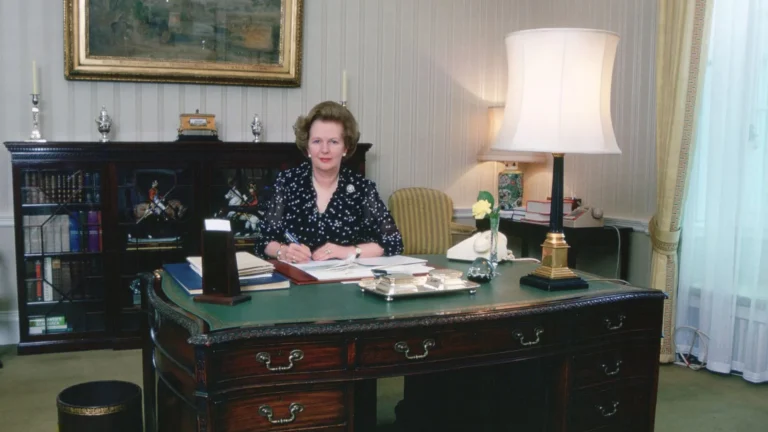
Tim Graham/Corbis via Getty Images
Even before he became Prime Minister in July, Andy Burnham had talked about the country in institutional, positively mechanical ways. He promised to ‘give Britain the circuit-breaker it needs’, and said that his Number 10 North, part of the Office for the Prime Minister and Cabinet based – where else? – in Manchester, would be ‘the nerve centre for a rewired Britain’ and ‘the conduit through which we redistribute power and resources across the UK’. Last week at the Labour Party conference, Burnham returned to this imagery, taking on the task of ‘the rewiring of the British state’ and of being ‘the first [Prime Minister] to rewire it to make it work for all people and places’.
The Stepping Stones report drew on a larger wiring diagram Hoskyns had sketched in 1974 to show the way in which both problems and solutions were intimately interconnected and had to be understood as a whole
Apart from demonstrating that he does not know what a circuit-breaker is or why it cannot simultaneously be a nerve centre and a conduit, this language is reminiscent of his predecessor. When Keir Starmer chose Chris Wormald as his Cabinet Secretary in December 2024, he described the mandarin’s task as ‘nothing less than the complete re-wiring of the British state to deliver bold and ambitious long-term reform’. Starmer sacked Wormald 14 months later with a severance package which topped £850,000.
Burnham refers frequently to history but for him it is an indistinct source of happy-vibe or solidarity-comrades punchlines: the Peterloo Massacre, the NHS, ‘1945, 1964, 1997, now’. If he looked more carefully at this historical record, he might find that the metaphor of ‘rewiring the state’ began hardly as a metaphor at all but a serious policy objective. He might even learn something.
John Hoskyns was commissioned into the Rifle Brigade just too late to see action in the Second World War. He spent 12 years in the army then joined IBM in 1957 at a time when the company was expanding rapidly, adopting solid-state circuitry and spurring technical innovation through its substantial work for the US government. He left in 1964 to start his own enterprise, the Hoskyns Group, an information technology and computer services company.
Commercially successful, Hoskyns found himself frustrated and focused his dissatisfaction on a few core questions: why did Britain, formerly an industrial superpower, have the longest working hours, the lowest rates of pay and lowest productivity per capita of any major northern European country? And why was it falling further behind with the passage of time?
By the mid-1970s, Britain had suffered the indignities of the three-day week, inflation was in double digits, GDP fell in real terms from 1973 to 1975 and in 1976 the government was forced to seek a multi-billion pound loan from the International Monetary Fund.
Hoskyns was not particularly party political but was drawn to the Centre for Policy Studies when it was established in 1974 by Keith Joseph and Margaret Thatcher because of its radicalism and openness to new thinking. He became an adviser to the Shadow Cabinet after Thatcher became Leader of the Conservative Party, and eventually devoted most of 1977 to working with Lever Brothers executive Norman Strauss examining the country’s challenges and failures from an institutional and procedural point of view.
In November 1977, Hoskyns and Strauss produced a detailed report called Stepping Stones. It set out an analysis of Britain’s economic problems, the policies that would be necessary to tackle these problems and a strategy for implementing them. Famously, it included diagrams which drew on a larger wiring diagram Hoskyns had sketched in 1974 to show the way in which both problems and solutions were intimately interconnected and had to be understood as a whole.
On inflation, for example, Hoskyns showed the cause, monetary expansion, the factors which perpetuated it – increased domestic costs, a falling pound, more expensive imports a smaller share of global trade – the policy response of the government, which under Harold Wilson and Jim Callaghan was pay and price controls, and the outcomes of this interconnected system, including fiscal drag. It also stated that ‘the one precondition for success will be a complete change in the role of the trade unions movement’.
Stepping Stones was methodical, clear and specific, everything one would expect from someone who had been successful in the private sector, dependent on their own talent, skills and organisational ability. In her memoirs, Margaret Thatcher paid tribute to Hoskyns’s ‘strong powers of analysis [which] had helped formulate our economic strategy in opposition’. It also appealed to her scientific training as a chemist.
A general election was called 16 months after Stepping Stones and Thatcher led the Conservatives to a comfortable win, with a majority in the House of Commons of 43. There was a romantic streak in the new prime minister. Her voice cracked audibly when, interviewed by the BBC during the 1979 election, she explained:
‘I can’t bear Britain in decline. I just can’t. We who either defeated or rescued half Europe, who kept half Europe free, when otherwise it would be in chains. And look at us now.’
But Thatcher, unlike Burnham, was not just mourning a half-remembered golden era of her youth and wishing things could feel the same way again. Thanks to John Hoskyns and Norman Strauss, she had a blueprint, a detailed plan for changing the way Britain worked: control the money supply, force inflation down, reduce state subsidies for industry, scrap pay and price controls and curb the power of the trades unions. Her first premiership was a bloody one, and for long periods in 1980-82, the transition to a modern economy was harsh. At times it seemed as if Thatcher could not possibly survive.
Now a new Prime Minister wants to ‘rewire the state’, and unlike Thatcher he has no wiring diagram to guide him. Is Burnham wearing his methodology lightly, or is he just a cowboy electrician with elaborate promises?


The Manchester City scandal drags on. Tax Policy Associates now argues, based on the Premier League commission’s findings and leaked documents, that the club may have failed to pay some £12 million in income tax and NICs due on the pay of Roberto Mancini, who managed the club from 2009 to 2013. City, which denies […]

Britain is looking for the effects of artificial intelligence in all the obvious places: redundancies, vacancies and unemployment numbers. So far, there is little evidence of dramatic change in overall headcount. The Office for National Statistics reports that most British businesses using AI have not changed the size of their workforce, even as AI adoption […]

Andy Burnham used the Labour Party conference in Liverpool this week to commit the Government to a National Care Service, universal and free at the point of use, while promising to ‘stick to our fiscal rules to get borrowing and debt down’. The service is due in the next Parliament and is supposed to be […]