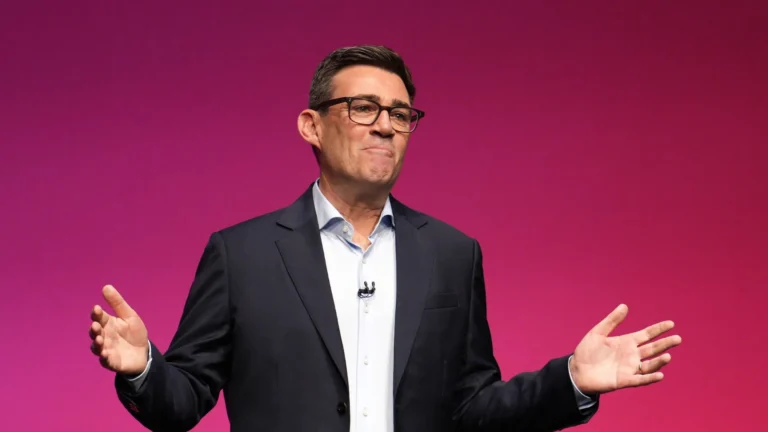
Andy Burnham used the Labour Party conference in Liverpool this week to commit the Government to a National Care Service, universal and free at the point of use, while promising to ‘stick to our fiscal rules to get borrowing and debt down’. The service is due in the next Parliament and is supposed to be paid for without borrowing, chiefly from savings generated by changing how the state pension is up-rated from April 2030.
That would be a bold plan even with the public finances in good order. They are not. ONS figures published last week put borrowing in the financial year to August at £77.3 billion, £8.1 billion above the OBR’s March forecast. The Government borrowed £18.3bn in August alone, the second-highest August on record, with a current budget deficit of £12.4bn. Our national debt now sits just below £3 trillion, or 93.8% of GDP.
No government can promise a universal care entitlement, cheaper energy, cheaper bus fares, more council housing, higher defence spending and protection for pensioners from the threshold freeze while refusing to take the welfare decisions that would pay for any meaningful part of it in this Parliament
None of this is sustainable.
It was amusing, then, to hear the Chancellor tell conference on Monday that there is ‘nothing progressive about losing control’ of the public finances. I agree. So, what is the Government doing about the existing deficit before adding another universal entitlement? Conference offered no answer. Instead, Healey’s first Budget on October 28 has to find money for the existing dire finances and also now accommodate everything his boss announced this week. VAT comes off household electricity bills from today. Bus fares capped at £2 throughout 2027. Help to Buy, version 2.0 (version 1.0 cost the taxpayer £3.6bn in hard cash), a publicly owned Great British Grid and the largest council-building programme since the war will all draw on the Exchequer within this Parliament. Pensioners have also been promised they will not pay income tax on the state pension, which invites the obvious question of whether working taxpayers can expect a £500 rise in the personal allowance to match.
Don’t get me wrong. The pension reform was very much needed and long called for. It does not, however, scrap the triple lock. Pensions currently rise each year by whichever is highest of inflation, average wages or 2.5%. Under Burnham’s triple lock lite, pensioners keep inflation protection and the 2.5% floor from 2030, but they lose the automatic right to the full average wage increase every year. I have long argued for change, and this is a substantial improvement on the status quo that should be (lightly) applauded. But it doesn’t go far enough. The 2.5% random uplift should have been removed, it serves no real purpose anymore.
More pressingly, the savings don’t start until 2030 and build slowly, reaching £15bn a year by 2039/40, and not hitting the expected £50bn a year until 2049/50 (or £11bn and £30bn respectively in today’s prices). By then a National Care Service, running up significant costs from day one, will have put the public purse under serious strain.
‘Free social care’ also needs defining, because it does not mean free care homes. From the limited detail available, the Government is offering free personal care (help with washing, eating, dressing and going to the toilet) whether you live at home or in residential care. Bed, board and accommodation in a care home remain means-tested, and that bill can be very substantial. Pensioners may still have to sell their homes to cover it.
The housing and welfare savings are just as distant. Lower housing benefit spending from council building is supposed to emerge over a decade, while the welfare reforms awaiting Alan Milburn’s final report will need money upfront before they save anything. Burnham has yet to announce a single meaningful welfare cut, let alone the radical ones desperately needed. Without them, the sums simply don’t add up.
That is why the claim that taxes need not rise is fiction, and nobody outside Labour’s front bench believes it. No government can promise a universal care entitlement, cheaper energy, cheaper bus fares, more council housing, higher defence spending and protection for pensioners from the threshold freeze while refusing to take the welfare decisions that would pay for any meaningful part of it in this Parliament.
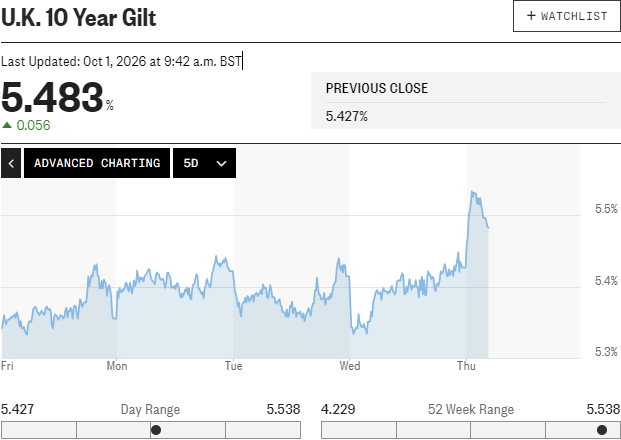
Initially gilt investors took the speech reasonably well. Two-year yields fell 13 basis points as details of the pension reform emerged, and the 10-year yields closed around 5.38%. ING said the triple lock change was ‘a positive for gilts as they reduce the tail risk of Labour triggering a more inflationary trajectory. If anything, lower pensions and potential tax rises should confirm the path of a fiscal consolidation.’
That relief didn’t last long. Today, 10-year government borrowing broke 5.52% and 30-year borrowing smashed through 6%, the level I have long called the ‘danger zone’. Some of that is global admittedly, with US Treasuries selling off and oil keeping inflation expectations elevated. But when Burnham spoke of ‘flexibility’ around the fiscal rules in July, gilts sold off. Markets are not waiting for 2030 to judge whether the savings are real.
Source: MarketWatch.com
Burnham is gaslighting the public when he says taxes need not rise. If this week’s speech told us anything, it is that he will not make the welfare cuts required and fully intends to increase the size, scope and cost of the state. Therefore, that can only be accommodated by higher borrowing and/or higher taxes.
Stay informed with our free daily briefing.
He told conference it was ‘time for honesty’. Healey can start in the Budget by publishing, with OBR certification, annual figures to 2035 for the cost of the National Care Service, the savings from the new pension uprating rule and the savings from any proposed welfare reform, along with the year each one begins.
As today’s price action in bond markets showed, if the Treasury won’t put those numbers in front of the OBR, gilt investors will draw their own conclusions long before 2030. And on today’s evidence, we’re in for a very bumpy and very painful ride. Buckle up!
Damian Pudner is an independent economist specialising in monetary policy and the Director of GBTT.
More Economics
23 Oct 2026
Taxation
John Penrose
How Kemi Badenoch can make sure work always pays
Making sure it always pays to work is political motherhood and apple pie: something so obvious it’s barely worth saying. Odd, then, that last week when Kemi Badenoch suggested changing childcare rules which leave successful parents facing crazy 100%-plus tax rates if they earn more than £100,000, she faced a barrage of criticism. The critics […]
23 Oct 2026
Economics
Tim Dier
Labour need to stop using smoke and mirrors accounting
Imagine borrowing £10,000 from the bank, lending it to a friend, then telling everyone the debt’s gone – because your friend owes you the money. That’s obviously nonsensical – you still owe the same £10,000 to the bank, regardless of what you did with the money. But that’s Labour’s approach to our public finances. Let […]
21 Oct 2026
Energy & Environment
Sean Ridley
Ministers must stop stalling on Rosebank
The Government has finally bowed to common sense and given the green light to the Jackdaw gas field in the North Sea. It’s the sensible move and a good start, although a decision on Rosebank is not yet forthcoming. Given the resistance both projects have faced, it’s worth setting out why Jackdaw’s approval is good […]
Manage Consent
To provide the best experiences, we use technologies like cookies to store and/or access device information. Consenting to these technologies will allow us to process data such as browsing behavior or unique IDs on this site. Not consenting or withdrawing consent, may adversely affect certain features and functions.
Functional Always active
The technical storage or access is strictly necessary for the legitimate purpose of enabling the use of a specific service explicitly requested by the subscriber or user, or for the sole purpose of carrying out the transmission of a communication over an electronic communications network.
Preferences
The technical storage or access is necessary for the legitimate purpose of storing preferences that are not requested by the subscriber or user.
Statistics
The technical storage or access that is used exclusively for statistical purposes.The technical storage or access that is used exclusively for anonymous statistical purposes. Without a subpoena, voluntary compliance on the part of your Internet Service Provider, or additional records from a third party, information stored or retrieved for this purpose alone cannot usually be used to identify you.
Marketing
The technical storage or access is required to create user profiles to send advertising, or to track the user on a website or across several websites for similar marketing purposes.