The trillion-dollar opportunity in outer space
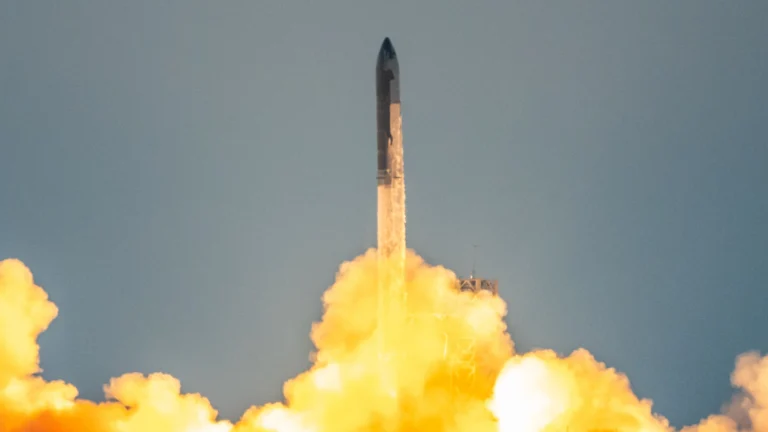
On June 12, SpaceX is expected to launch what could become the largest IPO in history. In its prospectus, the company states: ‘We believe that our current space efforts will catalyse transformative breakthroughs that could reshape terrestrial industries and lead to the emergence of new trillion-dollar markets on the Moon, Mars, and beyond.’
This vision may sound futuristic, but it raises a fundamental question: Why does space matter at all?
At a conference in June 2016, Elon Musk said the following about his motivation:
There are a lot of negative things in the world. There’s a lot of terrible things happening all the time. There are lots of problems that need to get solved – lots of things that are miserable and kind of get you down. But life cannot just be about solving one miserable problem after another. That can’t be the only thing. There need to be things that inspire you – that make you glad to wake up in the morning and be part of humanity. It is time to go forth, become a star-faring civilization, be out there among the stars, expand the scope and scale of human consciousness. I find that incredibly exciting. That makes me glad to be alive.
It is probably impossible for people who don’t set themselves ambitious goals and are content with the status quo to understand Musk’s motives. The great German spaceflight pioneer Hermann Oberth wrote in his 1957 book ‘Man into Space’: ‘And what would be the purpose of all this? For those who have never known the relentless urge to explore and discover, there is no answer. For those who have felt this urge, the answer is self-evident.’ In a similar vein, in 1923, when the British mountaineer George Herbert Leigh Mallory was asked during a lecture tour of the United States why he wanted to climb Mount Everest, he simply replied: ‘Because it’s there.’
Looking back at the 20th century, a central motivation for the space race was national prestige and the desire to demonstrate the superiority of the capitalist United States over the communist Soviet Union. President Lyndon B. Johnson put it this way: ‘One can predict with confidence that failure to master space means being second best in the crucial arena of our Cold War world. In the eyes of the world, first in space means first, period; second in space is second in everything.’
The Apollo program cost over $300 billion in today’s dollars, and at its peak, had 400,000 people and 20,000 companies working on it. They were all focused on a single goal – and that goal was achieved. But once the goal had been achieved, the driving force was gone.
Following the Moon landing, the architect of the Apollo program, Wernher von Braun, was asked what the priorities for space travel should be in the years ahead. He replied: ‘We have to show that spaceflight is useful, and even profitable, for people on Earth, and in fact, space projects should begin to pay for themselves.’
But this is precisely what state-led spaceflight failed to achieve.
We need private property in space as well
The joy of discovery and of space exploration will not be sufficient as a motivation in the future. As in all areas of life, major projects require strong economic incentives. And these are largely absent because, to this day, the question of property rights in space remains unresolved. According to the Outer Space Treaty, states may not claim ownership of celestial bodies. Whether this also applies to private individuals is disputed among legal scholars.
But how are projects that cost billions or even trillions of dollars to be financed? Looking back at history, without the squatters and the Homestead Act of 1862, the settlement of the western United States would have proceeded much more slowly. This Act provided nearly free land to anyone willing to heed the call to ‘Go West’. All adult US citizens and immigrants could apply for 160 acres of land if they agreed to settle and cultivate it for five years. The result was a mass migration from the eastern states and Europe to the Midwest, leading to the development of farms, settlements and infrastructure, particularly in connection with the construction of railroads.
We need private property in space as well. Systems without private property have not worked on Earth. Economic incentives are required for the next stage of the conquest of space. These are still largely missing.
So, who should have the right to acquire property in space? My answer: Those who have the financial means to get there, are willing to take the risks, develop, and use the land. For instance, if SpaceX succeeds in reaching Mars and starts to build permanent settlements on the Red Planet, then the ownership of land should go to SpaceX first. Not of the entire planet, of course, but of a practicable area, for example the size of Singapore. The surface area of Mars is 200,000 times that of Singapore, so SpaceX would initially only own 0.0005% of Mars. That would be enough to develop multiple settlements, but not so many that others would no longer have a chance.
SpaceX could fund its flight and development costs by listing the land on Mars in a real estate investment trust (REIT). The price would then be determined by the market. Most people would buy shares not to live there themselves, but in the hope of value appreciation. As an incentive for people to settle on and develop Mars, colonists could be offered stocks at a preferential price as a “golden hello” once they reach Mars and spend at least five years there.
The foundation of today’s space economy in orbit is economic motivation – money is primarily made with satellites. The next stage of space capitalism should, in its early phases, be a real estate story. Only in this way will the financing of gigantic projects such as space mining or the settlement of the Moon or even Mars become possible. Just as it was in the history of America.
Rainer Zitelmann’s forthcoming book, ‘New Space Capitalism: The Entrepreneurial Path to the Stars’, will be published July 30 by Skyhorse.

Since Andy Burnham became the Mayor of Manchester in 2017, the term Manchesterism has taken on a new meaning. To him, it stands for the expansion of the public sector and a managerial state. Now, with Keir Starmer on the brink of resignation and Burnham’s Makerfield by-election win clearing his path to Westminster, Britain may […]

Some are saying they don’t know what Andy Burnham’s big ideas are. They don’t know what he will try to achieve when he becomes prime minister. On GB News earlier this week, Boris Johnson described Burnham as a ‘mascaraed Mancunian mystery’. It is a peculiar concern. Burnham’s ideology seems to me no harder to identify […]

The UK has the lowest business investment of any G7 country. The last time its business investment stood above the G7 median as a proportion of GDP, John Major was Prime Minister. The Labour government’s instinct, both in its manifesto and in practice, reflects the old Keynesian mindset that “The duty of ordering the current […]