Will Elon Musk fly us to the moon?

Photo: Fabrice COFFRINI / AFP via Getty Images
Christmas may now be a distant memory, but I finally got to watch Frank Capra’s classic ‘It’s a Wonderful Life’. It really is a wondrous film, and not even my tipsy uncle talking all the way through it could dent it. One lovely line came back to me this week, where James Stewart’s George Bailey says: ‘What is it you want, Mary? What do you want? You want the moon? Just say the word and I’ll throw a lasso around it and pull it down. Hey. That’s a pretty good idea. I’ll give you the moon, Mary.’
This awkward attempt at flirting naturally made me think of Elon Musk. Not just because Musk too, has a massive impact on so many lives, nor because of his idiosyncratic way with chat up lines (inviting his ex-wife, actress Talulah Riley up to his hotel room, Riley expected him to make a move – he instead he showed her videos of rocket ships), but because of connecting ourselves to the moon.
The orbèd maiden, as Shakespeare called it, has not been stepped on by man for over half a century. But Musk’s company SpaceX has recently been told to pivot from terraforming Mars to building a self-growing city up there. Musk said:
For those unaware, SpaceX has already shifted focus to building a self-growing city on the Moon, as we can potentially achieve that in less than 10 years, whereas Mars would take 20+ years.
Musk further explained that he was sufficiently worried about a ‘natural or manmade catastrophe [that] stops the resupply ships coming from Earth, causing the [Mars] colony to die out. We can make the Moon city self-growing in less than 10 years’. A large part of this is that we can send rockets to the moon every 10 days; that same window of opportunity for Mars is 26 months.
Critics, as always, abound. But as Peter Thiel says, never bet against Elon. In his corner, Musk has some of the world’s biggest and most cutting-edge companies, and they are steadily morphing into one. Musk’s xAI has already bought Twitter, and now it has been bought by SpaceX for £200 billion, creating a £1 trillion entity.
Now SpaceX and Tesla, Musk’s other massive company, are going to be building more of the end-to-end stack when it comes to both power generation and advanced semiconductor chip manufacture, all because the world is already at capacity for both. It’s so bad, that Musk has claimed that it in a few years it will be cheaper to build AI compute in space, and in five years, SpaceX could be launching and operating more AI compute capacity each year than currently exists on Earth.
How damning that planning laws, poor energy generation policy and other public sector nonsense (not to mention his doomed efforts to rein in government spending) have caused Musk to think that it is simply much easier to relaunch civilisation in the coldness of space than have to deal with bureaucracy down here.
Speaking of government, how prepared is Britain, or indeed, all of Europe, for this genuinely science-fiction style future? Well France has forged ahead, pledging a whole €30 million for science, much to the mockery of the internet. Britain is home to some world-class AI talent, notably DeepMind, but our Government seems more focused on regulating this growth industry rather than unleashing it.
Britain once had the vision to build the world of tomorrow, but these days our horizons have narrowed. We seem more preoccupied with Keir Starmer’s latest pratfalls than exploring the frontiers of space. If we are to compete commercially on AI, robotics or other technologies, our leaders need to start looking up again, and imagining a more ‘wonderful’ future. If Musk builds his city on the Moon, they will at least have something inspiring to look at.


This week, Nimby Watch is in Axminster, because where else would you go to talk about the technologies of the future? Alright then, where are we off to this time? In this edition of Nimby Watch, we’re focusing in on Axminster, where – Oh, I love that we’re finally doing something different! I’m a huge […]

Britain says it wants to be a global hub for digital assets. Yet many people who want to use a lawful, FCA-registered crypto service cannot reliably move their own money to one. This is a test of whether the UK believes in individuals’ freedom to control their own money. A growing number of banks now […]
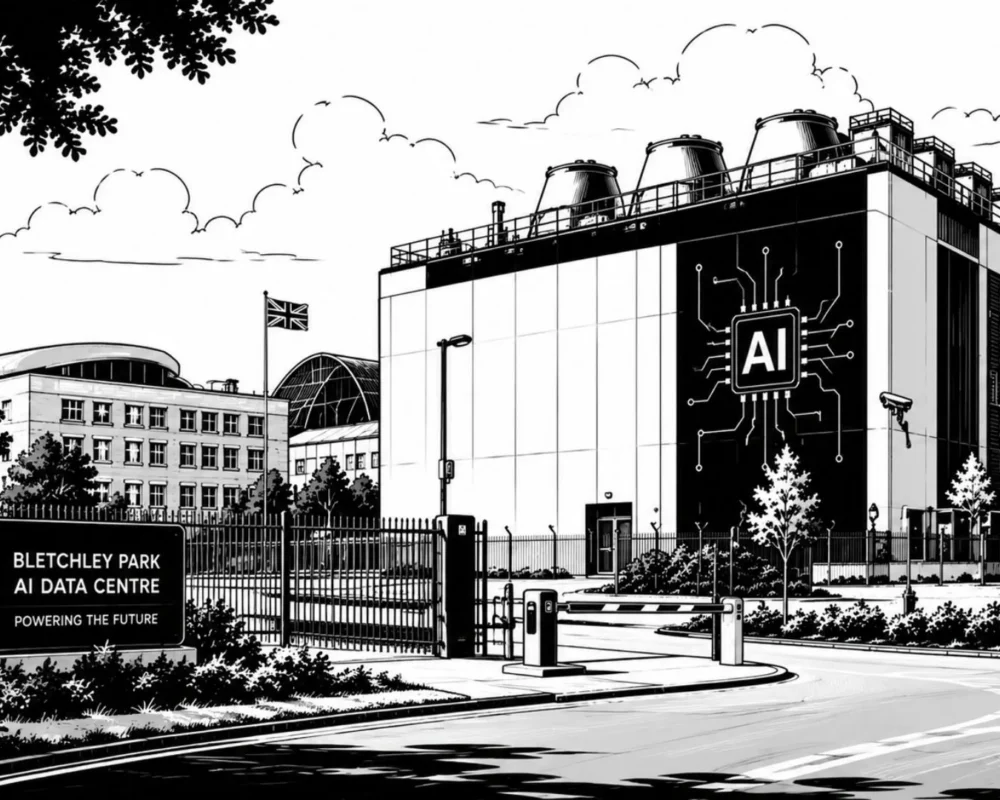
In 1943, a Post Office engineer called Tommy Flowers built a codebreaking machine out of 1,500 thermionic valves, partly out of his own pocket. Within a year Colossus, the world’s first programmable electronic computer, was cracking Nazi High Command ciphers at Bletchley Park. Britain had invented the data centre, in a large shed, and chock-full […]