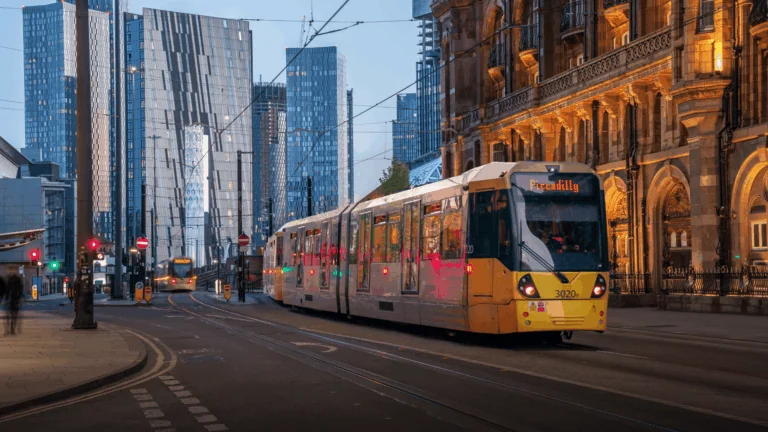
A tram in Manchester's city centre. Photo: Getty Images
Share this article
Since Andy Burnham became the Mayor of Manchester in 2017, the term Manchesterism has taken on a new meaning. To him, it stands for the expansion of the public sector and a managerial state. Now, with Keir Starmer on the brink of resignation and Burnham’s Makerfield by-election win clearing his path to Westminster, Britain may be about to find out what that means in practice.
Before the ‘King of the North’ took charge, Manchesterism was a cornerstone of classical liberal thought, championing everything Burnham now opposes. In the 19th century, Richard Cobden and John Bright championed the idea of free trade against a policy backdrop of government price-setting that Burnham now wants to return to. What was once sound liberal economic doctrine has been redefined, reduced to a cringe-inducing ‘feel-good’ stereotype involving Manchester United, bucket hats, and The Smiths.
The original Manchesterism came about as a response to repressive state practice that brought about import quotas, price ceilings and other state interventions. State mercantilism benefited rich landowners by keeping domestic grain prices artificially high, but penalized consumers, who endured a higher cost of living and constant shortages. Tariffs imposed by the Corn Laws made life more expensive to protect domestic producers from international competition.
‘Burnham’s ideas around government intervention fly in the face of everything the Anti Corn Law League stood for, the most famous example of the original Manchesterism in action.‘
Free market ideas have always been alien to Andy Burnham, so it is unsurprising that he wants to redefine Manchesterism on his own terms. During Covid-19, Burnham advocated for the strongest possible government intervention in Manchester, both through restrictions on personal freedoms and demands for large-scale government investment. In arguing for more government intervention, he was going against the Manchester school idea of limiting political power, not expanding it further.
His ideas around government intervention fly in the face of everything the Anti Corn Law League stood for, the most famous example of the original Manchesterism in action. Where the league stood for free prices and competition, Burnham has consistently advocated price capping and state monopolies, most famously on his Bee Network buses.
At his Makerfield victory rally last week, he called for an end to ‘trickle-down economics,’ demanded government control of utility bills and rail fares, public procurement of businesses, and job guarantees for young people. Judging by his public-private partnership housebuilding programme, ‘competitive market’ is not a phrase in the former Manchester Mayor’s vocabulary.
Classical liberals have historically viewed Manchester as a testament to the roots of free organisation, free trade, and free speech. Today, Burnham’s instinct to moralise extends even to economic growth, as shown by his rejection of Tony Blair’s call for more free market policy in Britain. Instead, he has called for ‘good growth‘ coming from more state control. If the likely new PM were in charge in the early 1800s, he likely would have called for a strengthening of the corn laws, possibly even declaring that protectionism was paramount to ‘good growth’. In other words, considering his record as Mayor, Burnham won’t be the Manchesterist in Number 10 he’s sold himself as.
The idea of Manchesterism shouldn’t be treated as a civic identity-turned-ideology; it is already a distinct idea of its own – one that Burnham routinely strays from and will depart from entirely in Number 10. Welfarism and state control are not the ideas that have made Manchester one of Britain’s fastest-growing cities; comparatively low rents, a booming property sector, and a history of entrepreneurship are the true elements that cement the city’s popularity. While previously, Manchester was a hub for friendly societies, cooperatives, and charities, those roles (provided by the market) have steadily been replaced by state intervention.
In promising to end ‘neoliberalism’ (a notoriously ambiguous term), Burnham isn’t providing a credible alternative. With the UK welfare bill already exceeding £300 billion, we cannot afford what he has sold to the people of Makerfield. The country cannot afford to borrow more either, as the debt-to-GDP ratio creeps toward 100%. Prioritising free trade and entrepreneurialism can lower the cost of living and make individuals better off, an idea that the now-departed Mayor of Manchester has forgotten.
One reason Manchester has outperformed many British cities is that it has permitted significantly more housebuilding than places with tighter planning restrictions. This reflects supply-side economics more than the traditional Labour statism he tries to attribute Manchester’s growth to.
Voters shouldn’t mistake Burnham’s calm, controlled demeanour for a qualification for high office. As a professional politician with no tangible private sector experience, we cannot expect him to run the country responsibly. While Manchester can always ask for more money from the national government, he cannot simply requisition funds from central government as Prime Minister. Real Manchesterism comes from fiscal responsibility, creativity, and reducing trade barriers, not building the ultimate managerial state.
Stay informed with our free daily briefing.
While Andy Burnham may yet be good for his constituency of Makerfield, he won’t be good for the country. His city is founded on the ideas that made Britain the foremost power in the world, but he has not integrated them into his own politics. In the abstract, his policies may appear attractive, but in reality, they are little more than Starmerism on steroids.
Manchesterism is about the voluntary and independent action of suppliers and consumers coming together, trading, and making each party better off as a result. The compulsion of Burnham’s Manchesterism to nationalise more, tax more, and spend more undermines everything the real Manchesterists stood for.
Ted Newson is a researcher at The Global Warming Policy Foundation.
More Capitalism
25 Jun 2026
Capitalism
Jamie Whyte
Labour’s misguided egalitarianism is about to get worse
Some are saying they don’t know what Andy Burnham’s big ideas are. They don’t know what he will try to achieve when he becomes prime minister. On GB News earlier this week, Boris Johnson described Burnham as a ‘mascaraed Mancunian mystery’. It is a peculiar concern. Burnham’s ideology seems to me no harder to identify […]
24 Jun 2026
Investment
Mani Basharzad
What the Left doesn’t get about investment
The UK has the lowest business investment of any G7 country. The last time its business investment stood above the G7 median as a proportion of GDP, John Major was Prime Minister. The Labour government’s instinct, both in its manifesto and in practice, reflects the old Keynesian mindset that “The duty of ordering the current […]
12 Jun 2026
Innovation
Reem Ibrahim
SpaceX is capitalism’s greatest vindication
Elon Musk’s SpaceX has launched the largest ever public offering of stock today, selling $75 billion worth of shares. SpaceX emphasised its remarkable achievements in its IPO filing: ‘We are the primary launch provider for the US government. In 2025, we launched 11 of 12 National Security Space Launch (‘NSSL’) medium and heavy lift missions […]
Manage Consent
To provide the best experiences, we use technologies like cookies to store and/or access device information. Consenting to these technologies will allow us to process data such as browsing behavior or unique IDs on this site. Not consenting or withdrawing consent, may adversely affect certain features and functions.
Functional Always active
The technical storage or access is strictly necessary for the legitimate purpose of enabling the use of a specific service explicitly requested by the subscriber or user, or for the sole purpose of carrying out the transmission of a communication over an electronic communications network.
Preferences
The technical storage or access is necessary for the legitimate purpose of storing preferences that are not requested by the subscriber or user.
Statistics
The technical storage or access that is used exclusively for statistical purposes.The technical storage or access that is used exclusively for anonymous statistical purposes. Without a subpoena, voluntary compliance on the part of your Internet Service Provider, or additional records from a third party, information stored or retrieved for this purpose alone cannot usually be used to identify you.
Marketing
The technical storage or access is required to create user profiles to send advertising, or to track the user on a website or across several websites for similar marketing purposes.
To provide the best experiences, we use technologies like cookies to store and/or access device information. Consenting to these technologies will allow us to process data such as browsing behavior or unique IDs on this site. Not consenting or withdrawing consent, may adversely affect certain features and functions.
Functional Always active
The technical storage or access is strictly necessary for the legitimate purpose of enabling the use of a specific service explicitly requested by the subscriber or user, or for the sole purpose of carrying out the transmission of a communication over an electronic communications network.
Preferences
The technical storage or access is necessary for the legitimate purpose of storing preferences that are not requested by the subscriber or user.
Statistics
The technical storage or access that is used exclusively for statistical purposes.The technical storage or access that is used exclusively for anonymous statistical purposes. Without a subpoena, voluntary compliance on the part of your Internet Service Provider, or additional records from a third party, information stored or retrieved for this purpose alone cannot usually be used to identify you.
Marketing
The technical storage or access is required to create user profiles to send advertising, or to track the user on a website or across several websites for similar marketing purposes.