Student loans are now a stealth tax on work

9 July 2026

Carl Court/Getty Images
Rachel Reeves has found another group of taxpayers to squeeze: graduates who still think they have a student loan rather than a second income tax. At the 2025 Budget, she froze the Plan 2 student loan repayment threshold at £29,385 for three years from April 2027, rather than uprating it with earnings.
Freezing a threshold while wages increase is a tax rise. Everyone understands this. It is called fiscal drag, and plenty of commentators, myself included, have called it one of the most dishonest ways for a Chancellor to raise money. Yet student loan repayments are still not treated by ministers as a tax.
The repayment-threshold freeze raises £255 million in 2027-28, rising to £355 million in the fiscal-rule target year, 2029-30. It also worsens the terms retrospectively for millions who had already signed up. Not much money for a great deal of lost trust.
Students did not sign a normal contract, so ministers feel they can move the goalposts after the event without consequence
And that was not the only freeze. The Budget also froze the thresholds used to calculate income-related Plan 2 interest rates. Unlike the repayment threshold, this was not announced in the Treasury’s Budget documents. The Committee heard that it appeared in the OBR costings and produced £1 billion of savings. When the Treasury Committee asked the Chief Secretary to the Treasury about it, she replied that she was not aware of it.
Ministers can insist on calling it a loan if they want, but tell that to a Plan 2 graduate above the repayment threshold who loses 37% of every extra pound once income tax, employee National Insurance and the 9% student loan charge are included. Above £50,270, the deduction rises to 51%. Add a postgraduate loan and it reaches 57%.
Then there’s the issue of loan repayments set by earnings, not by the size of the debt. How can it be right that a graduate owing £40,000 and a graduate owing £80,000 pay exactly the same amount if their incomes are the same? What may have been sold as a loan, with interest rolling up each year, is for most students a thirty-year charge on income.
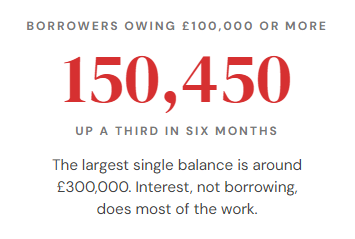
On the Department for Education’s own forecasts, only around a quarter to a third of Plan 2 borrowers ever repay in full. The loan book was £295bn at the end of March 2026 and, on the DfE’s projections, rises to about £492bn at today’s prices by the mid-2040s. Despite a large share not being expected to return to the Exchequer, around £21bn of new lending is added each year.

The government itself acknowledges this in its accounting. For Plan 2, the RAB charge, the share of each year’s lending that the Treasury does not expect to recover, has recently been around a third. Almost a third of every pound lent is a subsidy, initially recorded as a receivable. A bank with similar exposure would have to account for the expected loss.
The Treasury Committee, to its credit, has stopped going along with this charade. Its report on Tuesday called the system broken and unfair, found that governments had repeatedly changed the terms after borrowers signed, concluded that the failure to disclose retrospective changes properly, and the way repayments were promoted to higher earners, amounted to mis-selling. More than 52,000 people responded to the Committee’s survey, one of the largest ever responses to a Select Committee survey, and more than half said they had not understood the terms when they signed.
The same arrangement offered by a private lender would face a very different level of scrutiny. Student loans, however, sit outside the Consumer Credit Act and normal FCA regulation. Students were not even actively provided with the full terms of the loan. The substantive terms are set out in regulations, which they were directed to find for themselves.
That matters because student loans are statutory, not contractual. In plain English, students did not sign a normal contract, so ministers feel they can move the goalposts after the event without consequence. The Treasury Committee now says future loans should be contractual. Quite right. If ministers want to make the terms worse, they should pay compensation.
The OBR says the freeze brings in about £400m a year in the medium term. Handy enough given the dire state of the public finances. The larger prize was the one-off £5.6bn reduction in borrowing in 2026-27, booked because higher future repayments increase the value of the loan book today. After all, money not yet collected, from salaries not yet earned, makes the books look better today, right?
I am not arguing that universities should be free. Graduates earn more on average and asking them to meet part of the cost is perfectly reasonable. But let’s stop with the semantics and call it what it is: a graduate tax. Publish the rate and the threshold, then make ministers stand up in Parliament and defend it every time they want to take more.
In practice, the Treasury deducts 9% of a graduate’s income above the threshold for thirty years (forty years for students on Plan 5 from 2023), collects it through PAYE, changes the terms when the public finances get tight, and books hundreds of billions of pounds as receivables while knowing a large share will never be repaid.
The balance may give it the appearance of borrowing; the repayment mechanism gives away the reality. It is a tax – just one ministers would rather graduates did not recognise.

As the dust of party conferences settles and journalists try to read the runes of what they mean for the coming political year, two things are already clear. The first is that Andy Burnham’s conference speech was a masterclass in tickling the tummies of his party faithful, with a heady mix of teary emotion and […]
Just as there is a battle on the Right in Britain, so too is there a battle inside the Conservative Party for what the party should focus on. There are those who are concerned about the threat of political Islam, the damage to the social fabric of the Boriswave and other elements of mass immigration, […]
When William Buckley went on the front page of Time magazine, the title was simple: ‘Conservatism Can Be Fun’. That is what Kemi Badenoch has done at this conference. Conservatism can be fun, can be serious and can learn from its old mistakes. But most importantly, what makes it the world’s oldest party is its […]