Our governments are misreading the Hormuz crisis
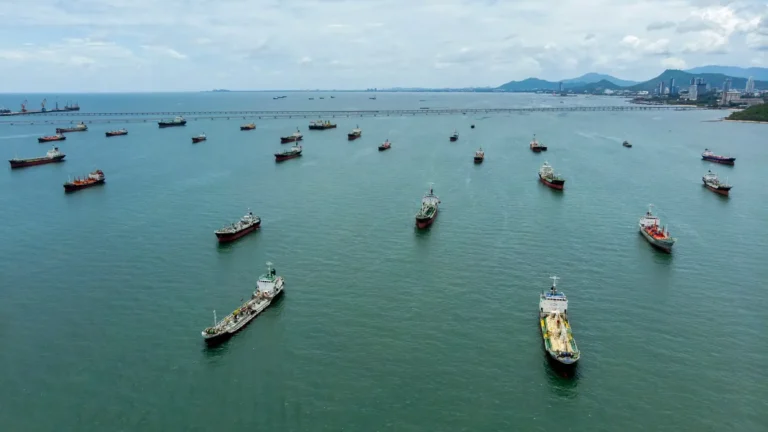
Photo: Getty Images
Hormuz has been front-page news for a month. The oil price has been reported, the tanker attacks recorded and the reserve releases announced. What has not been explained is why none of those responses have moved much oil. Oil does not simply flow through Hormuz, as it relies on a surprisingly large and complex web of relationships to get through the 21 mile gap between Iran and Oman’s Musandam Governorate.
A single cargo of crude leaving the Gulf is typically owned by a trader or major, carried on a vessel owned by a different entity, operated by a technical manager, and underwritten by a web of insurers. Each actor prices risk differently. Each has a different threshold at which a voyage stops making sense. For a cargo to move, their incentives must align – contract by contract, fixture by fixture, policy by policy.
Governments have responded to the Hormuz crisis in the way governments always respond to an oil price spike: they have reached for supply. The International Energy Agency’s (IEA) 400 million barrel reserve release is a serious intervention by any historical measure. The implicit logic is straightforward: the price is up because supply is constrained, so add supply and price falls. The price signal has been read, and answered.
Yet this misreads the problem: price is not the issue; the issue is what policymakers assume it is telling them.
Prices aggregate the expectations of everyone transacting in a market. The oil price spike is not a malfunction of any kind: it is traders correctly pricing the expectation of constrained supply. This is elementary and should not be controversial. A second-hand car market that seizes up and reprices upward is telling you something true and useful about that market. The oil price is doing the same thing.
But all prices are blunt instruments in one specific sense: they tell you that something has changed in the balance of supply and demand, without telling you why. Physical scarcity – not enough oil in the ground, or infrastructure destroyed – responds to reserve releases, alternative supply (and demand suppression – if news stories of rationing are to be given credence). These are the tools governments have, and they are the tools being deployed.
But there is a second kind of scarcity, less visible and less tractable. Economists working in the tradition of Ronald Coase and Oliver Williamson, and anyone familiar with liquidity crises, would recognise the condition immediately. We are at a point in time where the goods exist, the buyers exist, but the contractual infrastructure required to connect them has failed – a form of scarcity that adding supply cannot fix. We might call this contractual scarcity.
Hormuz is currently producing both kinds of scarcity (physical and contractual) simultaneously, and the two factors look identical in the oil price. The IEA release is aimed at fixing the physical scarcity. Contractual scarcity seems not to being addressed at all. The complex web of insurance, chartering, ownership, operational risk tolerance and more that binds shipping together seems to have been fractured. Those constraints are downstream of the security situation – they would not exist without it – but downstream does not mean identical. Contractual scarcity is a distinct and separately consequential effect, and the policy response addresses neither level.
Some of the factors driving this scarcity are financial and some are legalistic in nature. Many are both. War risk premiums were already rising before the US and Israeli strikes landed – moving from 0.125% to between 0.2% and 0.4% of ship insurance value per transit in the days before 28 February. For a large crude carrier, that is $250 million of additional cost per voyage. The insurance market was pricing contractual risk ahead of the war which posed problems for some operators ahead of a single strike being authorised.
However, the shipping insurance market is not a single instrument but a stack of overlapping covers, each with different triggers and different actors. War risk insurance is the specialist outer layer covering loss from acts of war, seizure, or state action. Protection and indemnity (P&I) clubs – mutual insurers owned by shipowners – cover third-party liabilities including crew injury, pollution, and cargo damage. Above both sits the reinsurance market, principally Lloyd’s.
War risk moved first, and by 5 March, P&I war risk cover was withdrawn entirely. This is the critical event: P&I cover is not optional, and its absence creates a legal and commercial veto on any voyage regardless of what every other party in the chain is willing to do. The shipowner might be willing to sail, and a charterer might be willing to pay a premium for freight. The cargo owner could well be willing to accept later delivery, but none of that matters. Without P&I cover, there is no means for the voyage to commence, and the whole chain collapses at its weakest contractual link.
Other, more human factors also come into play: benchmark tanker earnings in the Middle East were running approximately $200,000 a day above pre-war rates for owners willing to accept Gulf exposure. That is an enormous financial incentive to send vessels, and yet most owners were not sending them. Why not? Even in an industry as profit-focused as shipping, other factors can hold the whip hand.
Because crew safety is a separate consideration from commercial return, and seafarers have the contractual right under International Transport Workers’ Federation (ITF) and Joint Negotiating Group agreements to refuse to enter a declared war zone, traffic stopped.
This tension is invisible in coverage focused on the oil price. The price signal was screaming at owners to deploy tonnage, but the contractual rights of the people required to operate that tonnage were pointing in the opposite direction, and those rights sit in collective bargaining agreements that no government reserve release can touch.
One final consideration in the analysis is data availability. Normal chartering and insurance decisions depend in part on reliable vessel tracking data. In instances such as this war, vessels begin switching off Automatic Identification System (AIS) transponders mid-voyage, broadcasting false Chinese ownership or all-Chinese crew compositions to seek tacit clearance from Tehran, and hugging Iranian territorial waters rather than using international shipping lanes.
The effect is to corrupt the information infrastructure on which normal market functioning depends. Insurers underwriting a voyage cannot verify vessel position or routing compliance, and charterers cannot confirm delivery schedules. The market does not merely become more expensive – it becomes functionally degraded, suppressing participation further. What is left is not a functioning market, but a series of individual bilateral arrangements, negotiated under opacity, with no price discovery and no reliable data. Adding barrels to this environment changes nothing.
The current situation at Hormuz offers its own proof of the argument. Iranian ships have moved freely throughout the crisis, and Indian and Pakistani vessels have negotiated bilateral passage through diplomatic channels. Chinese-flagged ships broadcast ownership details via AIS to seek tacit clearance from Tehran. A Pakistani Aframax tanker hugged Iranian territorial waters rather than using international lanes, suggesting it had obtained some form of permission from Tehran rather than exercising its legal right of transit.
These are live demonstrations that the binding constraint is contractual: supply moves when the permission system allows it, and stalls when that system has not been assembled. Those Indian voyages did not represent the commercial market functioning – they represented it being substituted, case by case, by improvised bilateral arrangements that are inherently fragile and non-scalable. In other words, 20 million barrels a day cannot move on diplomatic clearances likely negotiated one cargo at a time.
At the time of writing, traffic is beginning to transit the strait again: partly due to the increased dialogue between combatants, partly due to special permissions for non-participating regional powers and partly due to the degradation of Iranian capabilities. Yet the contractual infrastructure will not be rebuilt as quickly as it collapsed. Insurance will return – but not simultaneously across all operators and not on uniform terms. Owners holding pre-conflict contracts of affreightment with fixed compensation structures face a different calculus from those able to take post-conflict spot engagements at elevated rates. Risk tolerance is not uniform, and the commercial incentives to resume are unevenly distributed across the market.
Despite this limited easing, the mess that still exists in the energy supply lines leaves us with many lessons. None of those lessons are that price signals are unreliable. They are not. The lesson is that a price signal generated by contractual scarcity looks identical to one generated by physical shortage, and the remedies are completely different. One requires adding supply. The other requires reconstructing the private incentive conditions – insurance markets, charter terms, flag-state negotiations, crew safety frameworks – under which trade can transact.
Governments have well-developed tools for the first. They have almost none for the second, partly because they have never needed to develop them, and partly because the institutional machinery of shipping – P&I clubs, war risk syndicates, ITF agreements, charter party law – operates almost entirely out of public view. Because those mechanisms are out of view, the media has reported the price and very little else. The 400 million barrel release will move the price temporarily. It will not fix a single charter. It will not reopen a P&I syndicate. It will not persuade a crew to sail into a declared war zone. And until those problems are solved, we remain in difficult and dangerous waters.

Josiah Quincy Jr., who was the mayor of Boston in the middle of the nineteenth century, wrote in his Last Will and Testament that his son should read ‘John Locke’s works, – Lord Bacon’s works, – Gordon’s Tacitus, – and Cato’s Letters. May the spirit of liberty rest upon him!’ Indeed, there is nothing closer […]
Spare a thought for Jared Kushner and Steve Witkoff, heading the US negotiating team, as they met with Qatari Emir Al Thani this week to discuss the ‘progress of the negotiations’ between the US and the Iranian regime in the Qatari capital, Doha. While the venue for the talks has shifted from Pakistan to Switzerland […]

The World Cup starts today and for the first time in over 30 years it is being held in North America. Not only is this exciting news for football fans, it should also be of interest to free trade enthusiasts, as the last time it was held there the North American Free Trade Agreement (NAFTA) […]