Labour’s price freeze will make our railways worse
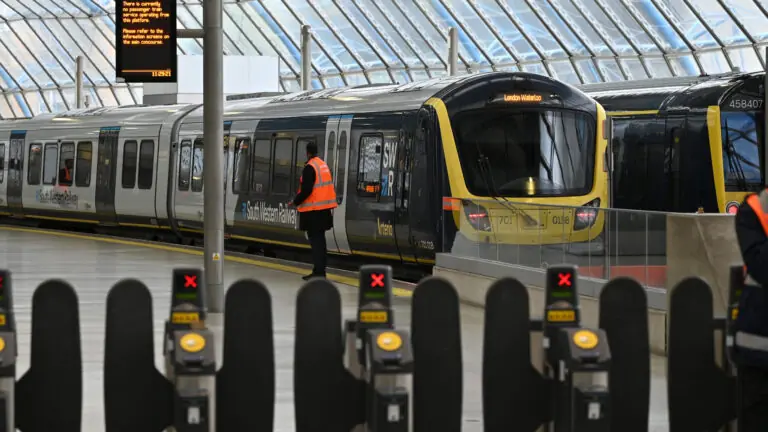
Photo: John Keeble/Getty Images
It appears that the Government is going to freeze rail fares for the coming year. This is a strange policy. Economists should never be very happy with the strategy of holding down prices as a ‘cost of living’ or anti-inflation measure. It produces distortions which are difficult to address subsequently.
As the passenger railway is now over 50% state-owned, with the remaining franchise contracts gradually coming to an end and the train operating companies leaving the field, holding down prices against flatlining productivity necessarily means a direct addition to the subsidy provided by the taxpayer. In the last complete financial year, the total railway subsidy was £22 billion, and is unlikely to have come down by much since then. The freeze on regulated fares such as season tickets and ‘anytime’ fares (which should have risen by 4.8% in line with the RPI to July) will probably cost somewhere between £500 million and £1bn in the coming year, depending on whether unregulated fares rise to compensate, and on the consumer response to fares which fall in real terms. Unless prices are increased faster than inflation in subsequent years – which seems unlikely – higher fare subsidy will be permanently locked in.
Even as a short-term political measure, further subsidising fares is an odd thing for Labour to be doing. There is considerable evidence that rail travellers are, on average, a good deal better off than non-travellers, while rail routes and connections are far more numerous and accessible in the prosperous South East than in many poorer parts of the country. In isolated rural areas, the taxpayers subsidising the train service may have to travel 20 or 30 miles by car or infrequent bus services before they reach a mainline railway. Remember that the National Travel Survey consistently shows that almost 40% of people will not travel on a train in a given year.
Moreover, even those regular passengers who gain from the price freeze will probably not be aware of it. Even if they do, ‘not increasing prices’ hardly has the resonance of actually cutting prices, which vox pops incessantly demand.
At the beginning of November, the Government laid before parliament the promised Railways Bill. This was to set up the legal framework for ‘Great British Railways’, the hubristic title for an entity first proposed by Keith Williams six years ago to be a directing mind for the complex railway industry.
So far, Labour have not come out with any clear strategy for the industry. The Bill promises to set up ‘business units’ which will be organised on a regional basis to coordinate national initiatives which will ‘drive consumer satisfaction, patronage and revenue growth’. The Transport Secretary will – though she hasn’t yet got round to it – devise a 30-year rail strategy, with five-year business plans within it. Heidi Alexander had better get a shift on if she is to leave a permanent impression on the future of the railways: she is the seventh Transport Secretary in the last ten years, and few have left a mark.
The Bill goes into little detail. We see again that Labour want to ‘simplify ticketing’, which the public seem to want too, though they may regret this when special offers and ultra-cheap seats booked in advance disappear and the new state booking app comes to dominate the market, with Trainline and others are squeezed out. There is to be a ‘passenger watchdog’ which will probably be as ineffective as most of the similar watchdogs that infest our regulated industries. But other concrete commitments are sparse.
The Transport Secretary will set a target for the growth of freight on the network, but how this is to be achieved is unclear. Rail freight is, and is planned to remain, a purely private operation. There is a real danger that its access to the tracks, and infrastructure investment, will not be a priority. Given that virtually all passenger transport will be in state hands and, as it is the part the public sees, it is likely to get the best timetable slots and track improvements.
Important questions are glossed over. They include the relation between Great British Railways and the devolved nations: ScotRail and Transport for Wales are already established nationalised sectors and value their independence and the real gains they have made, particularly in Wales. Then there are the mayoral fiefdoms. Sadiq Khan has already taken over many of the lines into and around London, and is demanding more. Merseyrail goes its own way, and Andy Burnham is demanding new powers around Manchester, while cities such as Birmingham and Newcastle also have ambitions.
Then there is the question of open access to the tracks. Companies such as Grand Central and Hull Trains were the clear successes of privatisation, exploiting gaps in franchise provision and opening up routes to competition. While existing open access businesses are allowed to continue, a large number of recent route applications have been turned down, on the grounds of either insufficient route capacity or ‘revenue abstraction’, where competition might eat into the revenue of sluggish state-run services.
Another area where private and public interests overlap is in the ownership of rolling stock. The rolling stock companies invested in trains which were then leased to franchise operators. While this is continuing for the moment, the unions want to see rolling stock in future inside the public sector, something which would be likely to have implications for government borrowing. Again, while a long-term strategy for rolling stock is mentioned, the detail is vague.
Then, of course, there are the unions themselves. Productivity increases in the sector have been very limited, and unions are a large part of this. The RMT and ASLEF are the main offenders, but other unions such as the TSSA, were involved in large numbers of strikes and other industrial action under the Conservatives, and continue to demand higher pay and a veto over working arrangements. A current example of the latter is to be found on the first section of the new East-West line which will eventually join Oxford and Cambridge. This is complete and has been ready to operate for some time, but the unions are demanding two-person operation on the short trains which Chiltern Railways want to use. This is a battle in a wider war. There are many former franchises such as the c2c line in Essex, where driver-only operation is standard, and the unions want to spread two-person operation throughout the country now the railways are being renationalised.
When Labour came into power, they made an over-generous settlement with ASLEF and set a dreadful precedent in paying out large amounts of public money without improvements in productivity. With that and this week’s freezing of prices to meet a short-term political objective, the echoes of the bad old days of British Rail reverberate. Labour promised that nationalisation would dramatically improve a railway damaged by the collapse of the Conservatives’ privatisation model. But this sort of response, together with the blandness of the new Railway Bill, suggests that little thought went into nationalisation. It may have pleased the Labour Left and the unions, but it is as yet unclear that the public is going to get much from it.

It will surprise the majority of people that the most important port in the UK for the export and import of goods is Heathrow Airport. By trade value, Heathrow is gateway for a quarter of the nation’s goods trade, worth nearly £300 billion per annum. You would expect as a consequence, how an expanded airport might […]
Dockless e-bikes are getting Londoners cycling at no cost to the taxpayer. So why is the Government planning to cap them? Cycling is the fastest-growing major mode of transport in London, up by 43% since 2019. This is good news for the Mayor’s Transport Strategy, which set a target for 80% of all trips in […]
Britain is pretty good at spending money on infrastructure. In the most recent OECD data, only China spent more on rail infrastructure as a share of GDP. Yet the problem for Britain is that we’re pretty bad at actually building infrastructure for the money that we do spend. The bulk of the money in the […]


