Dockless e-bikes are a free market success story for London
Apart from imposed monopolies caused by exclusive operator deals with councils, the dockless e-bike market is naturally competitive
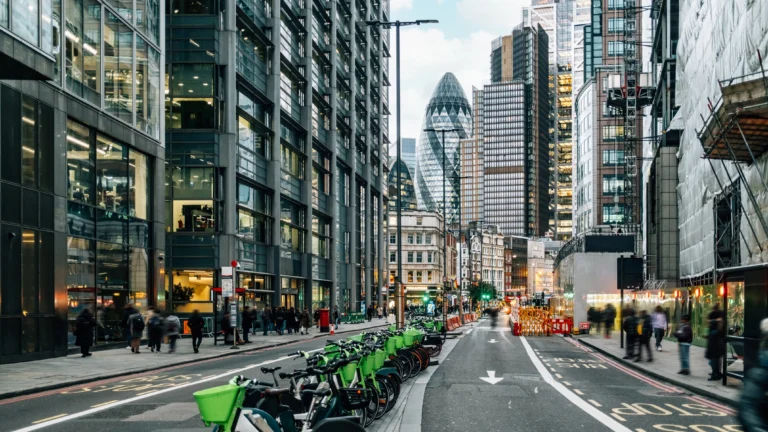
FilippoBacci via Getty Images
Apart from imposed monopolies caused by exclusive operator deals with councils, the dockless e-bike market is naturally competitive
Dockless e-bikes are getting Londoners cycling at no cost to the taxpayer. So why is the Government planning to cap them?
Cycling is the fastest-growing major mode of transport in London, up by 43% since 2019. This is good news for the Mayor’s Transport Strategy, which set a target for 80% of all trips in London to be made by walking, cycling or public transport by 2041. In 2025, we are at 63.5%. While walking and public transport have still not recovered to pre-pandemic levels, cycling has grown from 3.6% of all trips in 2019 to 4.7% in 2024. Out of this category’s growth, dockless e-bikes account for up to half. Considering that cycling is the only transport experiencing overall growth, any changes to cycling policy should be mindful not to discourage ridership.
Dockless e-bikes actively encourage ridership among people who would otherwise choose not to. A report by CoMoUK found that 61% of dockless e-bike riders cycle more than before and 47% were cycling for the first time in at least a year, or for the first time ever. They also support the goal to reduce car journeys, with 19% of dockless e-bike trips replacing a car trip.
It is fairly self-explanatory why many people who would not have cycled otherwise prefer electric bikes; they are much less effort to ride
It is baffling then that the ongoing consultation proposes a fleet cap in every licence, lets licensing authorities limit the number of operators, and sets no limit on the fees either TfL or councils can charge, yet does nothing to guarantee parking infrastructure that would address obstructions.
Some point to the public-sector competitor, TfL’s Santander Bikes, as an example of a bike hire scheme that causes fewer problems, since all rides end in a fixed docking point. The hire scheme launched as Barclays Cycle Hire in 2010, opening with 5,000 bikes and 315 docking stations covering Zone 1. The then mayor Boris Johnson’s ambition was for the bikes to become ‘as common as black cabs and red buses’.
Yet Santander bikes now make up only 2% of all cycle journeys, while dockless e-bikes account for five times the journeys, even though they are significantly more expensive. Without any subscriptions or deals, the same 30 minutes would cost £3 on a Santander, £9 on a Voi and £10.90 on either Forest or Lime. It is telling that dockless e-bikes are still able to out-compete TfL’s e-bike in ridership, even though they charge upwards of three times as much for the same journeys.
This can be explained by two main things. For one, out of TfL’s fleet of 12,000 bikes, only 2,000 are electric. There are approximately 50,000 dockless e-bikes. This means that electric hires are dwarfed at 0.4% of rides taking place on Santander e-bikes compared to 10% on dockless e-bikes. It is fairly self-explanatory why many people who would not have cycled otherwise prefer electric bikes; they are much less effort to ride. The availability of Santander e-bikes is very low, and finding one on a weekday morning is a rarity. If people want to incorporate e-biking regularly into their transport, they use dockless e-bikes.
Secondly, TfL bikes lack coverage. From the scheme’s inception – where it covered the City of London and eight central boroughs – it has only expanded to three new boroughs in 16 years. The 21 outer boroughs that have no TfL bike hire scheme at all coincidentally have the highest percentage of journeys made by car, standing at 40% compared to 18% in inner London. Encouraging cycling in these boroughs is crucial to hitting the 2041 target.
The reason expansion has ceased is cost. The scheme, while partially offset by a £25 million Barclays and £20 million Santander sponsorship in its first eight years, still cost taxpayers £195m over the same period, or about £3 in subsidy for each journey. To introduce the scheme to a new borough, councils need to invest in a network of docking stations, which creates huge upfront costs. In 2015, TfL estimated bringing the scheme to Greenwich would cost £5m to £6m and £1.2m a year to run, causing the scheme to be shelved.
Greenwich’s deputy leader acknowledged that the ‘dockless bike schemes require less infrastructure’ and ‘are easier to implement at much lower cost’. It is little wonder that the last significant expansion – seven docking stations in Brixton, in 2018, took placethe same year the first dockless e-bikes were introduced. Operators provide hire schemes to boroughs that TfL does not serve, something which cash-strapped councils cannot afford to do.
Free market provision for e-bikes is a great alternative to expanding via public-sector schemes. Dockless e-bikes are uniquely positioned for healthy market competition since operators share infrastructure meaning they compete on service provision. Apart from imposed monopolies caused by exclusive operator deals with councils that exclude competitors, the dockless e-bike market is naturally competitive.
As a loyal Santander rider, I have seen how competition can even improve the publicly run service. For example, the recent update to the Santander hire app this month included a change to the unlocking system – from typing in a code to scanning a QR code – mirroring the system used by dockless e-bikes, cutting unlock times. The addition of e-bikes to its fleet from late 2022 is another significant service improvement, influenced by competitors.
Solutions to frustrations with dockless e-bikes are possible without discouraging riding. A focus on e-bike infrastructure provision and rule enforcement will go a long way.

It will surprise the majority of people that the most important port in the UK for the export and import of goods is Heathrow Airport. By trade value, Heathrow is gateway for a quarter of the nation’s goods trade, worth nearly £300 billion per annum. You would expect as a consequence, how an expanded airport might […]
Britain is pretty good at spending money on infrastructure. In the most recent OECD data, only China spent more on rail infrastructure as a share of GDP. Yet the problem for Britain is that we’re pretty bad at actually building infrastructure for the money that we do spend. The bulk of the money in the […]
When you drive through the potholes and your suspension gives out, or when you sit fuming at temporary traffic lights because of roadworks, it’s for a reason. It’s because the cost to you in delays and disruption doesn’t figure much in the council’s budgeting or the contractors’ work schedules. The familiar ‘I don’t give a […]


