Labour’s energy profit cap would hurt Britain
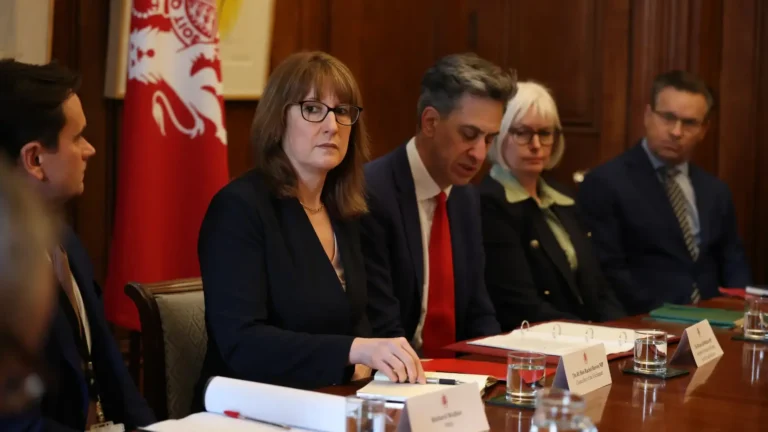
Photo by Dan Kitwood/Getty Images
If the title Baron Walker of Broxton leaves you blank, let me help: Richard Walker is executive chairman of the frozen food retailer Iceland, succeeding his father Sir Malcolm Walker, the company’s founder, in 2023. He was on the Conservative Party’s approved list of parliamentary candidates, then resigned in October 2023 because the party had ‘drifted badly out of touch with business and the economy’. Three months later he announced his support for Labour, and at the end of last year, Keir Starmer nominated him for a peerage.
Last month, the newly ennobled Lord Walker became the Government’s Cost of Living Champion. It is an ‘unpaid voluntary role’, and he will ‘consider how the whole of Government can go further to deliver on its priority of easing the cost of living for families’. Walker brings what he calls ‘real-world business experience and a sense of urgency’.
He is certainly thinking big. Last weekend, he wrote in the Sunday Times about the potential consequences of the conflict in the Middle East. He warned that energy companies should not raise their prices sharply and wrote in almost parodically bullish tones of the Government’s resolute stance.
‘We hauled the petrol retailers and energy producers into Downing Street last week to give them a shot across the bows – a warning that opportunistic rip-offs will not be tolerated. The Competition and Markets Authority was there too, with its newly enhanced power to step in if required… those sectors that have profited from price-gouging against the most vulnerable in society should consider themselves on notice.’
Walker added that he had asked ministers to consider a temporary profit cap on energy ‘to stop producers and retailers exploiting the crisis to make windfall profits at the expense of consumers’.
This is standard, we’re-on-your-side populist fare. Energy companies are sufficiently large and faceless to make easy yet satisfying targets, and there are few votes to be gained in standing up for British Gas, EDF or Total. Nevertheless, Walker was at pains to point out that his suggestion of a temporary cap on profits was very different from the ‘comprehensive, open-ended energy price cap’ which the leader of the Greens, Zack Polanski, had mooted. The economics of that policy, Walker argued, ‘don’t stack up – and could lead to disastrous consequences, such as rationing’.
It is one of those political irregular verbs: my price cap relieves the burden on hard-pressed consumers, your price cap leads to disastrous consequences, his price cap, presumably, is the first step towards a command economy.
By invoking the term ‘profiteering’, Walker has attempted to put a firewall around his argument. After all, no-one is in favour of profiteering. But it raises an issue which has frequently flummoxed and frustrated this Government, the gap between broad-brush, virtuous-sounding rhetoric and the hard yards of practical policy implementation.
Burnishing his business credentials, Walker emphasised that ‘I have no problem with profit. It’s what allows businesses to invest, employ people and pay tax. But I do have a big problem with profiteering, especially when families are under real pressure.’ But this humdrum position of approving of a good thing while opposing a bad thing has to have flesh put on its bones. If energy producers are at liberty to make a profit but must not ‘profiteer’, then, logically, there must be a quantum of profit beyond which it is impermissible to go.
What is that level, how is it calculated and by whom is it determined? It will have to be laid out explicitly, as the Government cannot impose financial penalties on the private sector on the basis of how something feels. ‘Profiteering’ cannot be reduced to knowing it when you see it.
Equally, rising fuel costs have consequential effects across many sectors. Walker believes it must be the energy producers who feel the squeeze of war, not businesses who buy their energy or, Heaven forfend, the consumer. And it is clear we are to dismiss any thought that retailers, let alone supermarkets, could be under pressure. There is no call for a profit cap on fish fingers or Arctic roll.
Walker wants ‘families’ to feel ‘not only a little better off but also that we have a Government that understands their struggles and is doing everything it can to help’. I have never ranked feeling that ministers understand my struggles as a particularly high priority. But the Government is not addressing the underlying fact that Britain already has some of the highest energy costs in the world, nor is it reflecting on the fact that the tax burden is at a historically high level and anticipated to rise for the rest of the decade.
Labour are the party of the well-meaning sticking plaster. It is too difficult to address the fundamental causes of high energy costs, so it will simply tell companies not to make too much money, presumably using statute to enforce its will.
Rachel Reeves, recently gave the Mais Lecture at Bayes Business School. She spoke of the need for an ‘active and strategic state’, though one could alternatively say ‘interventionist’ or ‘dirigiste’. Walker’s suggestion is the embodiment of her thesis. If there is an economic problem, then, despite all the evidence to the contrary, Labour are certain that the man or woman in Whitehall will know best.

The Victorian economist William Stanley Jevons was clearly a worrier. When, in 1863, the Tyneside arms-maker Sir William Armstrong calculated that Britain’s coal would run out in 212 years, Jevons checked the sums. Armstrong had assumed the country’s appetite for coal grew by the same tonnage every year. But it actually grew by the same […]

Margaret Thatcher is back in the news. But it is not her admirers on the Right who have put her there. It is our new Labour Prime Minister, whose diagnosis of our country’s ills seems to be that Britain was on the right path up until 1979, when the Conservatives got into power and precipitated […]
The verdict is clear. The Right has woken up to the innate statism associated with a statutory Net Zero target. Reform UK reject it outright, and the Conservatives have pledged to scrap the 2050 deadline and the 2008 Climate Change Act by which net-zero targets are enforced. Both accept the approach is a millstone around […]