Labour don’t work, and they’re costing us a fortune
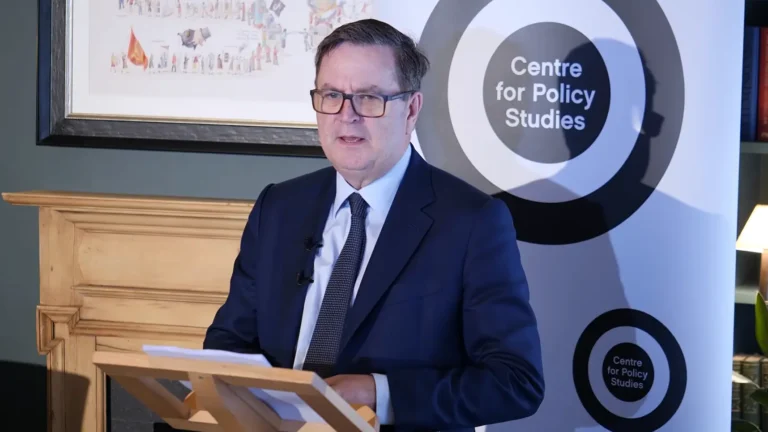
Below is a transcript of a speech delivered by the Shadow Chancellor Sir Mel Stride at an event hosted by the Centre for Policy Studies on May 19, 2026.
.
Today, our country is paying more to borrow than any other major western economy.
The yield on 10-year gilts is now sitting consistently above 5%.
Meanwhile, average yields across the rest of the G7 currently sit at about 3.5%.
That is a very significant premium. It is a damning verdict by markets on the current government.
And it has serious implications for all of us, costing us billions more in debt interest.
The immediate context, of course, is the chaos surrounding the leadership of the Labour Party.
But beyond that, it is about a deeper problem with economic and fiscal policy in our country.
And while politicians frequently complain about reckless borrowing, too often those same politicians have nothing concrete to say as to what they would do about it.
Or worse still, they come out with a list of fanciful and unfunded promises of their own.
That is not responsible.
It is not honest.
And it is not leadership.
Any serious party worthy of governing our country must have a clear answer as to what they are going to do about our rising debt.
I want to make a very clear statement – not just about what has been going wrong, but about my own party’s commitment to putting it right.
The most immediate problem, of course, has been political instability.
Last week, you could literally map the fluctuations in yields against the news reports on the latest resignations or rumours of leadership challenges. On Friday, for example, the market jumped 18 basis points, in response to the news that Josh Simons would be stepping aside for Andy Burnham.
To put that in perspective, if that increase was sustained across the Office for Budget Responsibility’s forecast, it would add nearly £2 billion to annual debt interest spending, and would cost £5.4 billion cumulatively across the five-year forecast. That’s £300 for every working household in this country.
There is now a ‘Burnham premium’ on our borrowing costs.
As we all know, if there is one thing markets dislike, it’s uncertainty.
But this is not just about uncertainty.
It is also about what the political context means for policy.
Markets do not care about personalities – they care about the fundamentals.
And there are two important fundamental factors here.
One is the prospect of a new Prime Minister coming in with a plan to borrow even more and to raise taxes, with no understanding of how markets will react.
There is now a ‘Burnham premium’ on our borrowing costs
On this latter point, Burnham has previously said the Government is too ‘in hock to the bond markets’.
One of his parliamentary backers said the bond market would need to, quote, ‘fall into line’.
He also suggested last month that we should treat defence spending as an exception to the fiscal rules – as if borrowing for defence is somehow different to any other borrowing.
Or you can look at Angela Rayner and the litany of tax rises she wants to bring in.
And even Wes Streeting, positioned as being more moderate, with his past comments on significantly increasing capital gains tax.
Investors are rational. If they see leadership hopefuls queuing up to borrow more or mismanage the economy, then they price that in.
The other factor is what the Prime Minister’s weakness means for the policy direction of the existing Government.
Even if Keir Starmer struggles on, it’s very plain that his Government is in hock not to the bond markets, but to his own backbenchers.
Policy is being dictated by those who are addicted to tax and spend, with no appreciation of the trade-offs or any capacity to take the difficult decisions that are sometimes needed.
And we see the consequences. Last week, the Prime Minister delivered a reset speech – which seems to have become a monthly fixture these days – in which he pledged to nationalise steel. A direct sop to the Left of his party.
The King’s Speech contained no measures to control the ballooning welfare bill, because there is no prospect of reforms making it past those who sit behind him.
This is a government unable to take tough decisions and increasingly compelled to lurch to the Left – a recipe for more borrowing, more taxes and higher inflation.
Again, investors are rational. The market can see what is happening, and they price it in.
So, it is not just the prospect of a change of leadership which is driving up gilt yields, it’s what the attendant pressures are imposing on current policy.
But beyond the recent chaos in Downing Street, there are other, deeper factors at play.
You see, even before the ‘King of the North’ started appearing in every other line of the newsfeed, we already had the highest gilt yields in the G7.
Higher indeed than Portugal, Spain, Greece and Morocco.
In fact, the highest of any major Western economy.
There are a whole host of factors behind the longevity of higher yields.
And chief among them is a persistently high level of government borrowing.
Rachel Reeves likes to talk of stability and her ironclad fiscal rules. When she came into office she made great play of a £22bn black hole in the finances – a black hole that the OBR refused to legitimise when they examined the evidence – ironically at her own behest.
And you might remember her rather performative statement in parliament when she repeated over and over the phrase: ‘if we cannot afford it, we cannot do it.’
Well, looking back, that all looks like some sick joke.
Because what she actually did was to go back on her word, change her fiscal rules to allow more borrowing, and then maxed out the credit card.
When Labour took office in 2024, the deficit in that fiscal year was forecast to be £87bn.
Where did the deficit that year end up? £152bn.
This was 75% higher than the plans Labour inherited.
And what about the last fiscal year?
Same again.
While Reeves boasted that the deficit had come down, it was once again around 75% higher than the plans she inherited. And is not the point here that bringing a number down is no achievement if you massively increased it in the first place.
In fact, in total, across this parliament, if you compare the current OBR forecasts to the last forecast before the general election, the additional borrowing adds up to more than a quarter of a trillion pounds.
A quarter of a trillion pounds of extra borrowing in a single parliament.
And of course, even those numbers assume that the Chancellor can deliver significant spending restraint in the runup to the next general election. I will leave you to make up your own minds as to whether that is in any way credible given the current mood in the Parliamentary Labour Party. The gilt traders have certainly made up theirs.
This high borrowing means issuing more and more gilts into a market which has already taken on huge stocks of public debt due to the pandemic.
And there are other factors contributing to historically high gilt sales, including refinancing of our growing stock of debt, and the steady sell-off of gilts by the Bank of England through quantitative tightening.
Gilt issuance last year was around £300bn. And according to the OBR, over their current five-year forecast, private sector holdings of gilts will expand around twice as fast as over the last two decades or so – increasing by around 5% of GDP per year on average.
In this context, the Government should urgently start to bring down the debt to GDP ratio – but Starmer and Reeves have done the opposite. Public sector net debt excluding the Bank of England is set to rise every year of this parliament.
This is simple supply and demand. Issue more gilts and you will depress the price – and push up the yield.
There is another significant actor in all this – inflation. Our cost of borrowing is of course significantly influenced by that.
And in countries like France, for example – which have similar levels of deficit and debt to us – the difference in the rate of inflation is part of the reason why they have much lower borrowing costs.
Not only does inflation impact conventional gilts by influencing interest rate expectations, but we are also uniquely reliant on index-linked gilts, which make up a quarter of our debt stock. That is around twice the proportion for the next highest G7 country.
And that is a problem. Because in the UK, we are an outlier on inflation.
We had the highest inflation in the G7 last year.
That has meant our interest rates staying higher for longer, which in turn impacts market interest rates including for government debt.
And now that we have a fresh energy crisis, the risk is we see even stickier inflation as higher expectations start to become embedded.
Now, government policies have contributed to that higher inflation.
The tax rises which came in last year, especially on National Insurance, not only depressed wages, increased unemployment, depressed investment but were also, in part, passed on to consumers through higher prices.
And higher borrowing is of course inflationary too.
So not only has inflation eaten away at the living standards of ordinary families, it has also added to the premium we are paying on our borrowing costs.
And the story of inflation goes deeper than that. Because the UK is also, in a number of crucial areas, supply constrained.
Whether it is in housing, energy, the burdensome regulations we pile on our businesses, our unusually high minimum wage rates or the fact we cannot build infrastructure on time or on budget – all of that makes things more expensive.
Again, this is not something being done to us by events – these are the results of policy decisions.
So while fiscal discipline has to be the foundation – I don’t for a moment pretend that slashing the deficit will be enough to bring our borrowing costs tumbling back into line with our peers.
No, we will also need a radical and comprehensive supply-side agenda – an agenda which brings down input costs and eases inflationary pressures in our economy.
That is why on energy, for example, my party has been making the case for abolishing carbon taxes, taking green subsidies off bills and opening up new oil and gas extraction in the North Sea.
And of course, supply side reform will also be vital for delivering sustained increases in our rates of growth, which in turn will help to shrink our debt as a proportion of the economy.
If that is a credible prospect to markets? Well, they will reward us with lower borrowing costs.
And why would that be such a glittering prize to seek? Why should we care so much about the gilt market?
Because we are spending vast sums every single year just to service our debt. Far more than was the case until relatively recently.
Before the pandemic, we were spending less than 2% of GDP on debt interest – but with higher interest rates and higher debts, that has now roughly doubled.
We spent well over £100bn on debt interest last year – nearly twice the entire defence budget. And the bill is set to rise to £135bn by the end of this parliament.
That’s money being poured down the drain, meaning we have less space to fund other priorities or to cut taxes.
In that context, even small fluctuations in rates can be worth billions.
Indeed, according to the OBR, if gilt yields and interest rates were a percentage point higher across their forecast, it would add another £15bn to the annual interest bill.
That’s about 2p on the basic rate of tax.
So the current costs are already staggering and the risks if things get worse don’t even bear thinking about.
Now of course, one obvious charge that might be levelled at me is that the debt burden rose under the Conservatives.
That is true. But as ever, context is important.
In 2010, we inherited a situation where for every £4 the government spent, £1 was being borrowed.
Despite that, we managed to deliver a falling debt ratio by the end of our first parliament.
And a few years after that, we achieved a current budget surplus – in other words, we were only borrowing to invest.
Let’s be clear – these were not just forecasts, not the Augustinian rolling fiscal targets that never actually get met. That was the actual state of the finances.
And it was, incidentally, achieved almost entirely by reducing expenditure rather than increasing the tax burden.
But then came the pandemic. And because we had done that work – because we fixed the roof – we were in a position to provide unprecedented levels of support for households, businesses and the health service.
Our opponents conveniently forget those facts when they quote our record on the public finances. They forget there was a little thing called a global pandemic – and that they spent those years calling for even higher spending.
We do have elevated levels of debt now – it’s true.
But the responsible thing to do in response to that fact should be to urgently bring down borrowing and reduce our exposure to high interest rates.
Instead, Labour came in and added a quarter of a trillion to borrowing this parliament, pushed up inflation and sent our borrowing costs sky-ward.
This situation is increasingly unsustainable – and with the current political chaos it is getting worse.
That is why we in the Conservative Party have made such a firm statement on fiscal responsibility through our Golden Economic Rule.
Now that rule sets us apart from any other party.
Because it is not enough to just complain about the Government borrowing too much. If you want to be a serious party of government, you need a credible plan to do something about it.
Reform UK like to attack Labour’s profligacy – but they don’t put any substance behind their words.
Reform repeatedly come out with unfunded promises or policies which they claim are fully costed but for which the numbers simply don’t add up.
But even if they did add up – which they don’t – they would still not be doing anything about the debt and the borrowing.
If you think the deficit is too high, you should be committing a significant proportion of any savings from public spending to reducing that deficit – not just blowing it all on propping up underfunded commitments.
So that is what our Golden Rule is all about. The Rule states that for every pound of savings we identify, at least half will go towards deficit reduction.
So at our conference last year, I announced a £47bn package of savings, including £23bn from welfare, and more than half of that sum is earmarked for getting borrowing down, with the remainder available for other announcements we made on pro-growth policies like abolishing Stamp Duty on homes, taking high street businesses out of business rates and providing a tax break for young people.
Now just consider that Golden Rule for a moment and what a significant commitment that is for an opposition party to make.
Consider what it means when we are considering any major policy announcement.
Each time we have to contend with the fact that anything that comes with a price tag will not only need an offsetting saving somewhere else, it will need a saving of at least double what the policy itself costs.
It is a genuinely tough and binding commitment.
It’s about being honest about the problems we face as a country and demonstrating our commitment to addressing them.
And sadly, we are a lonely voice on this.
We have a Labour Government that has ramped up borrowing and leadership rivals who think the answer is to borrow even more.
Not to mention a Reform Party who think the answer is to carp from the sidelines about the deficit while simultaneously announcing unfunded policies that would only make it worse. A position of complete dishonesty.
Kemi Badenoch and I are very clear about what we are offering as a party and a future government.
We will be honest about the problems we face and the tough decisions that need to be taken to fix them.
Because that is what leadership is about.
The current Government is on its knees. It may not be long for this world.
And that predicament can in large part be traced back to before Labour came to office. Because in opposition, they failed to develop a serious plan for government.
They deliberately said little of substance as they tiptoed with that ming vase across that shiny floor. They pretended they would be able to deliver all they had promised without putting up taxes or borrowing more money.
That was irresponsible. That was a deceit. And we in the Conservative Party will never make that mistake.
We will be honest and up-front with people. We can’t afford the nice stuff – like tax cuts – unless we also make sure we are balancing the books. That is the beating heart of our Golden Rule.
And that doesn’t just mean cutting a few billion from the deficit, and it doesn’t just mean stabilising debt levels.
It means delivering sustained reductions in the debt burden and in our debt servicing costs.
And over time, the dividends from that will be immense.
Because getting debt off our back is central to the vision of a brighter future for our country.
But with every passing day, that future now recedes before us – as debts pile up – as efforts dissipate, as the future of our children is traded away.
We must be honest about the magnitude of the challenge we face. Honest about the sacrifices required to meet it.
We are the only party that truly understands that.


The Manchester City scandal drags on. Tax Policy Associates now argues, based on the Premier League commission’s findings and leaked documents, that the club may have failed to pay some £12 million in income tax and NICs due on the pay of Roberto Mancini, who managed the club from 2009 to 2013. City, which denies […]

Britain is looking for the effects of artificial intelligence in all the obvious places: redundancies, vacancies and unemployment numbers. So far, there is little evidence of dramatic change in overall headcount. The Office for National Statistics reports that most British businesses using AI have not changed the size of their workforce, even as AI adoption […]
Andy Burnham used the Labour Party conference in Liverpool this week to commit the Government to a National Care Service, universal and free at the point of use, while promising to ‘stick to our fiscal rules to get borrowing and debt down’. The service is due in the next Parliament and is supposed to be […]