Wes Streeting is proof of how shameless politics has become
Leon Neal/Getty Images
A confession: I have never read Karl Marx’s ‘The Eighteenth Brumaire of Louis Bonaparte’. I don’t have a noble excuse for not having done so, just bone idleness. Nonetheless, I have Wikipedia, a penchant for clichés and a horror at the evolving Labour leadership race. If the fall of Boris Johnson was a tragedy for his party, the fall of Keir Starmer is a farce starring his.
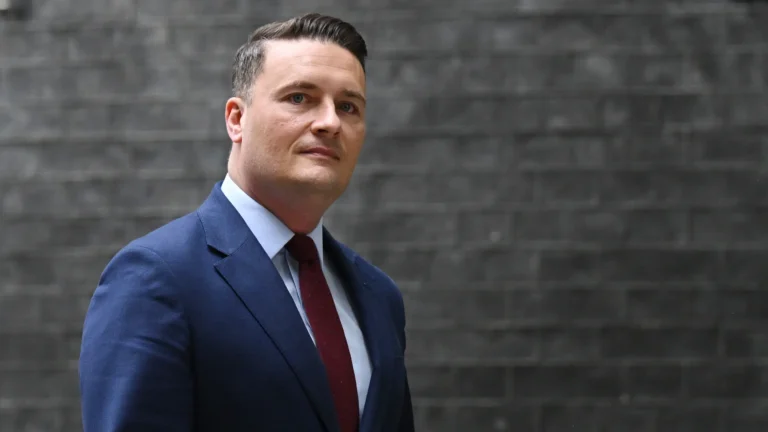
At one point this morning, it looked like Wes Streeting had bottled it. Reportedly struggling to get the 80 supporters needed to launch a challenge to Keir Starmer, confronted by LabourList polling that suggested he would lose handily, the Health Secretary seemed frozen. Yesterday’s upstaging of the King’s Speech – 16-minute meetings, Kemi Badenoch putdowns, conspicuous media silence – all seemed for nought.
But the Grand Young Duke of Ilford North had marched up the hill; it was impossible to march down it again. His resignation letter is a classic of the genre. While not openly launching a leadership challenge – merely calling for the ‘best possible field of candidates’ to stick it to Starmer – it hit the right notes to tickle the bellies of unhappy Labour MPs.
Cuts to the Winter Fuel Allowance and the hated ‘island of strangers’ speech were namechecked; the Prime Minister’s habit of throwing colleagues under the bus for his failures was lambasted; Streeting’s own leadership of the NHS lauded, with various groovy statistics about ambulance response times and waiting lists; the ‘dangerous English nationalism’ of Reform UK condemned, despite the party coming second in Wales and Scotland; and a not-in-anger-but-in-sorrow suggestion this was all an unfortunate calamity. Pull the other one, Wes.
One reason why Streeting is so despised by his party members is that he has clearly wanted to be Prime Minister since he was in teens, and has plotted his entire career – Cambridge, National Union of Students, once-safe-seat, leadership challenge – accordingly. I can’t complain, I’ve done the same. But Streeting’s problem is that there is little else to him, despite attempts to give him a backstory or vision.
He’s too slick, too soulless, too smarmy. Starmer might be a hopeless dud. But he doesn’t make activists’ skins crawl. Nonetheless, Streeting deserves credit for going over the top. Like Margaret Thatcher in 1975, he might be hoping to have his boldness rewarded. But he has instead blown the doors open for rival candidates more amenable to the party selectorate.
Undoubtedly, if Andy Burnham had made it back to the Commons via Gorton and Denton, he’d be in the best position to challenge Starmer. But he remains in his Mancunian quasi-exile. He has benefited from being half a country away, allowing to be projected onto his trademark combination of jumpers, bond market mockery and municipal bus painting a heft and popularity it lacks. But as much as he condemns Westminster, Burnham wishes he was here, not Manchester. Like Streeting, he is a lifelong politico; the top job is all.
The man who presided over Mid Staffs, who lost to both Ed Miliband and Jeremy Corbyn, would finally find in Starmer a challenger he could overcome. But finding a seat and running in a by-election would not only take weeks and months he may not have but is fraught with risk. The Greens and Reform would chuck everything they had at it; he could win, only for Labour to lose his mayoralty in a vote after his elevation.
If a contest kicks off sooner rather than later, the advantage accrues to those candidates who are MPs and thus able to stand. Angela Rayner, liberated from her travails with HMRC, is an obvious choice. When she resigned as Deputy Prime Minister, I predicted that she would be back. She remains popular with Labour members; her time out of the Cabinet is an advantage for those disillusioned with this government. But Rayner appears to be losing momentum, as questions over her competency and personal vagaries abound.
Instead, Starmer’s leading challenger is an all-too-familiar figure: Ed Miliband. The man who lead Labour to defeat in 2015 and whose name has become synonymous with Net Zero zealotry is the minister best placed to win over both Labour members and MPs. The heady days of Milifandom are over, yet Miliband remains the most experienced, the most clear-sighted and most popular Cabinet member willing to run. In Labour’s weird world, he is the biggest beast.
Nigel Farage and Kemi Badenoch will be licking their lips at the prospect of a Prime Minister who voters rejected a decade ago and who has made it his life’s mission to see their energy bills soaring. But Miliband is no fool. His objective would not be to win back voters lost to Reform or the Tories, but to target the Greens and Liberal Democrats, hoping to achieve a hung parliament that Labour would dominate. A coalition of chaos, as someone once put it.
Unlike Starmer, Miliband is at least in politics to do something, rather than just to be someone. He would be returning to his party’s leadership to block Streeting, but it would provide a springboard for his ambitions. He could do an awful lot of damage with three or so years in Number 10 – far more than Starmer’s bumbling could.
A large part of me wants Starmer to stay on. It would be both the best outcome for my bank balance, and the funniest. But it would also be a rebuke to our wider political culture. I have no doubt that Starmer has been promoted far beyond his abilities. But we have become too addicted to chopping and changing leaders.
Long-term thinking has fallen by the wayside in favour of continual chaos. It began under the Conservatives, but it has metastasised into a permanent state of affairs, an addiction to drama, to scandal, to crisis that we just can’t seem to shake. I don’t feel any happiness that it is Labour now suffering, instead of the Tories. Only sadness for this unlucky and unhappy country, stuck in this tedious rodeo.
Even before he became Prime Minister in July, Andy Burnham had talked about the country in institutional, positively mechanical ways. He promised to ‘give Britain the circuit-breaker it needs’, and said that his Number 10 North, part of the Office for the Prime Minister and Cabinet based – where else? – in Manchester, would be […]
The Manchester City scandal drags on. Tax Policy Associates now argues, based on the Premier League commission’s findings and leaked documents, that the club may have failed to pay some £12 million in income tax and NICs due on the pay of Roberto Mancini, who managed the club from 2009 to 2013. City, which denies […]

Britain is looking for the effects of artificial intelligence in all the obvious places: redundancies, vacancies and unemployment numbers. So far, there is little evidence of dramatic change in overall headcount. The Office for National Statistics reports that most British businesses using AI have not changed the size of their workforce, even as AI adoption […]