How to make gas storage competitive again
Leon Neal/Getty Images
The UK only has 13 days worth of natural gas storage capacity, and it’s about to be cut in half. Britain needs gas storage now, and it will need it as North Sea extraction declines. Otherwise, we’re badly exposed to another energy crisis.
Centrica has seemingly given us an easy out by offering to regenerate Rough, our largest gas storage site. But the price is a 45-year deal that leaves us worse off in the long term, whether gas demand rises or falls.
The anxiety about gas is real. We can channel that anxiety productively, instead of grasping for the first option presented. We don’t need to take Centrica’s 45-year commitment
Instead of signing Centrica’s deal, the Government should support Rough for five years, then require gas suppliers to hold a set number of days of storage, letting them compete for where they buy it.
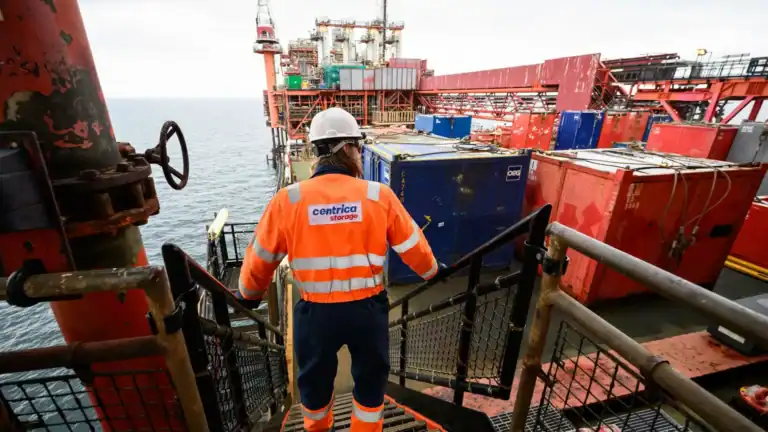
Rough, which provides half of UK gas storage capacity, is at its cliff edge. Its storage will be almost empty by winter, and its production and storage consent expires in April 2027. Centrica, its owner, says it will have to invest £2 billion to dig 16 new wells, construct pipelines and create a new platform to prevent facility decline. Rough could then store gas for 45 more years, and transition into clean hydrogen storage when needed.
According to Centrica, this whole scheme can only happen with a government deal. This is because the summer-winter gas price difference that used to fund storage sites has collapsed, tanking profitability. Under Centrica’s proposed model, electricity generators and regular households would guarantee a minimum price for Centrica’s stored gas and receive extra revenue back if gas prices spiked.
It looks tempting, as the case for gas storage is strong and getting stronger in the next decade. The National Energy System Operator found that without Rough and extra governmental intervention, a 1-in-20 cold day could leave the system without enough gas, affecting the 80% of households that still use it for heating. Imported liquefied natural gas could fill the gaps, but in a Europe-wide crisis UK households would pay exorbitant prices to outbid other buyers. As our own North Sea production falls, we’ll be even more exposed to price fluctuations in imported gas in the near future. We need UK gas storage now, so we can buy gas when it’s cheap and insulate ourselves from price rises.
Keeping Rough makes sense, but not on a 45-year deal. It doesn’t matter if gas demand drops or rises in the longer term, because in each scenario the country loses.
Take the first scenario: gas demand drops in the long term. Governments have been predicting this for decades. Consumption is already down 40% over 20 years, and the Department for Energy Security and Net Zero (DESNZ) expects another 40–75% fall by 2050. In that case, British households spend decades paying for an asset that we barely use. Even if Rough is converted to hydrogen storage, we’d still barely use it because it can hold only a quarter of its gas energy potential as hydrogen.
A second scenario, that gas demand rises, is also entirely plausible. Heat pump installations are lagging behind government targets, and both Reform UK and the Conservatives have committed to either scrapping or at least extending the timeline to Net Zero. If they manage to reduce energy costs as a result, industrial gas demand could soar, and so would the need for gas storage. In this scenario, we’ve handed Centrica a guaranteed revenue floor, allowing them to offer storage below cost. The other seven storage facilities will find it difficult to compete, pushing them to exit the market. In the long term, this could lead to less gas storage exactly when we need it most.
No plausible future makes the 45-year deal make sense. Still, we can’t ignore the fact that Centrica is very willing to shut Rough down if it doesn’t get some sort of support.
To prevent Rough’s immediate closure, we need a five-year supporting bridge. Under this deal, Centrica would fund gas injection. The Government would pay a fee to cover Rough’s operating costs, and agree upfront what it will pay for the gas. Then gas withdrawal would happen automatically when prices rise higher than a threshold. Rough has historically run a loss of up to £100 million per year, with wide fluctuations. If it was supported by all gas users in proportion with their consumption, the bridge would cost each household an estimated average of £1.60 per year added to their gas bill across the five years. The 45-year deal, on the other hand, is impossible to cost-estimate; because obligated consumer payments rely on future prices of gas, the deal is essentially a gamble.
This transition period would allow the Government to phase in obligations for gas suppliers to hold a set number of days of gas supply. Most suppliers don’t actually own storage facilities, so they would have to rent space in one of Britain’s eight storage sites. Competitive bidding would help improve efficiency and keep costs low. This system could actually keep Rough alive without subsidies as well. All Centrica would have to do is recruit private investment for their renovation and stay competitive with the seven other sites. These obligations would have to be phased in over time to encourage gas storage construction without spiking the price of existing storage.
This type of storage obligation is not unprecedented. Britain already has an oil storage obligation, and DESNZ already floated a similar strategy for gas. The EU has also run mandated gas storage targets since 2022, which it has recently loosened.
This shows that the obligations can be flexible. The mandated number of days of gas supply could be changed by a minister. If nuclear delivers on time, or liquefied natural gas prices plummet, we can decrease the mandate in line. If the costs balloon, the obligation can be unilaterally ended by the Government, unlike a Centrica deal, where the contract would be binding.
The anxiety about gas is real. We can channel that anxiety productively, instead of grasping for the first option presented. We don’t need to take Centrica’s 45-year commitment. Instead, we can buy time, and legislate our way to a freer and more flexible gas storage market. Our energy security will be built on our own terms instead of Centrica’s.


Nobody ever built a wind farm with wind. An energy transition is always a project that uses its current energy source to build its replacement while keeping everyone fed and warm. Every turbine, panel, pylon and battery is made, moved, installed and replaced with the help of cheap oil. The question under the plan for […]

A century ago you had to be rich to get any kind of choice over your clothes. And if you weren’t in the upper echelons of society you could forget going on a foreign holiday. Today, mass production ensures there is an abundance of clothes to choose from at all budgets, and cheap flights have […]
It’s not often that a Labour announcement reminds you of music. Reading Andy Burnham’s confirmation of his commitment to Net Zero in the Guardian last week, I couldn’t help but think of The Who’s 1971 epic rocker ‘Won’t Get Fooled Again’. Within it are the lyrics: ‘And the world looks just the same, And history […]