A year ago I ended the Growth Commission’s annual Growth Budget with the prediction that if the then Chancellor Rachel Reeves continued with her policy of tax and spend, she – or more likely her successor – would be back in a year’s time asking for more.
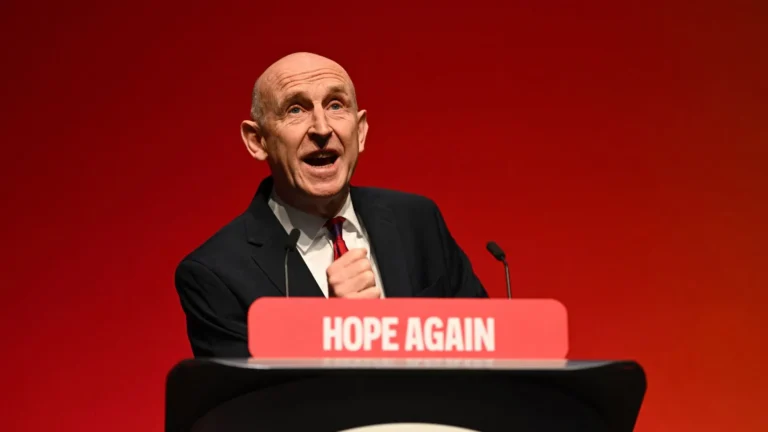
So the Government can’t say that they weren’t warned. And Rachel Reeves’s successor John Healey made it clear in his speech to the Labour Party conference on Monday that he is planning to come back for more.
Lower prices, lower taxes and higher incomes are what we need after so many years of higher taxes, high inflation and squeezed incomes
How do we get out of the mess of tax rises failing to raise the amount of money predicted, government spending running out of control and Chancellors coming back every year to raise taxes further?
Meanwhile the economy remains in the doldrums with only the tech sector (which is now at risk from an EU ‘reset’) providing any growth of note. Production in agriculture and construction has fallen over the past year, and manufacturing output is essentially flat, having risen by only 0.2% in the past two years. Output in pubs and restaurants is running below its level of two years ago; while over the past four years, output in financial services, long the powerhouse of the economy, has dropped by 8%. The Lahore Kebab House, for 50 years an East End institution that was the mainstay of bond traders after a hard day’s trading, shut its doors for the last time last week, reflecting the malaise in both finance and hospitality.
This is why The Growth Commission, of which I am a member, puts forward each year a Growth Budget setting out policies with a track record throughout the world of working to revive economies.
This year’s offering shows that what is required really is quite simple if you are not blinded by ideology: bring public spending under control; cut taxes, starting with those that lose money; and get rid of unnecessary red tape.
Public spending on central government headcount continues to rise – the savings made in local government show that public spending can be controlled, and it should be too in central government and especially the Civil Service. Public sector pay is rising twice as fast as in the private sector. In 2024, median pay in the public sector was 10% higher than in the private sector. Now the gap is 17%. Pay in the public sector needs to be frozen until it returns to its traditional relationship. Welfare also needs to be brought under control, bearing in mind that spending on health-related benefits alone surged from £38 billion in 2019-20 to £57 billion in 2024-25 (in today’s prices).
Taxes need to be cut – but this will not always reduce revenue. We have identified five taxes that cost the Chancellor revenue over the long term – capital gains tax on entrepreneurs, inheritance tax, corporation tax on retained earnings, stamp duty on property sales and the post-2024 system of taxing the so-called ‘non-doms’. Abolishing them would cost some money (paid for from public spending savings) in the short term, but over the longer term these taxes both damage the economy and reduce Treasury revenue. They should all be scrapped.
In addition we need to sort out the anomalies in the tax system that hit those earning just over the thresholds at which allowances are withdrawn. We also need to reform the student loan repayment scheme to sharpen the incentives to earn more, especially when the graduate premium is already falling. And finally on tax, with fuel prices rising, now is not the time to be putting up fuel duty as planned, while – as so many other countries have shown – tax-free shopping for tourists is a no-brainer.
While tax improvements are necessary, they are not enough to transform the UK fully.
We also need to protect our tech sector, first by not allowing any EU ‘reset’ to damage it – the EU’s own tech sector is struggling under heavy regulation. And looking ahead, we need any AI regulation to help the industry thrive, not slow it down.
We must sort out the mess that is the planning system, made all the worse by anti-landlord taxation and legislation. We need to free up the labour market from trade union-inspired and one-sided rules in the Employment Rights Act. We need to go for Smart Net Zero, because a botched energy policy has left us with energy costs that are much higher than our main competitors, most of whom are managing to cope with Net Zero targets at much lower cost.
We in the Growth Commission have correctly predicted the failure of tax and spend. We have used the same models to predict what would happen if our policies were implemented – nearly 38% more GDP in 20 years, providing every person in the country with an additional £16,630 in today’s money. The UK would return to being the fourth largest economy in the world, overtaking Japan and Germany. The deficit would fall, spending on defence and infrastructure should grow and taxes for everyone would fall as well.
Most importantly, the gains would be greatest for poorer people. They would not only benefit from higher incomes and potentially lower taxes, but our proposed EU ‘reset’ would hold down food prices while our plans for the housing and energy sectors will reduce rents and utility bills respectively.
Stay informed with our free daily briefing.
Lower prices, lower taxes and higher incomes are what we need after so many years of higher taxes, high inflation and squeezed incomes.
And the gain for the new Chancellor is that if he gets the economy going again, the markets won’t force him either to come back for more or to emulate his namesake from the 1970s and go cap in hand to the IMF.
To read the the 2026 Growth Budget in full click here.
Douglas McWilliams is a member of The Growth Commission and co-author of 'Prosperity Through Growth: Boosting Living Standards in an Age of Autocracy and AI'.
More Growth
Popular
29 Sep 2026
Economics
Mani Basharzad
Labour’s favourite economist has growth backwards
Why haven’t we grown in the last decade? We are experiencing the longest spell of workers experiencing no average wage growth in real terms for well over a century – ‘the longest in history since consistent wage records exist, dating back to Victorian times,’ as a paper in the Oxford Review of Economic Policy shows. […]
Popular
28 Sep 2026
Nimby Watch
James Ball
Nimbys: no skyscrapers anywhere – even Vauxhall
This week, Nimby Watch is in Vauxhall, where people are up in arms about a proposed new high-rise… Alright then, Vauxhall. According to my notes, we’re in a nondescript, marshy village near London, named for Faulke’s (or Fox’s) Hall, though not really known by that until the Pleasure Gardens opened in 1740. I mean, you’re […]
25 Sep 2026
Economics
James Mackenzie Smith
Britain’s safety-first state is smothering growth
For most of the post-war period, each generation in Britain could reasonably expect to be materially better off than the last. Since the financial crisis, that has changed. Productivity growth has been exceptionally weak and improvements in living standards have stagnated. This was the starting point for ‘Boosting Britain: A blueprint for radical financial and […]
Manage Consent
To provide the best experiences, we use technologies like cookies to store and/or access device information. Consenting to these technologies will allow us to process data such as browsing behavior or unique IDs on this site. Not consenting or withdrawing consent, may adversely affect certain features and functions.
Functional Always active
The technical storage or access is strictly necessary for the legitimate purpose of enabling the use of a specific service explicitly requested by the subscriber or user, or for the sole purpose of carrying out the transmission of a communication over an electronic communications network.
Preferences
The technical storage or access is necessary for the legitimate purpose of storing preferences that are not requested by the subscriber or user.
Statistics
The technical storage or access that is used exclusively for statistical purposes.The technical storage or access that is used exclusively for anonymous statistical purposes. Without a subpoena, voluntary compliance on the part of your Internet Service Provider, or additional records from a third party, information stored or retrieved for this purpose alone cannot usually be used to identify you.
Marketing
The technical storage or access is required to create user profiles to send advertising, or to track the user on a website or across several websites for similar marketing purposes.
To provide the best experiences, we use technologies like cookies to store and/or access device information. Consenting to these technologies will allow us to process data such as browsing behavior or unique IDs on this site. Not consenting or withdrawing consent, may adversely affect certain features and functions.
Functional Always active
The technical storage or access is strictly necessary for the legitimate purpose of enabling the use of a specific service explicitly requested by the subscriber or user, or for the sole purpose of carrying out the transmission of a communication over an electronic communications network.
Preferences
The technical storage or access is necessary for the legitimate purpose of storing preferences that are not requested by the subscriber or user.
Statistics
The technical storage or access that is used exclusively for statistical purposes.The technical storage or access that is used exclusively for anonymous statistical purposes. Without a subpoena, voluntary compliance on the part of your Internet Service Provider, or additional records from a third party, information stored or retrieved for this purpose alone cannot usually be used to identify you.
Marketing
The technical storage or access is required to create user profiles to send advertising, or to track the user on a website or across several websites for similar marketing purposes.