One doesn’t like to be a disappointment to one’s parents. But in (at least) one crucial regard, I’ve let my dad down. He is a steam train enthusiast, and I’ve never shown a blind bit of interest. So it was more with filial duty than pleasure that I took the old man to the Didcot Railway Centre to see working steam trains and learn about the history of these machines.
I don’t know if there is a railroad to Damascus, but I was nevertheless converted. I came to appreciate, for the first time, these engineering marvels, and the revolution they spurred. The beauty of them, too.
Instead of being afraid of technological progress, imagine if Britain embraced it
It made me think about how difficult such an explosive technological success would be today, with our thicket of regulations and special interest groups. You would never be able to lay enough infrastructure for the next technological revolution.
Then again, in 1865, Parliament decreed that any motor carriage on the roads of Britain must travel no faster than four miles per hour in the country, and two in town. They also had to be crewed by three men, one of whom walked 60 yards ahead carrying a red flag.
Picture him, trudging through the drizzle and mud, warning the Queen’s subjects of the future creeping up behind him.
This remained the law of England for three decades, while Daimler and Benz tinkered away in Germany. The country that stood ready to birth the motoring revolution legislated it down, literally, to walking pace.
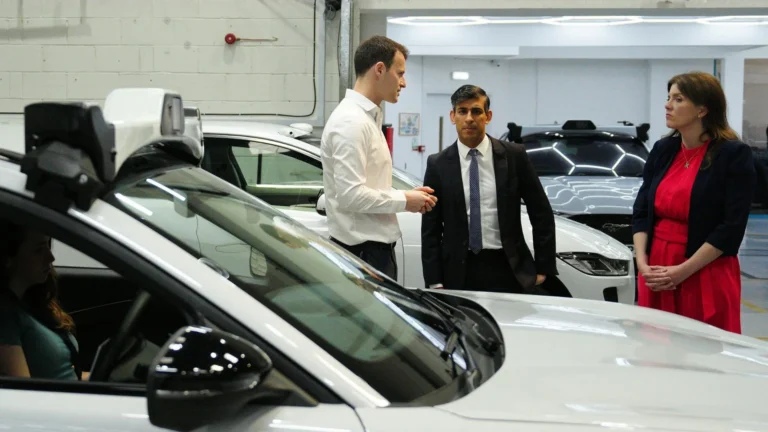
Perhaps we have learned our lessons. Last week, Transport for London granted licences to Uber and the British AI firm Wayve to carry paying passengers in robotaxis. More than 100,000 Londoners joined the waiting list in eight weeks.
In February, I wrote in these pages that London hosting Wayve’s tests proved that the relevant regulatory regime, so often a CapX villain, was quietly becoming one of Britain’s genuine competitive advantages.
At the risk of tempting fate, I thought the critics would be wrong. Six months on, I get to be smug. A British company, founded at a British university, will carry passengers through the capital before Google’s cars arrive.
Ok, so those cars will have to carry a safety supervisor, hands hovering above the wheel, ready to intervene. Whereas, across the Atlantic, ‘driverless’ really does mean driverless. Waymo, Google’s sister company, runs fully autonomous cars across a dozen American cities, providing roughly half a million paid rides every week and aiming for a million by the end of the year.
The company says its cars have achieved a 94% reduction in serious injury crashes across 220 million autonomous miles. There is still, clearly, some way to go before we can start to reap the benefits of this incredible new technology in Britain.
I suppose a supervised phase is more defensible when introducing robots to a Roman city than an American gridded metropolis, even if it’s still pretty weak. But we are behind where we could be. The Automated Vehicles Act 2024, passed under Rishi Sunak, was meant to be operational from 2026. Under Labour, full implementation slipped to late 2027.
Regardless, unlike in the late 19th century, there is no European competitor that comes close to the British success story that is Wayve. Other than our cousins across the pond, the only rivals to us are companies that are (literally) vehicles of the Chinese Communist Party. There are perfectly good national security grounds to ban these vehicles from ever being allowed to operate autonomously on Western streets.
That leaves our own regulatory regime as the only barrier to Britain seizing a leading role in a potentially enormous new industry. Well, that and the political will to push this through against the squawking of trade unions.
Stay informed with our free daily briefing.
Red flag laws were finally scrapped in 1896. The motorists of Britain tore up a red flag in Hyde Park and raced to Brighton in a glory of speed and ecstasy (of, umm, eight miles an hour).
But instead of being afraid of technological progress, imagine if we embraced it. The steam engines that so enthral my dad are beautiful, daring, British machines that pulled us into the future. Let British tech do so again.
James Price is a senior fellow at the Adam Smith Institute.
More Technology
02 Oct 2026
Labour Market
Liya Palagashvili
Who needs a boss in the age of AI?
Britain is looking for the effects of artificial intelligence in all the obvious places: redundancies, vacancies and unemployment numbers. So far, there is little evidence of dramatic change in overall headcount. The Office for National Statistics reports that most British businesses using AI have not changed the size of their workforce, even as AI adoption […]
24 Sep 2026
Technology
James Price
The private sector can take Britain back to the stars
In the graphic novel ‘Ministry of Space’, an alternate history is imagined whereby Great Britain nabs the Nazi rocket scientists before the US or USSR. Churchill becomes, in addition to his other (real) accolades and achievements, the father of the British space programme that sees us win the space race. There is a particularly poignant […]
23 Sep 2026
Technology
Samuel Williamson
AI regulation offers Britain no safety
Sam Altman, CEO of OpenAI, and Dario Amodei, CEO of Anthropic, have called for increased regulation of AI to slow down the pace of development. They warn in apocalyptic terms of the dangers their own technology poses. After Jacob Coxon, a researcher, resigned from Anthropic, stating that he could no longer justify working on AI […]
Manage Consent
To provide the best experiences, we use technologies like cookies to store and/or access device information. Consenting to these technologies will allow us to process data such as browsing behavior or unique IDs on this site. Not consenting or withdrawing consent, may adversely affect certain features and functions.
Functional Always active
The technical storage or access is strictly necessary for the legitimate purpose of enabling the use of a specific service explicitly requested by the subscriber or user, or for the sole purpose of carrying out the transmission of a communication over an electronic communications network.
Preferences
The technical storage or access is necessary for the legitimate purpose of storing preferences that are not requested by the subscriber or user.
Statistics
The technical storage or access that is used exclusively for statistical purposes.The technical storage or access that is used exclusively for anonymous statistical purposes. Without a subpoena, voluntary compliance on the part of your Internet Service Provider, or additional records from a third party, information stored or retrieved for this purpose alone cannot usually be used to identify you.
Marketing
The technical storage or access is required to create user profiles to send advertising, or to track the user on a website or across several websites for similar marketing purposes.
To provide the best experiences, we use technologies like cookies to store and/or access device information. Consenting to these technologies will allow us to process data such as browsing behavior or unique IDs on this site. Not consenting or withdrawing consent, may adversely affect certain features and functions.
Functional Always active
The technical storage or access is strictly necessary for the legitimate purpose of enabling the use of a specific service explicitly requested by the subscriber or user, or for the sole purpose of carrying out the transmission of a communication over an electronic communications network.
Preferences
The technical storage or access is necessary for the legitimate purpose of storing preferences that are not requested by the subscriber or user.
Statistics
The technical storage or access that is used exclusively for statistical purposes.The technical storage or access that is used exclusively for anonymous statistical purposes. Without a subpoena, voluntary compliance on the part of your Internet Service Provider, or additional records from a third party, information stored or retrieved for this purpose alone cannot usually be used to identify you.
Marketing
The technical storage or access is required to create user profiles to send advertising, or to track the user on a website or across several websites for similar marketing purposes.