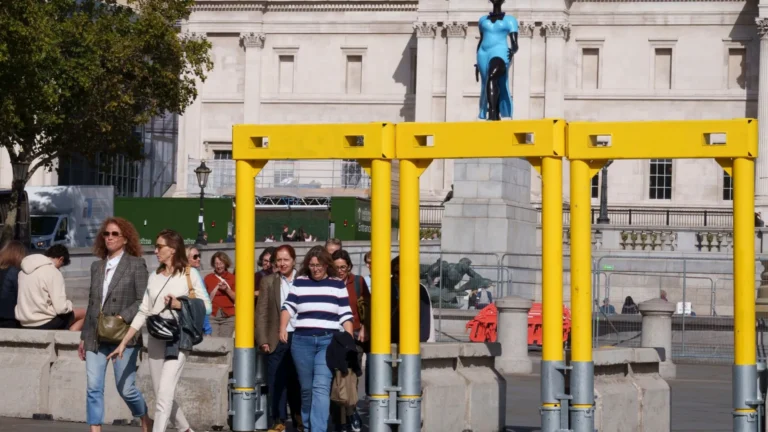
The worst architectural excrescence is to be found in Trafalgar Square, which is now encaged in bright yellow barriers that look like airport scanners from Teletubbyland
There is no axiomatic rule that street furniture has to be ugly
Freedom of assembly must include the freedom to enjoy our public squares without intrusive security measures
Mystery still surrounds an installation that appeared in front of the Bank of England some weeks ago featuring a Canon printer and a stream of bank notes inside a case emblazoned with ‘in case of emergency inflation break glass’. No one, it appears, is prepared to admit to the creation of a piece so ugly and economically illiterate that even Banksy repudiated all involvement.
But more baffling still was the City of London’s response. No sooner had the offending object appeared than it was surrounded by plastic security barriers – making an existing blight on the pavement even worse. The Corporation told City AM that: ‘Temporary protective measures have been put in place to ensure public safety while enquiries continue.’ Apart from annoyance at its total misinterpretation of quantitative easing, it’s difficult to see what danger the item posed to denizens of the finance district.
Following the 2017 London Bridge terror attack, vast concrete structures were installed on eight Thames crossings to prevent further vehicle ramming incidents. Again these monstrosities were only supposed to be provisional
But this was not an isolated incident. Hideous security infrastructure is springing up all over London, making the capital feel hostile, unsightly and less free. It is ruining our cultural inheritance.
Take the British Museum, one of the nation’s most popular tourist attractions. A decade ago, a visitor would stroll up Sir Robert Smirke’s Greek revival steps and glide into the magnificent Great Court with its Norman Foster roof. Now you enter through a white plastic tent and suffer the minor humiliation of a hi-vised guard peering lugubriously into your bag. You start your visit to this great temple of culture irritated rather than elevated.
The museum has secured planning permission to replace the tents with two ‘welcome pavilions’ which were due to be completed in the spring but have inevitably been delayed. Heritage groups have objected to the designs, which they say obscure the view of the facade and undermine its symmetry. These structures are supposed to be stopgaps, but so were the tents and they’ve been there for 10 years.
It was Milton Friedman who said ‘nothing is so permanent as a temporary government programme’ and London’s bridges prove the truth of this maxim. Following the 2017 London Bridge terror attack, vast concrete structures were installed on eight Thames crossings to prevent further vehicle ramming incidents. Again these monstrosities were only supposed to be provisional, but to date only those on Westminster Bridge have been upgraded to more elegant, permanent bollards. Proposals to replace the rest have been abandoned amid funding constraints. As Robert Kwolek, senior architectural designer at Create Streets, put it: ‘They are simply left as if abandoned, degrading our streets and abusing our eyes. They radiate apathy at best, a live terrorist incident at worst’.
So if TfL can’t find the money thanks to Sadiq Khan’s fare freeze, what about the City Bridges Foundation? This ancient charity exists to maintain the Square Mile’s river crossings, three of which are being made worse by ‘hostile vehicle mitigation measures’. But it prefers to spend its money on investigating its own historical links to slavery and organisations with links to Hamas. No political cause, whatever its merits, should take precedence over maintaining the basic function and aesthetic integrity of these bridges.
An FOI request revealed that these were hired for one year from May at a cost of £166,000. That may not sound like much, but consider how much we have lost by making this proud space so unsightly. Permanent hostile vehicle mitigation measures have been estimated to cost around £3 million. The Mayor’s office would not disclose what, if any, cost-benefit analysis it undertook for the current scheme, so we can’t know what value Sadiq Khan places on Nelson’s dignity.
All his spokesman would tell me was that: ‘Following the rise in the national UK threat level, temporary additional measures have been installed on the south-east and south-west corners of Trafalgar Square to improve safety for the public.’
But further investigation shows that enhanced security has been planned for Trafalgar Square since as far back as 2022, long before the terror threat was raised to ‘severe’ this year. Dig into the documents and this was recommended not just because of the possibility of terror attacks but also because Trafalgar Square is ‘a natural congregation point for demonstrations drawing supporters from across the UK’. Lord Toby Harris’s review of London’s preparedness for major incidents specifically cites: ‘rallies related to… the BLM movement, Extinction Rebellion and concerns around violence against women and girls, as well as a wide range of smaller demonstrations.’
It is one thing to protect the public from unforeseen events, but how we permit and control protests is a choice. Freedom of assembly must include the freedom to enjoy our public squares without intrusive security measures. Activists for divisive, minority causes should not be allowed to defile our communal domain. If civil disobedience in Trafalgar Square impinges on its utility for bystanders, law-abiding citizens and tourists to this extent then perhaps we should stop enabling it.
For his part, the likely Tory candidate for mayor James Cleverly told me: ‘I intend to make London a city we can all be proud of, and restoring beauty to our public realm is a key part of that. I intend to make our city safer, and reduce the need for bulky and ugly security infrastructure. Where it is needed, I will ensure that the visual impact on our public spaces is a key consideration.’
He is right, it doesn’t have to be this way. There is no axiomatic rule that street furniture has to be ugly. My local high street has bollards designed by Antony Gormley whose suggestive shape winks to the name ‘Bellenden Road’. Copies sell for thousands of pounds at auction. Works in Progress editor Samuel Hughes offers London’s traditional cast iron bollards and Paris’ slender olive-green ones as examples of successful design. He adds: ‘In 2008, the Government clad a security barrier on Whitehall with classically carved stone. With a little care and imagination, we can easily handle this design challenge – but we do have to make some small effort.’
Stay informed with our free daily briefing.
Nicholas Boys Smith, founder of Create Streets, goes further: ‘Every city should immediately fire any designer or engineer who says that anti-terrorist measures need to be ugly to be safe. It is a lie.’
I was in the Palace of Westminster in 2017 when an Islamist terrorist drove his car into pedestrians, crashed through the gates and murdered an unarmed policeman. I understand how important it is to keep these buildings safe. But if our response to these threats is to make our great city small, mean and ashamed of itself – then those who hate our way of life have won.
Alys Denby is the opinion & features editor at City AM.
More Culture
Popular
11 Nov 2026
Education
Len Shackleton
British universities are not fit for purpose
Britain’s higher education system, long heralded as a world leader in research and teaching, and a major export earner, is in big trouble. Yet our main political parties do not seem to be aware, or are turning a blind eye. The trouble is economic, academic and cultural, as we explain in a new book from […]
10 Nov 2026
History
Mani Basharzad
British history needs celebrating not rewriting
My favourite place in the world is outside Bank station, where Lombard Street meets Cornhill. To your right is Lombard Street, a name macroeconomists will recognise from Walter Bagehot’s 1873 book, which popularised the idea of the central bank as lender of last resort and which Ben Bernanke leaned on heavily during the 2008 financial […]
04 Nov 2026
Culture
David Clement
Why your gig tickets cost an arm and a leg
English rock fans are understandably thrilled over the announcement that Oasis will embark on another tour, including a stop in Manchester, where the band first got started in 1991. And while that may be good news, fans are still going to have a difficult time seeing them perform live – affording it, that is. Live […]
Manage Consent
To provide the best experiences, we use technologies like cookies to store and/or access device information. Consenting to these technologies will allow us to process data such as browsing behavior or unique IDs on this site. Not consenting or withdrawing consent, may adversely affect certain features and functions.
Functional Always active
The technical storage or access is strictly necessary for the legitimate purpose of enabling the use of a specific service explicitly requested by the subscriber or user, or for the sole purpose of carrying out the transmission of a communication over an electronic communications network.
Preferences
The technical storage or access is necessary for the legitimate purpose of storing preferences that are not requested by the subscriber or user.
Statistics
The technical storage or access that is used exclusively for statistical purposes.The technical storage or access that is used exclusively for anonymous statistical purposes. Without a subpoena, voluntary compliance on the part of your Internet Service Provider, or additional records from a third party, information stored or retrieved for this purpose alone cannot usually be used to identify you.
Marketing
The technical storage or access is required to create user profiles to send advertising, or to track the user on a website or across several websites for similar marketing purposes.