Britain could lead the world in self-driving cars
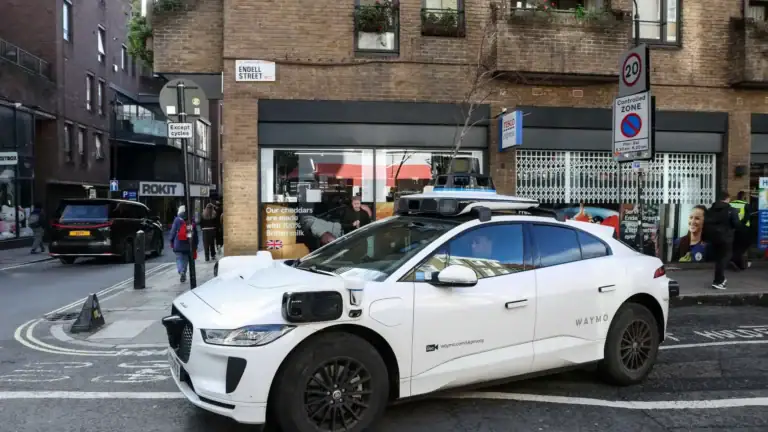
Photo: Adrian DENNIS / AFP via Getty Images
Earlier this year, I left London, for all the reasons you’d imagine an evil right-winger like me would. One of the few (and there are only a few) pangs of regret I had was when I was driving my wife and dog out along the Westway for the final time. Coming the other way was a driverless car. There’s probably a metaphor in there for a more whimsical writer, but I am focused on the reality of what I saw. Soon there will be actual robot cars driving around an ancient city.
Better yet, one of those companies is actually British!
The Cambridge-founded startup Wayve has just announced a $1.2 billion Series D on Tuesday, potentially rising to $1.5 billion once Uber’s investment kicks in. The round values Wayve at $8.6 billion – an extraordinary figure for a British technology company.
Interestingly, alongside the financial and tech backers, there are carmakers, too. Mercedes-Benz, Nissan and Stellantis (the company formed when Peugeot-Citroen merged with Fiat Chrysler) all invested in Wayve for the first time. That signals to me that legacy manufacturers see Wayve’s technology as a platform they may want to build into their products over time, not merely a flash in the pan.
Founded in 2017 by Alex Kendall, a computer vision researcher, the company built an end-to-end neural network that learns to drive the way a human does rather than following a pre-programmed rulebook.
Wayve works differently to its competitors. Waymo (part of Google) relies on exhaustive hand-crafted maps of every road on which it operates. Tesla uses a vast proprietary network that crunches video data, and of course also integrates the physical cars. And I shouldn’t have to explain the danger of letting Chinese firm Baidu’s Apollo Go loose on Western streets. Wayve’s USP is being able to be dropped cold into a new city and operate with no prior knowledge of the city. One hopes this will allow it to scale at speed.
The societal implications of the mass rollout of fully autonomous vehicles would be enormous. In the United States, one in every 60 working-age Americans (3.4 million) drives a lorry or a truck, and another 1.5 million drive taxis or Ubers. The numbers aren’t so high for Britons, but the concerns about AI taking jobs would crystallise fast if these reasonably low-skilled roles disappeared, whichever side of the Atlantic.
At the same time, the safety ratings of the self-driving cars will be much higher than the current crop of human drivers. Will the moral imperative of saving lives outweigh the moral concerns of rendering a vast swathe of people unemployed?
There are then the knock-on effects on public transport; will I ever want to get the train if I can have a similar but better experience working in the back of my robo-taxi every day? And it could well have a big effect on house prices if longer commutes into cities are made more bearable.
There are critics of course. Andrew Orlowski, probably the best (and certainly the funniest) critic of flights of futuristic fancy in Britain today, points to the more than $100bn the industry has spent over the last decade, and the relative lack of progress. At the risk of tempting fate, I think the critics will be wrong.
London being home to these tests is a proof of concept for a regulatory regime that is quietly becoming one of Britain’s genuine competitive advantages. The last Conservative government eased the rules on self-driving vehicles on public roads in an attempt to grow the industry here – if far too slowly.
And now a British AI company, founded less than a decade ago at a British university, has raised more than $2.5bn in total, won the backing of three global car manufacturers, and is about to run commercial robo-taxi trials in its home capital.
There is still so much to be deeply pessimistic about Britain in the short-term. But the story of Wayve shows that though much is taken; much abides. Deregulation, innovation and British genius remains a potent combination. The former CEO of GM once said, ‘What’s good for General Motors is good for America.’ Today we might say, ‘What’s good for Wayve is good for Britain.’


Britain says it wants to be a global hub for digital assets. Yet many people who want to use a lawful, FCA-registered crypto service cannot reliably move their own money to one. This is a test of whether the UK believes in individuals’ freedom to control their own money. A growing number of banks now […]

The Prime Minister has announced that economic policymaking will be led by No 10 North. Does this mean that the so-called ‘dead hand’ of the Treasury will no longer be able to frustrate worthwhile projects which will boost the UK economy? Or does it run the risk of expenditure and borrowing getting out of control […]
One doesn’t like to be a disappointment to one’s parents. But in (at least) one crucial regard, I’ve let my dad down. He is a steam train enthusiast, and I’ve never shown a blind bit of interest. So it was more with filial duty than pleasure that I took the old man to the Didcot […]