Donald Trump has destroyed American conservatism
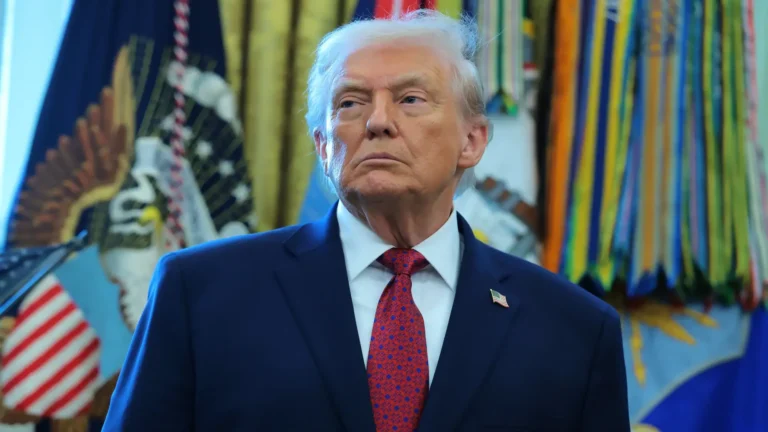
Photo: Anna Moneymaker/Getty Images
‘This is not my party’, George Will said when he left the Republican Party in 2016. Commentators often emphasise that Donald Trump destroyed the Democratic Party; as Niall Ferguson put it, ‘he destroyed the Democratic Party as we know it’. But the price of that destruction was the essence of American conservatism.
Figures like Elon Musk repeat the line, ‘we didn’t leave the Democratic Party; the Democratic Party left us’. But the same is true on the other side. Yes, Democrats have moved Left – but under Trump, Republicanism moved nowhere, at least not in a conservative direction. As George Will has long argued, populism is antithetical to American conservatism precisely because ‘populism means the direct translation of majority passion into governance’.
American conservatism, by its nature, seeks to slow public opinion, refine it and limit the direct translation of public emotion into power. It is a philosophy of constraint – of institutional buffers, separation of powers and suspicion of over-pragmatism and political emotion. Trump bulldozed these restraints, and for conservatives like me, it is unclear how, or when, the party can recover them. He has never been a fan of institutional limits on his power.
One of the most irritating claims made by Trump’s supporters is that he proved you can ‘just do things’ in politics. What they miss is that the whole point of the modern state is that you cannot simply ‘do things’. In Venezuela, Maduro can just do things. In Russia, Putin can just do things. But in any modern liberal democracy, power is constrained – and that is not a weakness but a strength.
This goes back to the genius of the American Founding Fathers. Before them, political philosophy largely searched for perfection: how can we achieve the most optimal outcomes? Plato’s philosopher-king is the clearest example. The Founders asked the opposite question: what is the worst possible outcome in politics? Tyranny. How can we avoid it? That mindset produced the separation of powers and the creative tension between branches of government, most clearly articulated by Madison in the Federalist Papers.
The result of Trump-style politics is governance unmoored from principle. Trump does not merely deviate from conservatism; he believes in nothing consistent at all. One day he praises Zelensky and distances himself from Russia; weeks later he flirts with a Russia-advised ‘peace plan’. One day he imposes tariffs to cripple China; the next he chases the ‘biggest trade deal ever’ with Beijing. When a leader believes in nothing, he requires subordinates who believe in nothing – except him.
The adults have left the room. Every press conference in Trump’s second term feels like a sitcom, with officials competing to praise the great leader. Governance becomes a mixture of Fox News talking points and real-estate salesmanship, with Marco Rubio often appearing as the lone exception.
At the heart of the problem is Trump’s fundamental misunderstanding of conservatism. American conservatism was never about preserving the manufacturing sector or returning to a lost past. It was about openness, dynamism, industry and entrepreneurial energy. Trumpism seeks to conserve an image – a sentimental vision of a church-going family with four children – rather than a system. Conservatism is not a timeframe. It is a set of principles. Trump has sacrificed those principles for a nostalgic, economically incoherent vision of American manufacturing. That was the strength of 1980s conservatism in both the US and the UK: it did not treat a particular historical period as an ideal to be restored, which made conservatism an intellectual journey rather than an exercise in nostalgia.
The core of American conservatism, especially after Barry Goldwater, is dynamism. Conservatism is not merely about resisting change or slowing it down. That was Hayek’s criticism of conservatism: that it can only slow change, not redirect it. But this was never true of Goldwater, Reagan or Thatcher. For them, conservatism meant conserving a system that allowed progress and change to emerge spontaneously.
Progressives, by contrast, wanted to ‘manage’ change – to supervise and design it. Trump, despite his rhetoric, belongs firmly in that camp. He recently suggested that the Warner–Netflix deal could be a problem and implied that he would like to be personally involved. This is not an isolated case. Trump repeatedly behaves as what Deirdre McCloskey calls an ‘economic daddy’: someone who wants to oversee everything, ensuring that nothing escapes his control.
As a recent New Statesman piece argued, Trump and Farage are both products of the 1980s – a world of finance, skyscrapers and admiration for success. That is true. What the report misses is that they are bad students of the 1980s. As American political conflict increasingly spills into Britain, it is worth reminding ourselves that Trump is no Reagan.
What made Reaganism great was letting markets work freely while confronting foreign threats with clarity and resolve. Trump represents the opposite: rolling out the red carpet for Putin while tightening pressure on domestic markets through tariffs, quasi-nationalisation and an unsettling form of crony capitalism.
The Republican Party was once the party of business. As the old saying goes, ‘the business of America is business’. But Trump’s relationship with billionaires is not business-friendly; it is cronyistic. You are welcome inside the circle only if you obey the economic daddy – as when Apple is pressured to bring manufacturing back to the US, raising costs and reviving jobs few Americans want. Increasing costs on one of your country’s most important companies and bringing jobs to America which no American wants to do it isn’t business-friendly, is it?
Yes, Trump destroyed the Democratic Party. But he did so at the cost of killing conservative sensibility itself.

I was diagnosed with Parkinson’s 12 years ago. I then started and ran a successful business, helping 339 mothers and 37 fathers back into work, and won Entrepreneur of the Year at the UK Business Awards. After five or six years, my health began affecting the business. Today I receive Personal Independence Payment (PIP). My […]

As an Anglo-Scot, I had a dog in the fight that was the Scottish independence referendum 12 years ago. I was a visceral opponent of the dismemberment of the United Kingdom, which, I believed, would damage everyone in the British and Irish Isles. As the UK’s ambassador to the UN in 2014 put it, ‘it […]
A quick show of hands. How many of you have a working torch in the kitchen drawer, and not just on your phone? Candles, matches or a working pack of AA batteries? What about a week’s worth of tinned food, a camping stove, a full jerry can? A generator? Most readers will have answered no […]