AI could fix policing. Politicians won’t let it
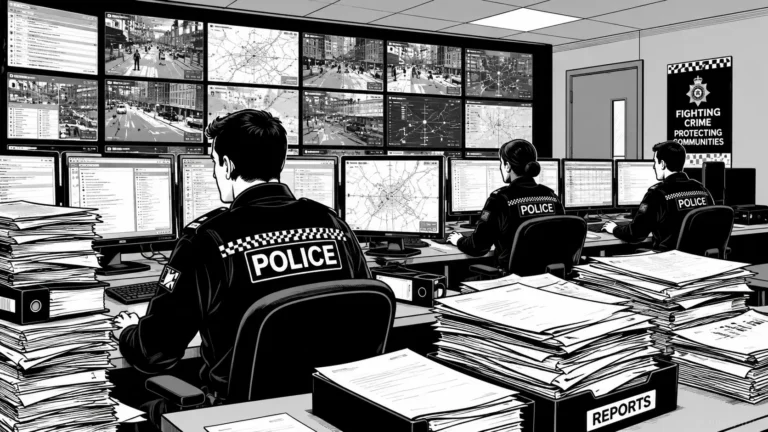
Created with ChatGPT
Artificial intelligence is already reshaping policing, and the recent row over the Metropolitan Police’s blocked deal with Palantir shows how far politics is lagging behind operational reality. If we are serious about protecting frontline officers and visible neighbourhood policing, we should embrace carefully regulated AI as a force multiplier that releases cops from analogue bureaucracy and gets them back out into the communities where trust is tanking.
Earlier this year, the Met was in advanced talks to spend around £50 million on Palantir’s AI-driven software to help automate and speed up intelligence analysis in criminal investigations. The aim was straightforward: sift vast volumes of data more quickly, spot connections humans would miss and reduce the time detectives spend wrestling with spreadsheets instead of assertive response.
London’s Mayor blocked the deal, citing procurement concerns and questioning value for money, and Palantir has now signalled its intention to sue. The Met Commissioner has warned that, without this kind of technology, the force will have little choice but to cut back frontline services even further to balance the books. The dispute is not just about one contract; it goes to the heart of how public services should use AI and whether we want police time spent on form filling or crime fighting.
AI is neither a silver bullet nor a dystopian inevitability
Used properly, AI is at its best when it handles exactly the kind of data-heavy work that currently buries officers in paperwork or hours gazing at screens. Modern policing involves processing intelligence logs, CCTV, phone records, digital forensics and case files on a scale no human team can realistically manage quickly.
Studies of AI and ‘smart city’ public safety tools suggest they can cut crime by up to 30–40% and reduce emergency response times by 20–35%, largely by improving information flow and decision making. Crucially, AI enables deep learning systems to absorb unstructured data at high speed, surfacing relevant leads and patterns while leaving human officers to exercise judgement. In practical terms, that means fewer hours manually collating reports, and more hours spent on visible patrols, reassurance visits, and victim outreach – the things communities notice and value.
This is the argument that should have been front and centre in the debate between the Met and Palantir: the point is not to replace officers, but to return them to the streets by stripping away low-value administrative tasks. A serious productivity agenda in policing almost inevitably involves AI.
Sceptics are not imagining the downsides. AI in policing raises hard questions about privacy, fairness and accountability. Historical policing data can embed bias, so a naïve predictive tool risks simply automating past injustices (in perception if not reality) and directing more resources at already over-policed communities. Powerful surveillance tools – from facial recognition to behaviour tracking cameras – can erode civil liberties if deployed without clear legal limits and democratic oversight.
There is also a transparency deficit: many AI systems are ‘black boxes’, making it hard for defendants, lawyers or the public to understand how a particular output was generated. These are real problems that demand robust governance – mandatory transparency registers, independent audits for unjustified bias, strict rules on what data can be used and clear lines of human responsibility for any decision that affects liberty. But they are arguments for regulating AI in policing, not for pretending we can turn the clock back.
In the United States, AI-enabled tools are already changing day-to-day policing practice. Departments use realtime crime mapping, AI-supported digital forensics and automated report drafting to cut investigation times and free up sworn officers. Analyses of AI-driven ‘smart policing’ initiatives suggest they can both reduce crime and speed up responses when embedded in broader reform programmes, rather than bolted on as gimmicks.
That experience matters for the UK debate: it shows AI is neither a silver bullet nor a dystopian inevitability, but a tool whose impact depends entirely on rules, culture and leadership. Where those are right, AI has already transformed policing from reactive paperwork management to faster, more proactive investigation.
For people who care about growth, productivity and effective public services, the conclusion should be clear: the priority is to build the right guardrails and then scale AI use across policing, not to stifle it at birth with performative vetoes. Properly governed AI offers one of the few realistic ways to square the circle of constrained budgets, rising demand and public expectations for visible neighbourhood policing.
The Palantir row is a warning about how easily that opportunity can be lost to political grandstanding. If we want more bobbies on the beat rather than more officers in offices, expanding AI in policing – with rigorous safeguards – is not a luxury. It is a necessity.


It is easy to be cynical. When Tony Blair was Prime Minister, he once sent a memo to his team demanding ‘eye-catching initiatives’ and adding: ‘I should be personally associated with as much of this as possible.’ The Home Secretary Shabana Mahmood is on manoeuvres. The speculation that Keir Starmer will be replaced as Prime […]

Much to the surprise of foreigners, Britain has never had a national police force, relying instead on 40-odd local forces since the 1960s, mostly covering one or two counties, but some bigger. Mark Rowley, who runs the Met, is unhappy. Earlier this month, he called for all existing forces to be merged into about 12-15 […]

Some issues in public life should be very easy: safeguarding children as an absolute priority is one of them. Avoiding heaping shame on the innocent is another. The longstanding principles of justice in our country ought to make both ideas apparent. And yet, as the Telegraph sets out, in some parts of our country those charged […]