Why can’t Britain fix its roads?
The AA estimated the total cost of repairing damaged vehicles at £645 million for pothole-related incidents in 2025
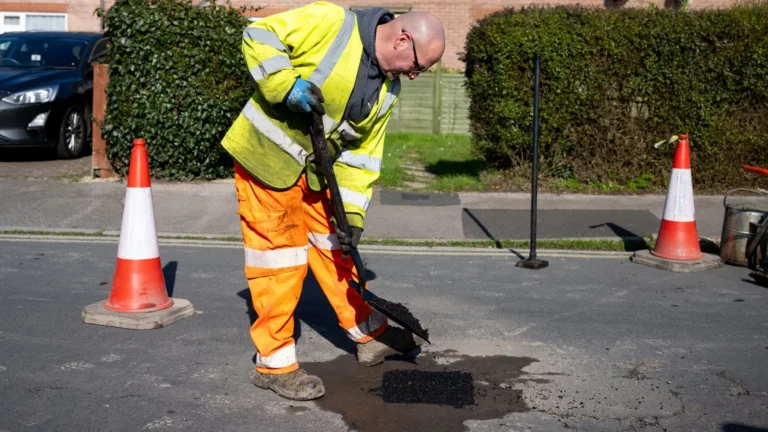
Finnbarr Webster/Getty Images
The AA estimated the total cost of repairing damaged vehicles at £645 million for pothole-related incidents in 2025
When you drive through the potholes and your suspension gives out, or when you sit fuming at temporary traffic lights because of roadworks, it’s for a reason. It’s because the cost to you in delays and disruption doesn’t figure much in the council’s budgeting or the contractors’ work schedules. The familiar ‘I don’t give a **** about your problems, mate, it’s our tea break’ attitude.
You might think the roads are in an appalling state, and you’d be right. I’ve seen better roads in Kathmandu (albeit the ones that run past the Transport Ministry). Here, our own Department for Transport says that in 2022-23, for example, England alone underwent 2.2 million street and roadworks, causing travel disruption costs of around £4 billion. According to data obtained by Sky News, the 425,524 miles of UK roadworks in 2024 were equivalent to circling the earth 17 times.
Cones and barriers with nobody working behind them should be regarded as political and economic failure – not a normal Tuesday
And as all drivers know, works can drag on for months – or longer. In Witham, temporary lights, a lane closure and barriers have been in place since a bridge crossing the A12 was damaged in 2015 – that’s an extraordinary eleven years and counting. (Works might be finished in 2027-28). There are plenty of other disruptions in the 3-6-year bracket too. It’s all a bit of a contrast with Japan after the 2011 earthquake, when a 150-metre stretch of the Great Kanto Highway was rebuilt in just six days (!) of round-the-clock work.
Back in the UK, the traffic data analysts INRIX figured that road congestion (which road works increase) cost £7.7bn in 2024 – an average of £581 per driver – with London drivers losing 101 hours in delays, at a cost of £942 each. And, of course, those disruptions raise business costs too. The Road Haulage Association says that road congestion accounts for 16% of HGV operating costs. Meanwhile, a 2026 Tempcover analysis using DfT data found that England’s van drivers wasted 98.6 hours in road delays, which for trades charging £50/hour means a £4,928 loss each. And you wondered why plumbers are so expensive?
Then there’s the potholes. The AA attended 613,638 pothole-related incidents in 2025 (that’s 1,681 a day) and estimated the total cost of repairing damaged vehicles at £645 million. Earlier this year, Aviva reported that the average claim for pothole damage was £3,863, with 25% of those claims being write-offs. Kwik Fit even has a Pothole Impact Tracker, which in recent years has estimated the cost at around £1.5–£1.8bn.
And the cost of filling a pothole itself? – £72.
A separate estimate by the Centre for Economics and Business Research in 2024 put the total cost of potholes in England alone at £14.4bn a year when you factor in £12.7bn in extra travel time, plus vehicle damage, accidents (e.g. swerving to avoid potholes) and the emissions caused by stop-starting in heavy traffic.
Even non-drivers are affected. In England, the target for getting an ambulance to someone in a life-threatening situation such as cardiac arrest is just seven minutes, which is not easy when there are delays, diversions, contraflows, temporary lights, cones and congestion due to potholes and roadworks. Diversions also hit high-street shopkeepers by reducing footfall, and cause damage to minor roads that were never designed to take heavy traffic. (And if you live next to the diversion, it can be a nightmare.) Meanwhile, bus passengers are buffeted around, children arrive late for school, and delivery slots and appointments are missed. Idling and stop-starts in congestion subject us all to higher CO₂, NOx and other nasty emissions. And daytime works concentrate noise, dust and fumes precisely when more people are outdoors.
Cones and roadworks signs with seemingly no work going on are not a minor irritation. Voters see them as yet another example of government waste – arguably doing far more political damage than the cost of the works needed to avoid them. Drivers, bus users, insurers, the NHS and employers all blame politicians for the costs and delays they suffer, forcing councils and ministers to spend their crumbling political capital on excusing delays. ‘They can’t even fix the roads’ becomes a standing indictment against the whole political class.
Plainly, the authorities should give much more weight to the public’s time and costs than merely to their own. Recognising those costs and charging contractors for them (through mechanisms such as lane rentals, which some authorities already charge contractors) would promote more overnight and weekend working, with roadworks finished quicker, and thousands of hours saved. Indeed, that should be the default everywhere, but the rollout has been slow and patchy at best.
Night working (when traffic is lower anyway) and flooding the job with people and equipment might cost the authorities more, but cut the public’s costs, which can easily exceed the cost of the works themselves. That’s why Japan uses round-the-clock work shifts and all-weather surface mixes that set in an hour. It’s why the Netherlands sees potholes as a planning failure and adopts a long-horizon approach to road maintenance, with fewer patch-and-pray jobs and on-the-day-it’s-reported fixes. India uses crumb-rubber (from old tyres) in an asphalt mix to produce flexible, crack-resistant surfacing and repairs; in the UK these remain non-standard.
But it’s not a technical problem. It’s about whether the public’s wasted hours, repair bills, missed appointments and 999 delays count as much as the contractors’ day-rate. It’s about counting those costs, working at night, finishing fast, and using materials that will last.
Cones and barriers with nobody working behind them should be regarded as political and economic failure – not a normal Tuesday.

As the dust of party conferences settles and journalists try to read the runes of what they mean for the coming political year, two things are already clear. The first is that Andy Burnham’s conference speech was a masterclass in tickling the tummies of his party faithful, with a heady mix of teary emotion and […]

Just as there is a battle on the Right in Britain, so too is there a battle inside the Conservative Party for what the party should focus on. There are those who are concerned about the threat of political Islam, the damage to the social fabric of the Boriswave and other elements of mass immigration, […]

I particularly enjoy a phrase that appears in Christopher Bullock’s ‘The Cobbler of Preston’: ‘Tis impossible to be sure of any thing but Death and Taxes.’ The sentiment was later popularised by Benjamin Franklin in his correspondence. In the world of government budgets, there’s another thing that is, sooner or later, unavoidable: fiscal consolidation. That […]