Can Britain believe in fiscal conservatism again?
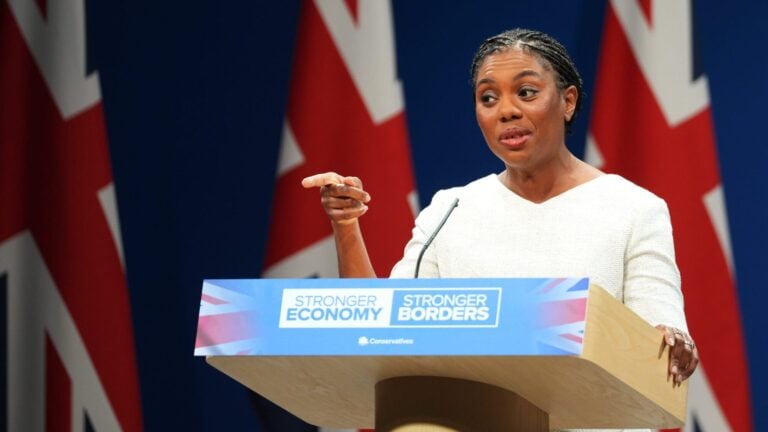
Photo by Christopher Furlong/Getty Images
A year into this Labour Government, the Conservatives remain trapped in an identity crisis. The polls are grim, morale is lower still and every new policy announcement has seemed to only invite the same weary question: what does the party actually stand for? In that context, Kemi Badenoch’s first ever conference speech was always going to be more than just another pitch to the faithful. It was a test of whether the Conservative Party still has a future at all.
Badenoch spoke of the Conservatives as the party of fiscal responsibility. Her new ‘golden economic rule’ – that every pound of government savings should be divided equally between reducing the deficit and cutting taxes – was presented as a guiding principle, not a gimmick. ‘You cannot tax your way to prosperity,’ she said. ‘You must save, invest and reward work.’ It was a line that could have been lifted straight from Margaret Thatcher’s 1980 conference speech, when she declared that ‘you cannot spend your way out of a recession.’ That echo was deliberate. Badenoch wants to re-establish Conservatism as a moral creed, one that prizes sound money, limited government and reward for effort.
In recent years, her party has drifted into managerialism and caution, promising reform while presiding over the steady expansion of the state. Public spending now consumes almost half of national income, yet Britain feels poorer and more sluggish than ever. Labour, far from reversing course, has entrenched that model. Rachel Reeves’s Treasury taxes, spends and borrows in equal measure, while growth flatlines and public services decay.
Badenoch’s intervention was an attempt to drag the debate back to first principles: that prosperity depends on discipline, that government cannot print its way to progress and that fiscal restraint is not the enemy of compassion but its foundation.
The trouble is, Britain has heard this before. Since 1997, successive governments have unveiled more than a dozen fiscal rules, most of which have been broken, suspended or quietly rewritten. Gordon Brown’s original ‘golden rule’, allowing borrowing for investment only, lasted until the numbers stopped adding up. When that happened, he simply re-dated the economic cycle to make the sums fit. George Osborne’s structural deficit target met the same fate, and the frameworks introduced by Philip Hammond, Sajid Javid and Rishi Sunak fared little better. Each promised credibility, only to be undone by the politics of convenience.
Badenoch’s version is easier to grasp. Half of every genuine saving would go to debt reduction and half to lowering taxes – prudence and growth, discipline and reward, joined in a single principle. Yet clarity is not the same as credibility. The Treasury has a long history of creative accounting – a delayed project here, a departmental ‘saving’ quietly eroded by inflation there. Unless Badenoch binds her rule to independently verified figures, it will end up in the same graveyard as its predecessors.
The politics are no less treacherous. Real fiscal consolidation takes time, yet modern governments live by the news cycle. The temptation to promise tax cuts before savings are delivered will be irresistible. The last decade has proved that Britain’s political class prefers applause of the announcement to patience. Badenoch’s success will depend not only on moral conviction but on institutional discipline, and Whitehall has shown little of either.
Still, there’s a moral energy in her message that’s been missing from Conservative economics for far too long. Badenoch speaks of government living within its means so that families can keep more of what they earn. She frames saving not as austerity but as responsibility. She understands that high taxes stifle ambition and drain enterprise. Her instincts are unmistakably Thatcherite – the belief that prosperity grows from the bottom up, through effort and aspiration, not dispensed from the Treasury down.
The specifics remain uncertain. Her shadow chancellor claims to have identified £47 billion in potential savings – £23 billion from welfare cuts, £8 billion from slimming the civil service and £7 billion from reducing overseas aid to 0.1% of national income, with the rest from departmental efficiencies. For a party searching for purpose, the signal matters as much as the arithmetic. It suggests, at least, a willingness to define limits in a political culture that has long forgotten how.
The harder challenge is political. After fourteen years in government and a year in opposition, many Conservatives no longer believe that fiscal discipline wins votes. As soon as NHS budgets tighten or councils threaten insolvency, the pressure to suspend Badenoch’s rule will grow. That’s what defeated Osborne and Sunak before her, and it could undo her too. The real problem is not simply financial but cultural: a British state that spends more, delivers less and resists reform at every turn.
Politically, Badenoch’s announcements may buy her time. She marks one year as leader on November 2 – the first date on which a confidence challenge can be launched. Robert Jenrick is already manoeuvring, and others are waiting their turn. By reclaiming the language of duty, thrift and self-reliance, Badenoch is appealing to the party’s moral core. That might be her strongest defence against internal rivals, even if it does little to move the wider electorate.
Whether the public will believe her is another matter. They’ve heard promises of fiscal virtue before, only to watch spending rise and taxes follow. The markets also have long memories, recalling every suspended rule since the 1990s. If Badenoch wants her ‘golden rule’ to be more than another piece of Treasury theatre, a future Conservative government will have to rediscover the courage to say no – to lobbyists, to false comforts and to the illusion that the state can provide everything.
Badenoch’s speech was about more than numbers. It was an argument for belief – that thrift and aspiration can coexist, and that fiscal discipline is not an act of cruelty but of care. Whether she can convince her party, and the country, that Conservatism still stands for something will determine not just her leadership, but the survival of the Right as a serious political force.


Alan Milburn revealed the truth about one of Britain’s most fraudulent small taxes. His NEETS report says we should be ‘honest about what the Apprenticeship Levy is, which is a payroll tax. It is not a hypothecated tax and it is not ringfenced for apprenticeships. Government sets an apprenticeship budget, which is generally lower than […]

Andy Burnham’s much-promised strong and decisive leadership has been long on vibes, short on action during his first 100 days. With one telling exception. He has stuck to his guns about what the nation should call white bread rolls. Namely, ‘barm cakes’, as they do in his new constituency of Makerfield. In doing so, he’s […]
The problem with being a political golden boy like Labour pensions minister Torsten Bell is that it paints a target on your back, putting you firmly in the crosshairs of rivals and commentators in your own party and the opposition every time you do or say anything at all. Kudos, then, to the man widely […]