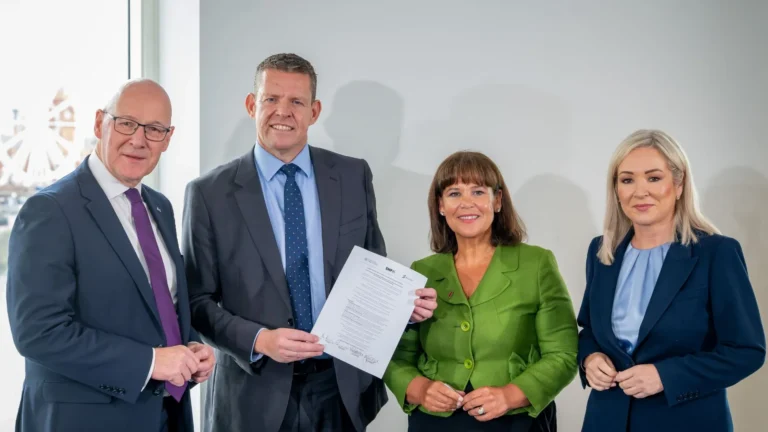
Did you ever hear the one about the leaders of Sinn Fein, Plaid Cymru and the Scottish National Party holding a press conference? It sounds like the beginning of a bad joke, but yesterday, the UK’s foremost regional separatists came together in Cardiff to pressure Andy Burnham into facilitating the dissolution of the nation.
Michelle O’Neil, Rhun ap Iorwerth and John Swinney – the parties’ respective leaders – have signed a pact codifying their ‘commitment to working constructively with one another in the shared interests of our people’. Further down the document, the signatories state that ‘We believe the future of our nations belongs in the European Union. We want to work together to rebuild and strengthen those European relationships, creating greater opportunities for trade, investment, culture and cooperation.’ Rejecting the centuries-old union of the people of the British Isles for a Brussels superstate is certainly a novel approach to independence.
Though the Prime Minister is a devolution enthusiast, he has so far resisted calls from independence parties to reconsider our constitutional settlement. How long his resolve will last is another question entirely
Why now? During his visit to Ireland over the weekend, Donald Trump gave his thoughts on the unification of the Republic and Northern Ireland: ‘It seems to me that one of the naturals of all time is to put them together’. Like his predecessors, Trump is bound by electoral calculus to court ‘the old country’. With midterm elections approaching, the President will be looking to shore up Irish-American votes in key swing states such as Pennsylvania. Though it could also be that Trump simply enjoys being a menace and is testing Burnham’s mettle.
Whatever the reason, this is a wake-up call for unionists across the UK. Emma Little-Pengelly – Northern Ireland’s Deputy First Minister and Democratic Unionist Party politician – pointed out that ‘in Wales, Scotland and Northern Ireland, you have separatist, nationalist first ministers because of divided unionism’. However, while the unionist movement may be fractured, there is still no democratic mandate for independence.
Support for Welsh independence stands at 32%, in Northern Ireland, 33.7% favour Irish unification and while tight, in Scotland 47% support seceding from the UK. Of course, when it actually came to a vote in Scotland, 55% of Scots voted to remain British in a referendum which was agreed to stand for a generation. The lack of enthusiasm is hardly surprising. Each of the separatist administrations has made a hash of running their countries.
In their manifesto, Plaid Cymru made a slew of public spending commitments – including an extra £400 million on childcare each year – and promised to push for further tax devolution so they could ensure that higher earners pay a greater share. As the Institute for Fiscal Studies remarked, the party gave little explanation as to how it would fund this extra spending and did not detail whether its proposed changes to the Welsh tax system would increase revenue.
In Northern Ireland, Sinn Fein has chosen red tape over economic dynamism, exemplified in their harebrained ‘Good Jobs Bill’, designed to strengthen workplace rights. Businesses have warned that giving trade unions sweeping statutory rights to enter workplaces will overregulate the labour market, harming the small businesses that employ more people in Northern Ireland than large firms and the public sector combined. As the Employment Rights Act has done here, Sinn Fein’s legislation will likely have a chilling effect on hiring. While unemployment in the Province remains low at 2.4%, data released today showed that businesses are becoming more cautious about bringing on new staff, with the number of temporary workers having fallen in the second quarter of 2026.
Since coming to power in 2007, the SNP have driven Scotland into the ground and presided over a humiliating display of scandal, profligacy and incompetence. Despite vast levels of public spending – £22,281 per person in 2025/26 – educational performance has fallen compared to England, waiting times in the Scottish NHS remain significantly worse than pre-pandemic levels and Scotland has failed to increase hospital activity above pre-pandemic levels as planned, despite having 14% more NHS staff than before the pandemic.
In each of the devolved administrations, separatist parties leave a track record of failure in their wake. Nevertheless, they are intent on lobbying Burnham to abdicate control of sovereign British territory.
Though the Prime Minister is a devolution enthusiast, he has so far resisted calls from independence parties to reconsider our constitutional settlement. How long his resolve will last is another question entirely.
Stay informed with our free daily briefing.
As the realities of life under socialism dawn on a population exhausted by years of fiscal mismanagement and high prices, the ‘Burnham bounce’ in the polls will fade. Indeed, it is showing little sign of even appearing. Household energy bills are set to rise by 25% in January, which could tip inflation above 4% next year – an existential threat to Burnham’s pledge to be a ‘cost-of-living’ Prime Minister. When it comes to economic growth, it looks unlikely that Burnham will shift the dial in a positive direction. Chancellor John Healey has refused to rule out tax increases and in Prime Minister’s Questions, Burnham recently stated that ‘national security cannot come at the expense of social security’, giving Britons a sense of where his spending priorities lie.
The impact of these misjudgements will be painful for the Burnham administration, and without more taxpayer money to spend on welfare, the impulse to turn to constitutional reform as an alternative legacy will be strong. He must fight that urge. Breaking up the nation simply to be seen doing something while in power would be an act of unforgettable treachery towards the majority of Britons who recognise the strength of the Union and the kinship of the British people.
Joseph Dinnage is the senior press officer for the Prosperity Institute and former Deputy Editor of CapX.
More UK Politics
05 Oct 2026
Trade
Shanker Singham
Don’t swap Britain’s growth for EU food rules
The UK-EU relationship must be viewed through the lens of the battle for the world’s operating system. There are three operating systems in the world. The first is a competition on the merits system where countries are free to engage in regulatory competition but inter-operate on the basis of mutual recognition and equivalence. This historically […]
05 Oct 2026
Policy
Marc Sidwell
Katie Lam: Nimbys are a symptom of broken planning
In the mid-90s, you could save up a deposit for a house in a year; now it takes about a decade. That’s a really meaningful change. That’s a whole stage of your life where 30 years ago you might reasonably have expected to become a homeowner and now that is highly unlikely In a room […]
04 Oct 2026
Economics
Eliot Wilson
The wiring diagram behind Thatcher’s revolution
Even before he became Prime Minister in July, Andy Burnham had talked about the country in institutional, positively mechanical ways. He promised to ‘give Britain the circuit-breaker it needs’, and said that his Number 10 North, part of the Office for the Prime Minister and Cabinet based – where else? – in Manchester, would be […]
Manage Consent
To provide the best experiences, we use technologies like cookies to store and/or access device information. Consenting to these technologies will allow us to process data such as browsing behavior or unique IDs on this site. Not consenting or withdrawing consent, may adversely affect certain features and functions.
Functional Always active
The technical storage or access is strictly necessary for the legitimate purpose of enabling the use of a specific service explicitly requested by the subscriber or user, or for the sole purpose of carrying out the transmission of a communication over an electronic communications network.
Preferences
The technical storage or access is necessary for the legitimate purpose of storing preferences that are not requested by the subscriber or user.
Statistics
The technical storage or access that is used exclusively for statistical purposes.The technical storage or access that is used exclusively for anonymous statistical purposes. Without a subpoena, voluntary compliance on the part of your Internet Service Provider, or additional records from a third party, information stored or retrieved for this purpose alone cannot usually be used to identify you.
Marketing
The technical storage or access is required to create user profiles to send advertising, or to track the user on a website or across several websites for similar marketing purposes.
To provide the best experiences, we use technologies like cookies to store and/or access device information. Consenting to these technologies will allow us to process data such as browsing behavior or unique IDs on this site. Not consenting or withdrawing consent, may adversely affect certain features and functions.
Functional Always active
The technical storage or access is strictly necessary for the legitimate purpose of enabling the use of a specific service explicitly requested by the subscriber or user, or for the sole purpose of carrying out the transmission of a communication over an electronic communications network.
Preferences
The technical storage or access is necessary for the legitimate purpose of storing preferences that are not requested by the subscriber or user.
Statistics
The technical storage or access that is used exclusively for statistical purposes.The technical storage or access that is used exclusively for anonymous statistical purposes. Without a subpoena, voluntary compliance on the part of your Internet Service Provider, or additional records from a third party, information stored or retrieved for this purpose alone cannot usually be used to identify you.
Marketing
The technical storage or access is required to create user profiles to send advertising, or to track the user on a website or across several websites for similar marketing purposes.