Britain’s businesses have given up on Labour
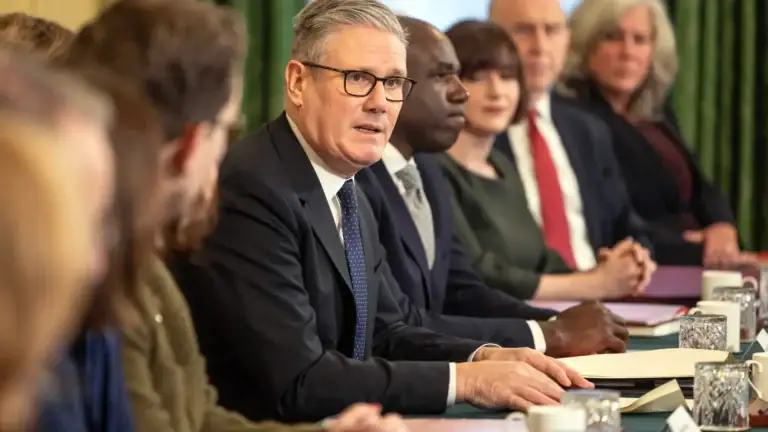
Photo: Richard Pohle / POOL / AFP via Getty Images
The Jobs Foundation recently commissioned a poll of 1,150 family firms. The results are grim reading for Keir Starmer.
Asked which political party they trusted most to support their business, 43% of respondents said none. Far behind in second place was the Conservative Party on 20%, while 16% named Reform UK. Labour tied with the Greens on 6%.
No party can take much solace from those results. The Conservatives, who will currently take a win wherever they find it, can allow themselves some small celebration that they were the most popular positive choice, and that there is a poll in which they are ahead of Nigel Farage’s party. For Labour, however, it is catastrophic.
It must be particularly painful for Starmer and Rachel Reeves because they devoted enormous time and effort to wooing the business community in opposition. In May 2021, Starmer reshuffled his shadow cabinet and replaced the clever but ineffective soft-left Anneliese Dodds as Shadow Chancellor with Reeves. She then played up – not wholly truthfully, it transpires – her career as an economist and presented herself and her party as serious, responsible and committed to fiscal discipline.
For three years, Labour’s Treasury team drove home the message that they could be trusted with the nation’s finances. Reeves’s grinding schedule of breakfast meetings and roundtables in the City and beyond reminded me of the ‘prawn cocktail offensive’ undertaken by John Smith as Shadow Chancellor in the early 1990s; Michael Heseltine declared theatrically at the time ‘Never have so many crustaceans died in vain!’
It was easy to mock Labour’s efforts, but they bore fruit. Veteran PR hack Iain Anderson was lured away from a lifetime of Conservatism to produce a plan for business relations, ‘A New Partnership’; it was an exercise in warm, empty platitudes, but it served a purpose. In May 2024, just two months before the general election, 120 business leaders signed an open letter to The Times welcoming the way Labour had ‘shown it has changed and wants to work with business to achieve the UK’s full economic potential’.
It hardly requires the perceptive powers of Sherlock Holmes to see why business’s trust and confidence in Labour has since collapsed. The October 2024 Budget increased employers’ National Insurance Contributions by £25 billion, despite the party having stated in its manifesto that ‘Labour will not increase taxes on working people, which is why we will not increase National Insurance’. Reeves also raised the National Living Wage by 6.7%, well above inflation, which completed a double blow for businesses employing those on lower wages.
Then came November 2025’s Budget. Where there had previously been 100% relief on inheritance tax on trading businesses, partnership interests and shares in unlisted companies, business property relief will be capped at £1 million from April this year. The incentives to create, grow and pass on an enterprise are gradually being chipped away as the Government desperately looks for revenue.
There is a fundamental weakness in the Government’s whole vision for the country – everything is predicated on growth, but it is simply not happening. Reeves called growth ‘the number one mission of this Government’ at the end of 2024, yet the economy grew by 1.1% in 2024, and almost all of that came in the first two quarters under the previous government. The Office for Budget Responsibility predicts 2025 will have seen 1.5% growth, and expects 1.4% for 2026. All of this means that GDP per capita is either stagnant or falling. According to the Jobs Foundation survey, 68% of family businesses did not believe ministers when they said that growth was their first priority.
Business confidence is an important barometer because it is a hard-headed assessment made on the basis of people’s livelihoods. It is not a knee-jerk instinct nor subject to passing moods. For that reason, it matters that the trust businesses place in the Government has dropped like a hanged man through the scaffold’s trapdoor.
Rebuilding any level of confidence will be an overwhelming challenge. Nor is there any reason to think that it would be substantially improved by a change of leadership: after all, where have Wes Streeting or Andy Burnham or Shabana Mahmood or Angela Rayner indicated they would significantly change the direction of economic policy? None is promising to reduce taxation, revisit business incentives or shrink the state by any noticeable margin.
Ministers instead are pretending that everything is basically fine. On January 1, the Chancellor was talking about Britain as the best place to do business; at the weekend, the Prime Minister wrote in The Times that ‘Britain has chosen to rebuild, and we will see that work through’. But he protested that it would not be fair to judge the Government’s performance until the end of this Parliament in 2028 or 2029.
That is not a condition any politician gets to impose. It was the godfather of investors, Warren Buffett, who observed, ‘It takes 20 years to build a reputation and five minutes to ruin it’. Starmer certainly spent a number of years persuading business that Labour was on its side. That trust has been dramatically lost, and the Government will find that pressing ahead with existing policies will not restore it. Future Labour leaders should hope he has left a ‘prawn cocktail offensive’ briefing note, for when it has to be done all over again.

After months of anticipation, Alan Milburn’s long-awaited review into Britain’s NEETs crisis has now been released. Milburn’s report does address the NEETs crisis with the ambition required. With almost a million young people not in employment, education or training, he rightly says that ‘we’re at risk of a lost generation’ of young people, and his […]

This week, Nimby Watch ventures out to the village of Cookham, just south of High Wycombe, and about 30 miles to the west of London… What a beautiful village! Something seems very familiar about this place, though. It should: Cookham might have become the archetypical English village, not least because it served as the real-world […]
Alan Milburn revealed the truth about one of Britain’s most fraudulent small taxes. His NEETS report says we should be ‘honest about what the Apprenticeship Levy is, which is a payroll tax. It is not a hypothecated tax and it is not ringfenced for apprenticeships. Government sets an apprenticeship budget, which is generally lower than […]


