Nimby Watch
Proposal for 48 small homes in an enclosed field prompts outcry
Nimbys know it seems unreasonable to just oppose new homes, so they come up with objections that sound more valid

23 November 2026
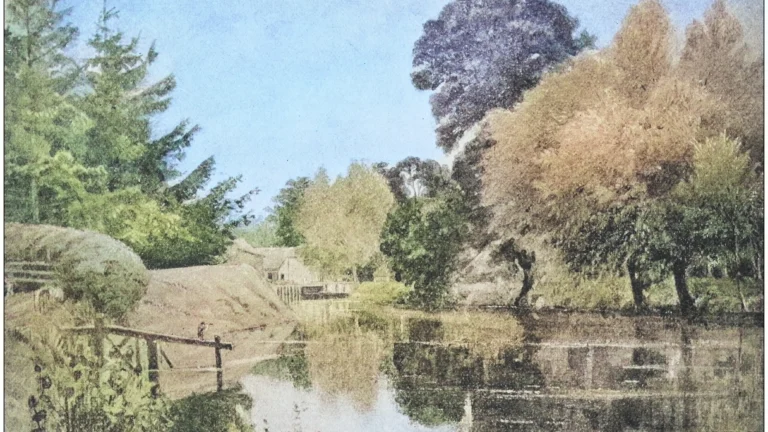
Cookham Mill – Getty images
Nimbys know it seems unreasonable to just oppose new homes, so they come up with objections that sound more valid
This week, Nimby Watch ventures out to the village of Cookham, just south of High Wycombe, and about 30 miles to the west of London…
What a beautiful village! Something seems very familiar about this place, though. It should: Cookham might have become the archetypical English village, not least because it served as the real-world inspiration for ‘The Wind in the Willows’, as Kenneth Grahame lived here when he wrote it for his son.
Oh yes, lots of idyllic rural locales, Ratty, Mole and all that. There was an irritating driving frog, too, wasn’t there? But I wasn’t thinking of the book. It was, famously, an irritating driving toad who set off the events of the book. But even if you’re not up to speed on your Willows lore, you might know Cookham as one of the Sunday Times’ Best Places to Live list in recent years. Its combination of beautiful countryside, independent shops, breweries and delightful places to eat keep it near the top of the charts – and probably contributes to the average house price being somewhat north of £800,000.
That’s all very plausible, but we both know I’m not a broadsheet reader. Why do I know it? Well, it was for many years the home to which singer Chris Rea was driving every Christmas, and it also counts luminaries such as Timmy Mallett and Ross Kemp among its famous residents. Truly, it’s a village with a whole constellation of stars.
This is a desirable place to live, with lots of local amenities, and it’s within 30 miles of London. This is exactly the sort of place that should expand
THAT’S the one. So…what are we doing here, then? It’s going to involve bulldozers, isn’t it? Maybe a few: this is a desirable place to live, with lots of local amenities, and it’s within 30 miles of London. This is exactly the sort of place that should expand, and there’s a developer who wants to build here.
What are we talking here? This is going to be some huge 800-home estate that will turn Cookham into a town, right? Are you expecting me to be on board with bulldozing poor mole and ratty? I mean, I’m not sure the residents of Cookham would be all that enthusiastic about sharing their village with rats, but…not really. The plans we’re talking about here concern building up to 48 homes on a field towards the west of the village.
I see what you’re doing here. You expect me to go along with this just because there’s not that many homes, don’t you? But even a few dozen homes can ruin an area – who wants big soulless brick boxes right where their view used to be? Well…let’s talk ‘character’. The field that would contain most of this proposed development is ‘well enclosed by substantial hedgerow’, which would remain after the building. Most of the homes would be small, and half of them would be affordable. None would be taller than two storeys. There is a planned ‘ecology corridor’ alongside landscaping and public open space. The field is classed as green belt, rather than grey belt.
Okay, so they’ve done something. But is that really all we can expect from greedy, profit-making developers? I mean, it sounds like an awful lot to me. But no, that’s not all: the developer would also have to provide £800,000 as a contribution in lieu of building community amenities, £200,000 of which would go to the local parish council – and it would have to pay even more towards local infrastructure.
So…at least an extra £800,000 just to build fewer than fifty homes? Yup.
Well, has all of that at least won over local support? It has not!
I’m sure they have good reasons, though. Well, let’s hear what parish council chairman Bill Perry had to say: ‘The residents have previously been, whenever I’ve talked to them, not pleased about the idea of having further houses beyond their back gardens,’ he told the Maidenhead Advertiser. ‘They look out on a field at the moment and that’s the way they like it.’
Oh. Oh indeed. It starts to feel like something of a no-win situation, doesn’t it? Much of our planning system seems designed on trying to tackle the reasons people say they don’t want new houses in their area: infrastructure concerns, local amenities, public spaces, biodiversity. But we should maybe ask ourselves whether the reasons people say they don’t want houses are the actual reasons they don’t want houses.
It sounds like you think you know why Nimbys actually object to new homes. Yes: they just don’t want them! People know this doesn’t sound reasonable, so they come up with objections that sound more valid – like facilities, or that homes aren’t affordable, or that there isn’t enough provision for wildlife. But really, they just don’t want the homes, and for each problem that’s solved, they’ll find a new reason to object instead.
Well, if each of the objections leads to the new homes being better, what’s the problem? What does ‘better’ mean here? Because each of these adds more cost and reduces profits, making building new homes less desirable for developers, as well as making the process much slower.
By taking the pretend objections seriously, we reduce the benefits of building new homes, in exchange for doing nothing to reduce the objections against them. If we can’t build 48 small homes on a field in Cookham, we’re never going to build 300,000 nationwide in a year, and even that isn’t actually enough to tackle the housing crisis.
Well, that’s depressing. Can’t you leave us on a more optimistic note? Not unless you can convince Mole to turn Mole End into an HMO any time soon, no.


This week, Nimby Watch is paying a visit to the University of Warwick Warwick! What a beautiful place to visit. We’ve got the River Avon, a truly historic castle – begun by William the Conqueror himself – and a beautiful series of heritage buildings. What a delight. I assume you want to bulldoze half of […]

This week, Nimby Watch is in Cardiff Bay, at the site of the Welsh Senedd Oooh…Wales. Why are we here? Surely you’re not about to kvetch about the Senedd building. They finished it 20 years ago! I’ll admit it’s not my favourite building from the outside – very generic glass-and-steel – but the inside is […]

This week, Nimby Watch is golfing in Sevenoaks, a leafy town firmly within London’s commuter belt. Hang on, we’re golfing now? Since when did either of us play golf? Hey, I’ll have you know I placed third in a golfing competition just last month. I take my time at the tee deeply seriously. That was […]


