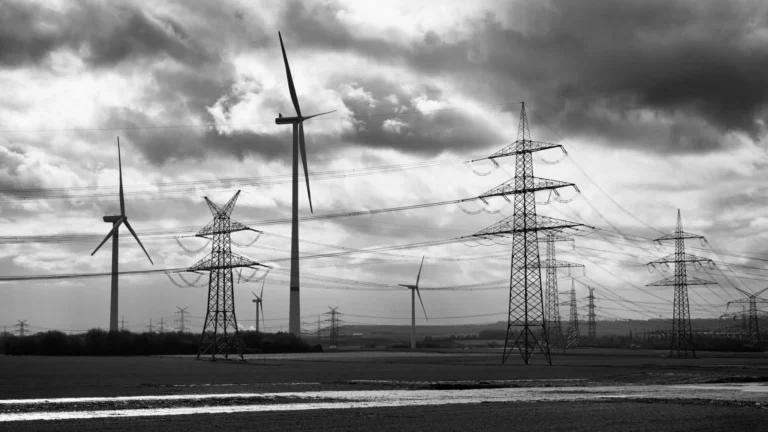
Britain was the cradle of the Industrial Revolution – where cheap, abundant coal fuelled the inventions that built the modern world. Those breakthroughs – railways, modern medicine and electricity – transformed humanity. But we often forget that it was energy, our ability to produce it and (crucially) to store it, that made all of this possible.
Yet despite this proud history as the original energy superpower, modern Britain is anything but: it is burdened by crumbling infrastructure, a sclerotic planning system and skyrocketing bills. Central to these energy challenges is our energy insecurity.
If global fuel supplies ran short tomorrow, could we keep the lights on? In Britain today, the answer is not a straightforward yes
In fact, a new global index from the Adam Smith Institute shows that Britain trails behind the US, Canada, France and Japan for energy security. Among G7 nations, only Italy and Germany rank lower – the latter a country that has become an international byword for energy failure after its Green Party systematically shuttered its nuclear fleet, causing it to rely instead on Russian gas.
Of course, when it comes to energy security it is not merely our economic peers that outstrip us. Britain is now less energy secure than Romania, Serbia and Azerbaijan. Given the staggering disparity in development, the comparison ought to be deeply alarming.
What makes this even worse is that the UK’s high GDP artificially boosts it up the rankings. When it comes to the ability to generate our own energy, we’re in the bottom 7%.
So, what does energy insecurity actually mean in practice? It boils down to a fairly simple question: if global fuel supplies ran short tomorrow, could we keep the lights on? In Britain today, the answer is not a straightforward yes.
The rise of energy security as an issue per se is not strictly the fault of the British political class, but it is driven by geopolitical turbulence. History, contra Francis Fukuyama, has stubbornly refused to end. But our vulnerability is the result of deliberate political choices. For decades, we have closed down power stations, demonised nuclear energy and developed an over-reliance on weather-dependent energy: this is the result.
It’s good to see that the UK has been able to develop renewable energy sources, but wind and solar cannot offer true energy security because they inherently fluctuate. On a bright, breezy afternoon, they generate cheap, clean power. But unlike gas or nuclear, you cannot turn up the wind or sun on demand.
The Germans, also grappling with the downsides of renewable energy, even have a word for the days when the weather refuses to cooperate – Dunkelflaute, a deliciously evocative word that means the dark doldrums.
Because renewable power cannot yet be stored at scale, we cannot choose how much electricity to generate. This causes issues on a freezing Tuesday evening when millions crank up their heating and put the kettle on. As Cadent has demonstrated, peak winter heat demand is four to five times higher than the entire capacity of the electricity grid. The truth is, we cannot keep the nation warm on intermittent power alone.
None of this means abandoning renewables. Cheap wind power has a legitimate role to play in Britain’s energy mix. Until we build a fleet of nuclear reactors (which would take 10 years at a minimum), the basic engineering reality is that fossil fuels remain an essential baseload for any renewable-dominated grid. It is this baseload that we lack.
This is where security really becomes an issue. Wind and solar now account for 36% of British electricity generation, compared to 17% in the United States and 10% in Norway. When global fuel supplies tighten, our heavy reliance on weather leaves us far more exposed than our peers – we have to compete to secure gas in an overheated and competitive market.
Britain buys nearly half its energy from abroad, leaving domestic bills at the mercy of foreign events. We saw the grim consequences when Russia invaded Ukraine: wholesale gas prices tripled, forcing the Treasury to spend £40 billion merely to cushion the blow to household budgets.
This should not lead us to penalise external suppliers; as an unapologetic free-trader, I have no philosophical objection to buying energy from abroad. But it ought to serve as an urgent wake-up call to expand our domestic reserves for times of crisis.
This is not mere hand-wringing; energy insecurity has deadly real-world consequences. One only needs to look at Spain’s catastrophic blackout in 2025, where a grid lacking adequate gas backstops collapsed, leaving seven dead and forcing even military installations onto emergency power.
Fixing this is hardly beyond human ingenuity. After all, this is the country that invented the steam engine and built the world’s first commercial nuclear power station. We sit on vast North Sea gas reserves and possess a legacy nuclear sector, even if it is one we have spent decades neglecting.
Stay informed with our free daily briefing.
To strengthen our energy security, we must gut the planning friction that paralyses infrastructure development. We must also rethink well-intentioned but misguided green taxes, recognising that, even under a Net Zero future, gas will play an important role in the UK’s energy mix for years to come.
We can be an energy superpower once again. Reclaiming that status would protect us in an increasingly dangerous world while simultaneously driving down bills for businesses and consumers. It is actually a win-win: a policy that strengthens our security and eases the cost of living at the exact same time.
Sebastian Charleton is an Associate at the Adam Smith Institute.
More Energy & Environment
24 Sep 2026
Energy & Environment
Richard Lyon
Net Zero can’t help Britain escape the energy trap
Nobody ever built a wind farm with wind. An energy transition is always a project that uses its current energy source to build its replacement while keeping everyone fed and warm. Every turbine, panel, pylon and battery is made, moved, installed and replaced with the help of cheap oil. The question under the plan for […]
23 Sep 2026
Economics
Jack Rowlett
Bristol’s Greens have declared war on the bargain
A century ago you had to be rich to get any kind of choice over your clothes. And if you weren’t in the upper echelons of society you could forget going on a foreign holiday. Today, mass production ensures there is an abundance of clothes to choose from at all budgets, and cheap flights have […]
22 Sep 2026
Energy & Environment
Juno Chowla-Song
How to make gas storage competitive again
The UK only has 13 days worth of natural gas storage capacity, and it’s about to be cut in half. Britain needs gas storage now, and it will need it as North Sea extraction declines. Otherwise, we’re badly exposed to another energy crisis. Centrica has seemingly given us an easy out by offering to regenerate […]
Manage Consent
To provide the best experiences, we use technologies like cookies to store and/or access device information. Consenting to these technologies will allow us to process data such as browsing behavior or unique IDs on this site. Not consenting or withdrawing consent, may adversely affect certain features and functions.
Functional Always active
The technical storage or access is strictly necessary for the legitimate purpose of enabling the use of a specific service explicitly requested by the subscriber or user, or for the sole purpose of carrying out the transmission of a communication over an electronic communications network.
Preferences
The technical storage or access is necessary for the legitimate purpose of storing preferences that are not requested by the subscriber or user.
Statistics
The technical storage or access that is used exclusively for statistical purposes.The technical storage or access that is used exclusively for anonymous statistical purposes. Without a subpoena, voluntary compliance on the part of your Internet Service Provider, or additional records from a third party, information stored or retrieved for this purpose alone cannot usually be used to identify you.
Marketing
The technical storage or access is required to create user profiles to send advertising, or to track the user on a website or across several websites for similar marketing purposes.