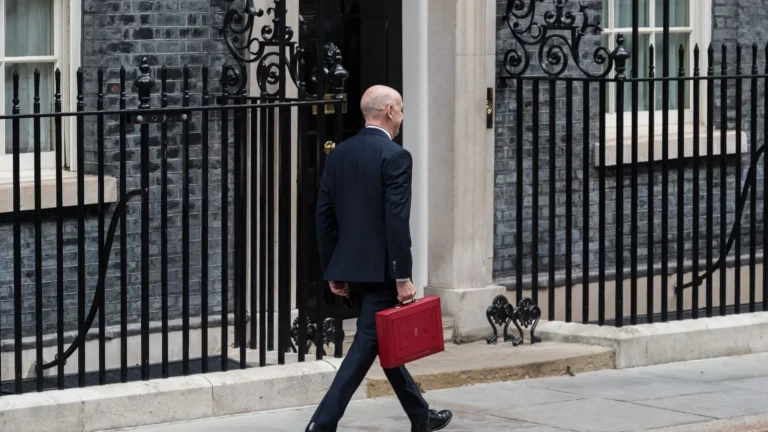
Wiktor Szymanowicz/Future Publishing via Getty Images
Share this article
Yesterday, the Chancellor had the chance to confront a runaway benefits bill and a tax burden strangling growth. He bottled both, and instead billed the banks and workers.
John Healey stood up yesterday afternoon and told the Commons that fiscal discipline was his first commitment. He then announced that Britain will borrow more in every one of the next five years than the OBR expected in March. This year’s deficit is now 4.2% of GDP, not 3.6%. Next year’s jumps from 2.9% to 3.4%. Even in 2031/32 the Government plans to be borrowing 1.8% of national income. If this is discipline, I would hate to see the Chancellor let himself go.
Britain needed a chancellor with a backbone and economic philosophy to do what’s right in the long term for the country, but got a nothing burger Budget designed to change as little as possible
The Debt Management Office (DMO) has just increased planned gilt issuance this year by £4.4 billion to £250.6 billion, while the Treasury’s overall financing requirement has risen by £7.4 billion to £258.6 billion. Britain has another £1.36 trillion of gross financing needs to meet in the next five years, nearly £800bn of which is simply refinancing maturing debt. The DMO has also made a huge change to its borrowing plans, slashing long-dated gilt issuance by £7.7bn, almost a third, while shifting £7.5bn into medium-dated debt. You can see the attraction. Although, somewhat problematic when markets are already expecting the Bank of England to raise rates in November and again next year.
Never one to waste a good excuse, Healey blamed much of the economic deterioration he’d inherited on the orange man across the pond and the conflict in the Middle East, with the OBR now forecasting an additional £14bn in debt interest this year. External shocks are an unfortunate fact of economic life, but they are no excuse for ducking difficult decisions at home. If anything, a worsening fiscal outlook makes the case for spending restraint, particularly on welfare, all the more urgent.
Treasury ministers know the benefits bill is out of control. The state pays millions of working age adults to not work on questionable health grounds, self-diagnosed anxiety, depression or a weak constitution. In 2025 the Government tried some modest tinkering with disability benefits, and Labour MPs revolted in droves, presumably worried about upsetting their voters. Since then, no one in the Government has dared to mention the subject. Ministers call it compassion. I call it political cowardice.
Of course, the truly sick and disabled must be looked after. But too many claims are waved through unquestioned and billions are lost to fraud and error every year. Ministers should be making assessments more difficult, requiring more rigorous, face-to-face assessments, tightening eligibility rules and making sure work always pays more than staying at home.
Instead, the blob rolls on undefeated, with all its overlapping quangos and bloated procurement arrangements. The public will rightly ask the question; how has spending risen year after year with little to nothing to show for it from public services?
The OBR now expects Government receipts to climb from 41.4% of GDP this year to 42.9% by 2031/32. The tax-to-GDP ratio breaks its historical high of 37.2% in 2027/28 and ends the forecast almost six percentage points above its pre-pandemic level. The morally indefensible ploy of fiscal drag does much of the heavy lifting, pulling more modest earners into higher bands every year the thresholds stay frozen. Employers too will continue to pay more for every worker they hire.
Today the banks were in the firing line. The bank surcharge doubles from 3% to 6% from January for 15 months (it will no doubt become permanent), on top of 25% corporation tax, to fund a £100 energy bung to voters. Healey told the banks, ‘I celebrate and I am grateful for the role that you play,’ shortly before reaching into their pockets. Tax on bank profits comes out of retained capital, and capital is what banks lend against. Banks create money when they lend, so squeezing their capital in a stagnant economy squeezes the credit and broad money any recovery needs. As for the 15-month limit, I refer you to income tax, introduced in 1799 as a temporary measure.
Stay informed with our free daily briefing.
Labour will insist there was no alternative. In fact, I was surprised not to hear the usual 14 years of Tory mismanagement blah blah blah. But there is an alternative. Five days ago, the Great British Think Tank, where I am director, published one: £150bn of spending reform over this Parliament paying for £97bn of tax cuts. It takes 200,000 posts out of the civil service, about 38% of current headcount, closer to where it was in 2014/15, and swaps the triple lock for CPI-only uprating from 2028. The savings pay for a £15,000 personal allowance, a £60,000 high-rate threshold, the abolition of inheritance tax and stamp duty land tax, and reform of business rates.
Labour have a huge majority and three years in which it could make the difficult decisions. It could have been honest with the public and told the country that the welfare system is unaffordable, that the tax burden is killing growth and that the state must shrink. Instead, the Chancellor bottled it, choosing to borrow more, tax more and pray for a growth miracle to rescue him. Britain needed a chancellor with a backbone and economic philosophy to do what’s right in the long term for the country, but got a nothing burger Budget designed to change as little as possible.
After months of anticipation, Alan Milburn’s long-awaited review into Britain’s NEETs crisis has now been released. Milburn’s report does address the NEETs crisis with the ambition required. With almost a million young people not in employment, education or training, he rightly says that ‘we’re at risk of a lost generation’ of young people, and his […]
20 Nov 2026
Taxation
Peter Young
We must scrap the pestilential small taxes
Alan Milburn revealed the truth about one of Britain’s most fraudulent small taxes. His NEETS report says we should be ‘honest about what the Apprenticeship Levy is, which is a payroll tax. It is not a hypothecated tax and it is not ringfenced for apprenticeships. Government sets an apprenticeship budget, which is generally lower than […]
09 Nov 2026
Labour
Malcolm Gooderham
The UK will pay the price for Burnham’s U-turns
Andy Burnham’s much-promised strong and decisive leadership has been long on vibes, short on action during his first 100 days. With one telling exception. He has stuck to his guns about what the nation should call white bread rolls. Namely, ‘barm cakes’, as they do in his new constituency of Makerfield. In doing so, he’s […]
Manage Consent
To provide the best experiences, we use technologies like cookies to store and/or access device information. Consenting to these technologies will allow us to process data such as browsing behavior or unique IDs on this site. Not consenting or withdrawing consent, may adversely affect certain features and functions.
Functional Always active
The technical storage or access is strictly necessary for the legitimate purpose of enabling the use of a specific service explicitly requested by the subscriber or user, or for the sole purpose of carrying out the transmission of a communication over an electronic communications network.
Preferences
The technical storage or access is necessary for the legitimate purpose of storing preferences that are not requested by the subscriber or user.
Statistics
The technical storage or access that is used exclusively for statistical purposes.The technical storage or access that is used exclusively for anonymous statistical purposes. Without a subpoena, voluntary compliance on the part of your Internet Service Provider, or additional records from a third party, information stored or retrieved for this purpose alone cannot usually be used to identify you.
Marketing
The technical storage or access is required to create user profiles to send advertising, or to track the user on a website or across several websites for similar marketing purposes.