Free markets are the Gulf’s best defence against Iran
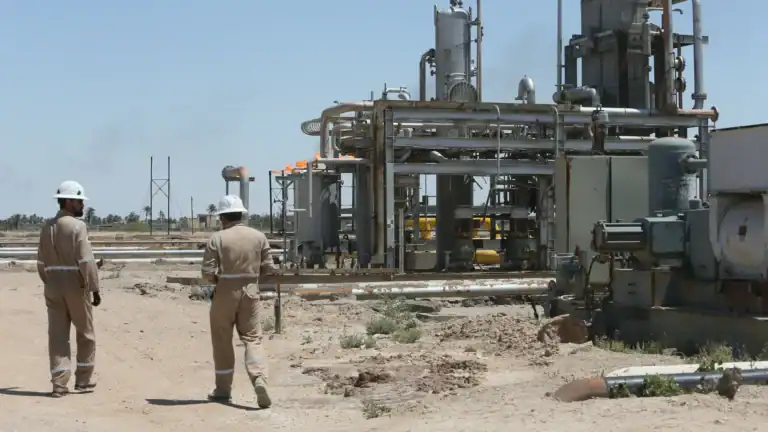
Refinery in Basra, Iraq. Stringer/Anadolu via Getty Images
The Iran war has created the largest supply disruption in the history of the oil market, beating the shocks of the 1970s and the war in Ukraine. Whatever happens with Donald Trump and the Strait of Hormuz, the Middle East oil industry cannot afford to be this exposed again. The Gulf has the money and now the political will to build oil pipelines quickly, but free market reforms are the missing piece.
Middle Eastern National Oil Companies (NOC) are still reeling from the acute revenue shock of the Strait of Hormuz closure. No doubt, they will welcome the news that Oman and the US seem close to a deal with Iran to reopen the Strait. Since Iran closed the strait in late February 2026, Gulf states and Iraq have lost approximately $1.2 billion per day in oil revenue. However, the impacts varied widely between different countries, depending on whether they could bypass Hormuz.
The Middle East’s low productivity is self-inflicted. Restrictive labour laws and nationalistic procurement requirements have slowed down the delivery of oil pipelines across the Gulf
Saudi Arabia, which has the East-West bypass pipeline with 7 million barrels per day (bpd) emergency capacity, saw a 10% increase in oil revenues, helped by higher oil prices. Oman experienced an 80% increase in oil revenue because its coastal geography makes the entire country a Hormuz bypass. Meanwhile, Iraq and Kuwait, with extremely limited bypasses, saw a more than 70% fall in oil revenue.
As a result, every NOC is building bypasses to protect its revenues. Seven oil pipeline projects to bypass the Strait of Hormuz are in the planning or construction phase, of which five were proposed since the start of the conflict.
None of this makes pipelines a panacea. Iranian attacks have hit overland routes as well, cutting East-West pipeline throughput by 700,000 bpd. The value of pipelines does not lie in being invulnerable or optimally efficient. Instead, they are important because they reduce reliance on a single chokepoint and contribute to a more secure overall network.
The NOCs have more than enough funds for this construction. Gulf Cooperation Council national oil companies’ combined capex will reach $115-125bn a year over 2025-7, up 7% from 2024. Sovereign wealth funds in the region already invest heavily, and private capital is pouring in as historic returns have been 12-14%. An investment of $120 billion has been made in Middle Eastern and North African oil transportation, storage and processing projects which are now planned or underway, compared to $59bn in 2020.
Capital, then, is not the bottleneck. In the current scenario, speed is especially important. After the breakdown of the Iran ceasefire, the situation is highly uncertain. Gulf countries don’t know if the hostilities will last for weeks or years. To secure stable oil revenues and balance state budgets, the Middle East needs to build out pipelines as soon as possible.
Many of the obstacles to pipeline buildout have been diplomatic or political. For example, the Basra–Aqaba pipeline through Iraq was delayed due to militant activity. However, when an oil crisis creates a surge of political will to build, as shown by the fast-tracking of pipeline projects all around the region, low productivity becomes more important. In the Middle East, 80.9% of construction projects overrun their schedule, compared to only 66.5% worldwide, which is consistent with their productivity constraints.
The Middle East’s low productivity is self-inflicted. Restrictive labour laws and nationalistic procurement requirements have slowed down the delivery of oil pipelines across the Gulf.
The Gulf construction workforce is 95% foreign. In Jordan, Lebanon, and the Gulf Cooperation Council countries, variations of the kafala employment system tie migrants’ legal residency to a local sponsor. Workers typically cannot leave or change jobs without permission from their employer. Even if they do get permission to leave, they must have another job lined up or risk being deported. Predictably, this invites exploitation.
The International Labour Organization reports that low labour mobility keeps wages low, leading to poor productivity and reducing companies’ incentives to invest in productivity-enhancing technology. Recent reforms have given workers more freedom to change sponsors and leave the country, but no Gulf country has fully abolished kafala.
The market restrictions extend to construction materials as well. Saudi Arabia’s Local Content authority runs a National Product Mandatory List that forces contractors on publicly funded projects to buy over 1,500 types of products from domestic manufacturers. In the UAE, construction firms trying to secure government, semi-government or national oil company-linked contracts must demonstrate that they are prioritising local procurement, hiring or investment.
Meanwhile, regulations grant 10% and 15% price advantages to local companies in Saudi Arabia and Kuwait, respectively. A foreign bidder can be cheaper and still lose.
All of this protectionism means that tenders are decided on localisation rather than merit. Efficiency losses are the natural result. New pipelines will cost more and take longer to build.
None of this makes Gulf construction slow in absolute terms; the average buildout time of 2.5 years is quick by international standards. Still, cutting delivery times by even a few months is worthwhile when each additional day of Hormuz exposure costs the region billions.
The kafala system could be reformed so that after the first two years in the country, migrants are granted a universal temporary work visa for the next five years, allowing them to switch jobs more easily. The UAE’s green visa is a successful precedent for this kind of scheme, although it was limited to those with a bachelor’s degree. Protectionist requirements and price advantages should be scrapped. These reforms are free, immediate and would help insulate the world from the whims of Washington and Iran.

It may feel like a long time coming, but Britain is on the cusp of one of the biggest Brexit wins so far. In May, Britain became the first G7 economy to conclude negotiations on a multi-billion-pound Free Trade Agreement (FTA) with the six-nation Gulf Cooperation Council (GCC), following nearly four years of negotiations and […]
President Trump’s imposition of ‘economic D-Day’ against Iran – a series of sanctions against any nation dealing financially with Iran, as well as banks and businesses – has already been dismissed by the usual suspects whose knee jerk response is always to attack any new measures against the Tehran regime. When it comes to Iran, […]
Last week, the Community Security Trust’s (CST) report covering incidents between January and June 2026 showed alarming results. The unprecedented wave of antisemitism that started on October 7, 2023, when Hamas massacred and kidnapped over 1,200 people in Israel, shows no sign of easing. On the contrary. The 1,926 incidents recorded represent a 21% rise […]


