Money alone can’t stop antisemitism
The Government is spending £251 million to protect the Jewish community – but it is treating symptoms, not the cause
Vuk Valcic/SOPA Images/LightRocket via Getty Images
The Government is spending £251 million to protect the Jewish community – but it is treating symptoms, not the cause
Last week, the Community Security Trust’s (CST) report covering incidents between January and June 2026 showed alarming results. The unprecedented wave of antisemitism that started on October 7, 2023, when Hamas massacred and kidnapped over 1,200 people in Israel, shows no sign of easing. On the contrary. The 1,926 incidents recorded represent a 21% rise on the same period last year. Assaults on Jewish people were up 82%. Incidents in schools rose 59%. Online abuse hit a record 680 cases. And this is only a partial picture, because antisemitic incidents are notoriously under-reported.
Jews in Britain are exposed to antisemitism virtually everywhere: in schools and universities, at work, on public transport, in shops and on the streets. Virulent anti-Jewish racism, age-old tropes about Jewish power and influence, Holocaust minimisation and inversion and blood libels have become normalised. Much of it is now repackaged in a language of human rights, colonialism, claims of a genocide and starvation – all of which don’t hold up to scrutiny or historical facts.
Britain is not a country of Jew-haters. But, as politicians have rightly noted, antisemitism has become a national emergency
Even the Mayor of London has used the divisive and inflammatory ‘genocide’ lie – language that makes hostility and violence towards Jews easier to rationalise. CST notes that antisemitism is ‘becoming more direct, aggressive and explicit’.
Britain is not a country of Jew-haters. But, as politicians have rightly noted, antisemitism has become a ‘national emergency’. The Government’s response has been money: £251 million to protect the Jewish community, including increased policing, intelligence and counter-terrorism efforts. This is necessary, but it treats the symptoms, not the cause. When the money runs out in three years, what then? More police and higher walls around schools and synagogues are not a long-term answer. Nor is it how the Jewish community wants to live.
The high levels of antisemitism and the widespread vilification of Jews are not simply a sudden, grassroots emotional reaction to the war in Gaza. It’s a well-packaged narrative that has been actively amplified and sustained by an ecosystem of ideological actors that include Islamist organisations and activists, religious speakers, campaign networks, charities, trade unions, influencers and sections of academia and civil society.
These actors are not necessarily coordinated, but their narratives are similar and reinforce one another – online, in protests, on campuses – landing in mainstream media and political discourse. This is what makes the ecosystem powerful.
Concern for Palestinian civilians or criticism of Israel are legitimate. The problem happens when criticism crosses into glorifying or excusing terrorism, holding Jews collectively responsible for Israel, denying Jews the right to self-determination, recycling blood libels and other antisemitic conspiracies or portraying Israel and Zionism as uniquely and inherently evil. It is the point at which anti-Israel activism becomes a vehicle for extreme and racist narratives, and for political coercion and violence.
None of this is new. In 1993, the US Muslim Brotherhood’s Palestine Committee in Philadelphia discussed how to support Hamas and its campaign against Israel while legitimising the cause in the West through the more palatable language of human rights, suffering and liberation. But these ideas did not originate with the Muslim Brotherhood. European antisemitism provided much of the raw material, while Soviet propaganda after Israel’s creation repackaged older antisemitic conspiracies, portraying Zionism as inherently racist, colonialist and part of a global conspiracy for power. These ideas were subsequently adopted and developed by Palestinian and other Arab political movements and internationalised through institutions including the United Nations. Over time, this political language migrated into Western activist, academic and humanitarian discourse, where it is presented as anti-racism, anti-colonialism or human-rights advocacy rather than hostility towards Jews.
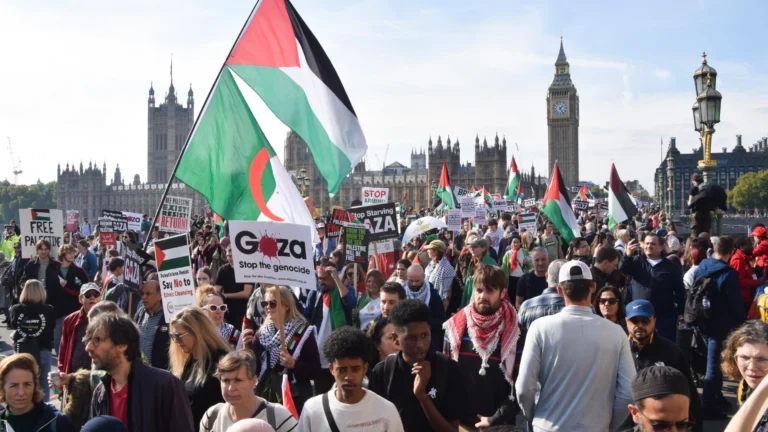
A recent report found that the regular pro-Palestine protests – at which antisemitic incidents have repeatedly occurred – are organised by a small coalition of organisations central to this ecosystem. One of these is the Palestine Solidarity Campaign (PSC). PSC has succeeded in embedding its agenda within parts of British politics and civil society, including in the National Education Union and the University and College Union. The PSC’s influence is particularly visible in local politics, where more than 1,000 councillors have signed PSC pledges, and where Green politicians have become important allies.
Universities are another crucial transmission belt, giving these ideas a sense of institutional legitimacy and passing them on to the next generation. There are many credible reports of anti-Israel narratives being repeated in classrooms and on campus. A student in Manchester said a lecturer defended hostage-taking as ‘the only way for Palestinians to negotiate’ and one campus speaker at UCL even allegedly spread a blood-libel about Jews using the blood of non-Jews to make matzah.
Charities and civil society organisations provide another route into the mainstream. Some are directly connected to hostile foreign powers who have spent decades promoting explicit antisemitic world views. Others are mainstream charities. Claims that originate in these spaces acquire the authority of respected institutions, reach new audiences and are then fed back into the wider ecosystem.
If Britain wants to combat antisemitism, it needs to understand the networks, funding, foreign links, narratives and amplification mechanisms involved. Universities, charities and public bodies should not promote racist ideologies and disinformation with impunity. Online coordinated foreign influence and disinformation campaigns must be taken more seriously. Organisations conducting sustained political campaigning, including intimidation of MPs and mass mobilisation, should not be able to use opaque corporate structures to conceal their funding sources.
Our public representatives must also be more responsible in the language they use. The Government promotes education on antisemitism, but MPs, councillors and other elected officials undermine those efforts when they repeat anti-Jewish conspiracies or use inflammatory language.
The answer is not to police opinion. People must remain free to voice their views and stage protests. But freedom of speech does not require us to be indifferent to the infrastructure that amplifies hatred that ends in discrimination, violence and terrorism.
We must stop pretending that antisemitism appears spontaneously every time something happens in Gaza. There is well-oiled machinery that turns events in the Middle East into a vehicle for anti-Jewish hatred. If the Government is serious about reducing antisemitism, it must confront the ecosystem that produces, amplifies and normalises the narratives that sustain it.
Britain’s prisons are at breaking point. This month, 85,840 people are currently detained across prisons in England and Wales, with the estate operating at over 96% capacity. In 2023, 66% of prisons were operating above their original design capacity. The situation is desperate. In 2024, with fewer than 100 spare beds across the entire male […]
Just before Christmas, His Majesty’s Inspectorate of Prisons (HMIP) walked out of HMP Swaleside on the Kent coast to issue a rare red flag warning to Ministers. The ‘Urgent Notification’ painted a dystopian picture of an institution no longer in the control of the state, wracked by staff shortages, violence and drugs. The prison was […]
This week, the think tank Policy Exchange delivered a mid-term report on the performance of Metropolitan Police Commissioner Mark Rowley, who was enticed out of an apparently lucrative retirement to take command of the capital’s beleaguered police service. He will not find it agreeable reading, but then little that crosses his desk these days is. […]