Why did anyone ever listen to Noam Chomsky?
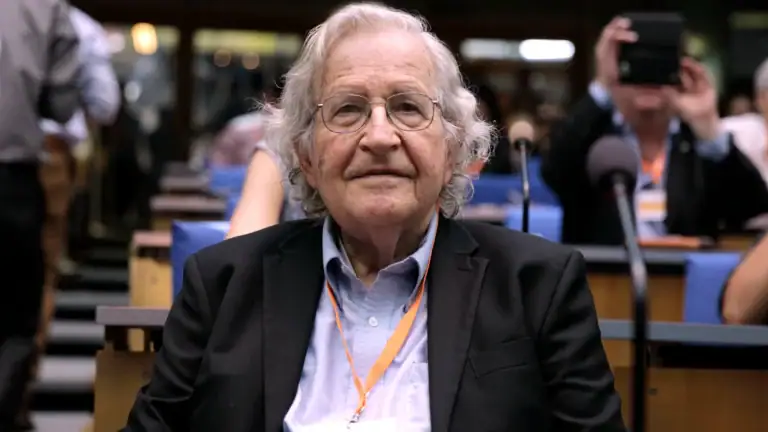
Photo: Brill/ullstein bild via Getty Images
‘It’s painful to say, but I think the best way to proceed is to ignore it.’
It’s the kind of supportive message you might expect from a friend you consulted for advice on, say, how to get over a breakup. Not the advice you would send to Jeffrey Epstein if you were one of the most famous left-wing academics in the world, and he was facing high-profile accusations of sex trafficking. Yet that is precisely the message that Noam Chomsky sent, while commiserating with Epstein over the horrible way he was being treated by the press and the public.
Of course, the fact that Chomsky’s name is in the files does not imply illegality. But his anti-capitalist acolytes might be surprised to see the bespectacled grandfather of the conspiratorial student Left in there at all. Yet for a number of years, they plainly were on friendly terms.
A thoughtful piece in The Critic a few days ago encouraged us to take Chomsky’s political writings on their merits, not coloured by his association with Epstein. I couldn’t agree more. Because even if you take Epstein out of the equation, Chomsky was long due for a fall from grace.
To be clear, it would be unfair to accuse his work on linguistics – for which he originally made his name – of being as risible as his opinions on politics and world affairs. His theory of Universal Grammar has proven influential among those brighter than me in studying how language and grammar are acquired and developed.
Yet if his career as a linguist propelled him to academic fame, then Chomsky’s stance on Pol Pot’s Cambodia brought him political notoriety. His record of denial on the Communist genocide in Cambodia is grotesque. In an article he co-wrote with Edward S Herman in ‘The Nation’ in 1977, he talked of ‘entirely fanciful’ accounts of Khmer Rouge barbarism.
The central plank of the piece is that contemporary scholarship on the havoc wrought upon the Cambodians from 1975-1979 focused too much on Pol Pot and not enough on the Americans, whose war in neighbouring Vietnam bled over the border. Two things can of course be true at once. That US bombing campaigns killed tens of thousands of people is a matter of record. But so is the existence of Pol Pot’s ‘killing fields’, where under the overgrowth could be found the bodies of approximately 1.3 million Cambodian victims to Communist depravity.
Chomsky’s appetite for controversy later extended to another tragedy, thousands of miles away in Bosnia.
In 2005, the academic was interviewed in The Guardian, during which he made a number of inflammatory statements about the 1995 Srebrenica massacre, when Serbian forces killed 8,000 Bosniak Muslims. The interview was ultimately pulled due to the journalist having sexed up the wording of one of her questions about Chomsky’s support for fellow Bosnia revisionist Diana Johnstone. But it can still be found, and the vast majority is unrelated to the passage about which Chomsky filed an editorial complaint. In it, he dismissed people’s concerns over the atrocities in Bosnia, stating that many had fallen for ‘a hysterical fanaticism about Bosnia in western culture… like old-fashioned Stalinism’. Chomsky also claimed that the journalist Ed Vulliamy, whose work uncovering the Bosnian genocide earned him awards, was ‘caught up in a story which is probably not true’.
The interview provoked outrage, including a letter to The Guardian from a survivor of the Serbian concentration camps. Undeterred, Chomsky, in an interview published in 2006, took aim at those who suffered during the 1998-9 conflict in Kosovo. The essential claim Chomsky made was that describing the ethnic cleansing of thousands of Kosovo Albanians as a ‘genocide’ was to buy the West’s propaganda, which he claimed cynically used the killings to ‘justify’ its ‘massive self-adulation’ and military intervention. Chomsky mocked the use of ‘genocide’ to described the aforementioned massacre of thousands, because ‘if that’s genocide’, then ‘the whole world is covered in genocide’.
Cambodia, Bosnia, Kosovo: for Chomsky, these atrocities were not examples of the brutal fallout of ideological projects gone terribly awry. That would be too simple. Regardless of the scale of the murder involved, Chomsky was determined to prove that the developing world is always the perennial victim of US imperialism. This has been his life-long mission. And his abject refusal to recognise that developing nations are capable of committing their own evil too, even in the face of the most glaring, gory evidence, has long singled him out as one of our most dangerously myopic thinkers.
Tragically, Chomsky’s pig-headed fetishisation of the ‘global south’, and the enduring readership for his work on college campuses, continue to provide the philosophical bedrock for any number of wrongheaded mass movements. From those on the Left who celebrated Hamas’ massacre on October 7, 2023 as a just protest against Israeli occupation, to demonstrators who bullied Venezuelans who cheered Donald Trump’s deposition of the murderous Nicolas Maduro, Chomsky’s influence is felt everywhere.
It shouldn’t have taken the spectacle of a socialist sharing a private jet with an ultra-wealthy paedophile for people to think again about Chomsky’s legacy. Yes, Chomsky’s association with Epstein is a source of shame – but so was the Left’s long and fervent embrace of his terrible ideas.

Young Britons have stopped having sex. This is news to me, obviously, but according to a recent study in The Lancet, British people, particularly teens and young adults, are having less or no sex compared with past generations. Adults under 45 have sex an average of only twice a month, compared with once a week […]

In a novel I have begun publishing on Substack, ‘The Allowance’, I imagine a future Britain in which AI and machines do most of the work and the state provides citizens with a daily allowance. Any credits (‘money’) left unspent at midnight expire. Saving has become socially suspect, and a government that began by taking […]
In the summer, when Andy Burnham arrived at the door of Downing Street having been appointed Prime Minister by the King, he declared that he was going to end 40 years of neoliberalism. If we have indeed had 40 years of neoliberalism, it has very much passed me by. There is of course a strong […]


