We should fight back against Burnham’s rejection of neoliberalism
The neoliberal project was vital for ending the post-war consensus and it rescued us from bankruptcy
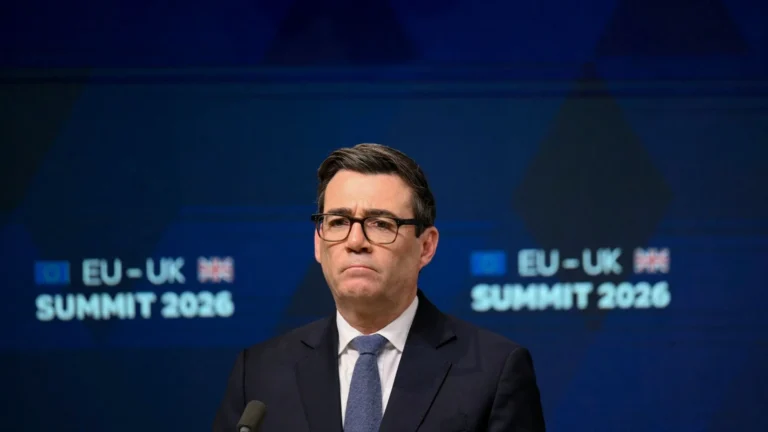
NICOLAS TUCAT / AFP via Getty Images
The neoliberal project was vital for ending the post-war consensus and it rescued us from bankruptcy
In the summer, when Andy Burnham arrived at the door of Downing Street having been appointed Prime Minister by the King, he declared that he was going to end 40 years of neoliberalism. If we have indeed had 40 years of neoliberalism, it has very much passed me by. There is of course a strong case for calling the government of the 1980s and 1990s neoliberal and to a certain extent through the 2000s New Labour exemplified many neoliberal features. But as a man born in 2001 (yes, I know, for many of you it will be hard to believe that someone born after the turn of the millennium can ever become a man), I can’t say that I can remember a time when neoliberalism was in vogue.
It is very easy to make sweeping statements about 40 years of neoliberalism. This is because essentially no one really understands what neoliberalism is. Neoliberalism was an attempt to revive the original liberal idea that most economic decisions are better left to people and businesses than made for them by the state. That meant allowing people to recognise price signals, rather than the government. The state would still enforce contracts, protect property and set the rules under which firms competed. The state would set the rules of engagement for business, rather than running business itself.
If freedom is only an afterthought and we consider it a welcome by-product of a strong economy, then it remains incredibly fragile
In a way, neoliberalism isn’t really an ideology. It lacks a set of guiding principles other than that economic growth is a good thing. For the policymakers that advanced it, it was clear that economic growth could be achieved through wide-ranging liberalisation of regulations and the privatisation of industry. The case for freedom though must go much further than this. If freedom is only an afterthought and we consider it a welcome by-product of a strong economy, then it remains incredibly fragile. As soon as someone presents a freedom-limiting policy that it turns out might boost the economy, we will inevitably fall for it. This is essentially what did happen with the neoliberal project once we allowed in third-way socialists like Tony Blair. Suddenly, when the spreadsheet told him that increasing government spending would be a good thing, the idea of freedom was quickly lost.
Do not get me confused, the neoliberal project was wonderful. It ended the post-war consensus and rescued us from bankruptcy. But it put the idea of a booming economy before the idea of freedom and for this reason, it was fragile. For me, this is why I still consider classical liberalism superior to neoliberalism. They are inherently very similar. They reach broadly the same conclusions but from different starting points. I am more interested in reading Locke than neoliberal thinkers because he made the moral case for man to be left to pursue his own wellbeing. I often consider it a great stroke of luck that a structure which delivers freedom also delivers economic growth, rather than the other way around.
This is the problem when you develop a system which still allows the government to be the setter of rules. If your idea of government is based solely on the idea that the government is responsible for ensuring economic growth, then you can easily slip out of supporting freedom if you become convinced that a state-imposed measure will be good for the economy. This is how you ended up with the bank bailouts. This is how you ended up with our culture where you require a licence to undertake so many different activities in Britain.
When Patrick Henry famously declared ‘give me liberty, or give me death!’ at the Second Virginia Convention in 1775, he did not follow it up with ‘or I’ll take your second-best option – a good economy’. We are fortunate that the pursuit of liberty is rarely at odds with economic goals, but where it might be we must be prepared to hold our resolve and declare that liberty is more important.
I don’t wish to start a civil war with neoliberals though. It would be unwise for us to become Trots, squabbling akin to the People’s Front of Judea. I think it is important though that if we are to fight back against Burnham’s rejection of neoliberalism, that we should do it instead under the banner of classical liberalism.


Young Britons have stopped having sex. This is news to me, obviously, but according to a recent study in The Lancet, British people, particularly teens and young adults, are having less or no sex compared with past generations. Adults under 45 have sex an average of only twice a month, compared with once a week […]

In a novel I have begun publishing on Substack, ‘The Allowance’, I imagine a future Britain in which AI and machines do most of the work and the state provides citizens with a daily allowance. Any credits (‘money’) left unspent at midnight expire. Saving has become socially suspect, and a government that began by taking […]
In 1970 a book was published by the Nobel laureate in economics James M. Buchanan entitled ‘Academia in Anarchy’. At the time, academia really was in anarchy. During the student protests of 1969, American students, convinced of their moral righteousness and their belief that they were on the right side of history, burned around 40 […]


