What Terry Pratchett can teach economists
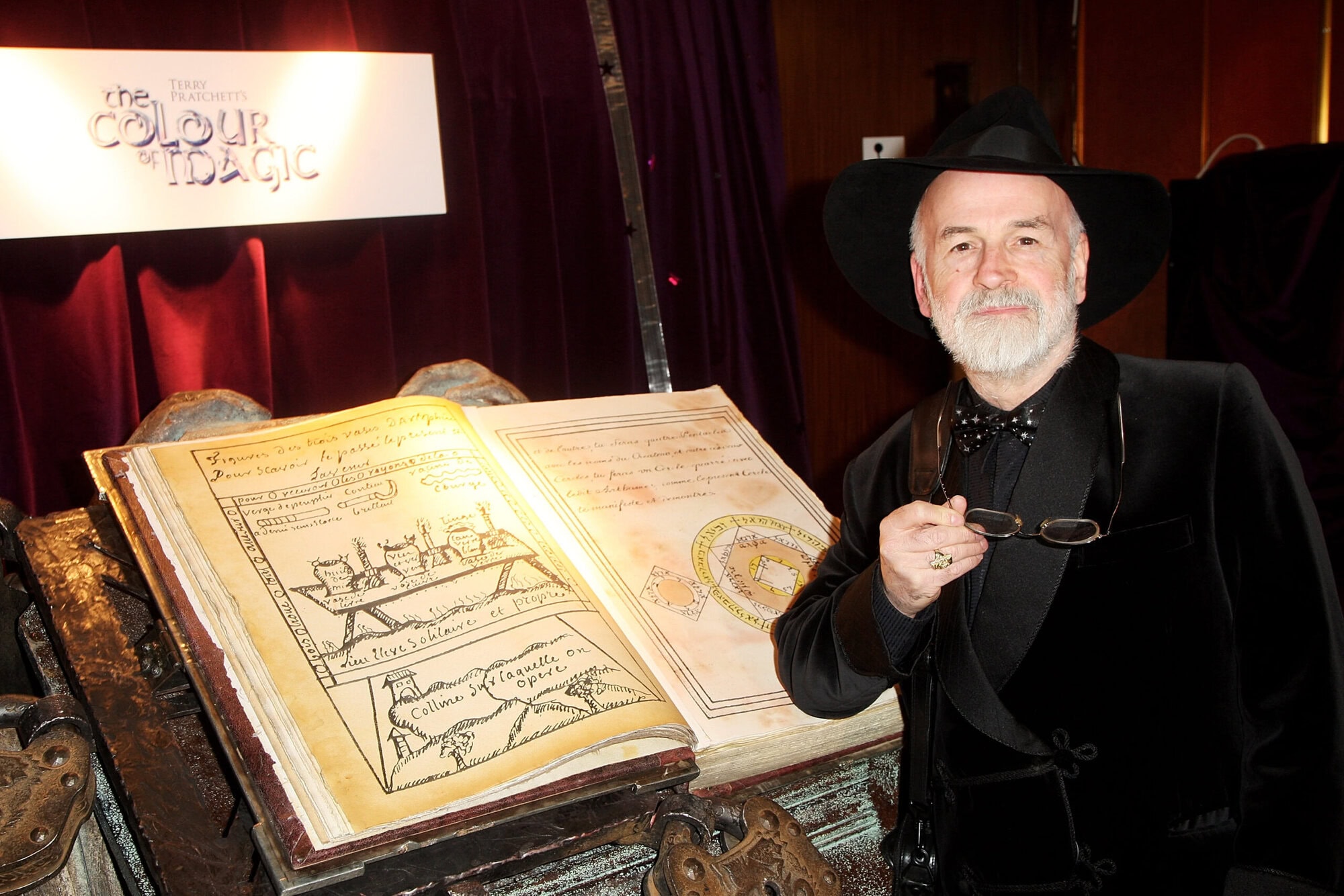
Photo by Dave Hogan/Getty Images
Recently, Kemi Badenoch revealed that one of her favourite authors was the late Terry Pratchett. As well as showing her good taste and judgment, this will surely cause her stock to rise among the many admirers of the sadly departed comic genius. Pratchett was probably the funniest writer in English since PG Wodehouse. He was also, like Wodehouse, an acute observer of real life, with his comic and fantastical stories and novels capturing the nature of that reality better than any number of learned disquisitions.
Most of Pratchett’s writings are an extended series of novels set in the fantasy realm of Discworld. This, as fans know, is a flat world supported by the backs of four gigantic elephants that in turn stand on the back of a massive turtle that is slowly swimming through space. Discworld is very like our world but in a zany and fantastical way. As with all the best satire, much of the humour comes from the way apparently surreal and over-the-top narratives and images actually track reality. It is the combination of the preposterously surreal and the applicability to real life that generates so many laugh out loud moments.
This is particularly true in things to do with economics – or, as it is known in the Discworld, ‘echo-gnomics’ – one of Pratchett’s favourite subjects (along with the idiocies of bureaucracy, law enforcement and academia). His best known excursion is the ‘Boots’ theory of poverty, in ‘Guards! Guards!’. The argument is that someone who can afford to spend $50 on a pair of boots will have the same pair after ten years while someone who can only afford a $10 pair will have to buy ten pairs (and spend $100) over the same time. This, while comic, is also a profound insight into the way low income constrains the options of the poor and makes it hard to, for example, save. It also shows how abstract measures of things like inflation do not capture their differential impact on people with different incomes, and the way that the price of necessities with inelastic demand is much more important than that of discretionary goods such as televisions. It is also relevant for discussions about Net Zero, where the way that it is being done imposes severe costs on the least well off, while the benefits accrue to the better off who can afford the upfront costs.
Money is also covered in Discworld, in ‘Making Money’ where the newly appointed head of the Mint, Moist von Lipwig, discovers in the course of the book that money is essentially an imaginary commodity, created by trust and social interaction and convention, so if that trust (in the banks and the Mint) is lost, the whole system is in danger of collapse. He also finds out that an expansion of the money base that is not matched by an increase in output leads to inflation. The economics of insurance (or ‘inn-sewer-ants’) and the perils of assets and risks being mispriced is one theme in ‘The Colour of Magic’ where one character insures his pub for what he realises is a hugely inflated valuation (the person selling the policy does not realise this, in a classic example of an information asymmetry). When he realises that the policy is essentially a bet that his pub will not burn down, he promptly torches it, leading to the entire city being consumed.
Another topic that Pratchett frequently looked at was technological innovation and its impact (all done in a comic way of course). In ‘Going Postal’ (also featuring Moist von Lipwig), he examines the effects of introducing the postage stamp and a mechanical telegraph system, while ‘Raising Steam’ looks at the introduction of a system technology that has impacts across the economy (the steam engine). In general, in Discworld, innovations and discoveries always have extensive and completely unforeseen consequences and effects, something economists often talk about but without the comic delivery and description, which makes the basic point more memorable.
There is much more for the economist or anyone interested in economics and public policy to get from reading Terry Pratchett. Want to understand why government projects such as HS2 always have massive cost overruns and never meet deadlines? Read ‘Pyramids’ where the entire space time continuum is distorted by the mother of all wasteful and politically inspired white elephant projects. (The joke is that only the distortion of space-time makes it possible to deliver the project). If you have ever wondered about the economics of royalties and publishing, you should read ‘Maskerade’, while ‘Soul Music’ gives an acute description of the way the music and entertainment business works along with an account of how restrictive practices by guilds prevent talented newcomers from entering the business legitimately.
As Badenoch surely knows there is much more, from the portrayal of the ultimate unimaginative and process obsessed bureaucrats in the Auditors of Reality (who appear in several books) to the self serving pomposity of academics. If economists could illustrate their arguments with the kind of comic absurdity Pratchett delighted in, they might persuade more people.
It’s only on the basis of truth that power should be won – or indeed can be worth winning. Margaret Thatcher, 1996 It is a hundred years since Margaret Thatcher was born in Grantham. Fifty years since she took over the Conservative Party. Almost 35 years since she was forced from office. Today’s voters are […]
If you have argued in favour of market-based solutions in some area of society which is under government control, you may have received objections along the lines of ‘I don’t believe the market can handle X’, ‘companies only look at the short term’ or ‘companies are motivated by greed and cannot be trusted to handle […]

Should universities have a say before speakers are excluded from the UK? The Government has cancelled the Electronic Travel Authorisation (ETA) of a controversial left-wing US political commentator, in a move that prevents him from appearing at one of the UK’s oldest debating societies and raises renewed questions about broad and discretionary powers used to […]