Should we have banned Cenk Uygur from the UK?
Sam Barnes/Web Summit via Sportsfile via Getty Images
Should universities have a say before speakers are excluded from the UK?
The Government has cancelled the Electronic Travel Authorisation (ETA) of a controversial left-wing US political commentator, in a move that prevents him from appearing at one of the UK’s oldest debating societies and raises renewed questions about broad and discretionary powers used to exclude foreign speakers whose anticipated speech is lawful.
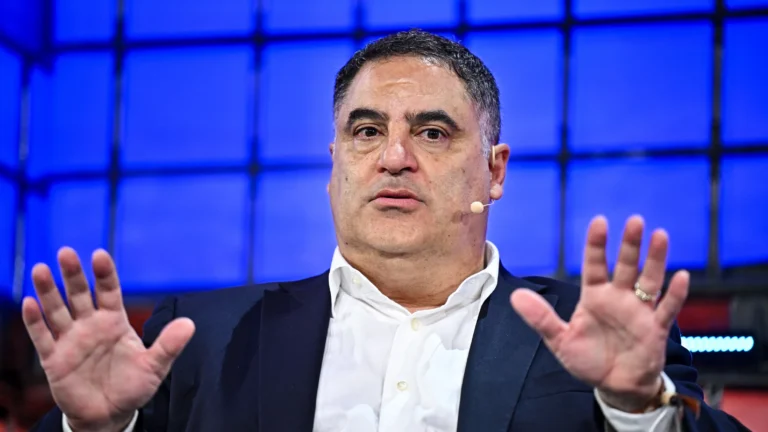
Cenk Uygur, the co-founder of The Young Turks political talk show, which has more than 6 million subscribers on YouTube, was due to appear at SXSW London, a tech-focused festival, and had also been scheduled to speak at an Oxford Union event organised by University of Oxford students. Another controversial figure from the US, outspoken anti-Israel commentator Hasan Piker, was also prevented from attending SXSW.
This appears to be the first high-profile instance in which the system has prevented a speaker from appearing before a university debating society.
The apparent legal basis lies in the UK’s immigration rules, which confer broad discretionary powers on the Home Secretary to cancel a travel authorisation where an individual’s conduct, character, associations or other circumstances are judged to make their presence in the UK ‘not conducive to the public good’. Unlike a criminal sanction, the power does not require proof that a person has committed an offence, or that the speech they intend to deliver would itself be unlawful.
Although ETA cancellations have been used before – most recently against a number of foreign speakers seeking to attend a Tommy Robinson-led rally in London, including the Dutch right-wing commentator Eva Vlaardingerbroek and Flemish MP Filip Dewinter – this appears to be the first high-profile instance in which the system has prevented a speaker from appearing before a university debating society.
Many people will find Uygur’s views deeply unpleasant. In commentary on Gaza, he has described Israel’s conduct as ‘genocide’, ‘barbaric’ and ‘savage’, and accused it of using Jews as ‘human shields’. While he insists on a distinction between criticism of Israel and antisemitism, critics have repeatedly accused him of propagating antisemitic tropes.
But the Oxford Union is not just another events venue. It is one of the UK’s most important student debating institutions and has long played a distinctive role in academic and intellectual life by fostering adversarial debate on controversial and contested questions. Indeed, as Arwa Elrayess, the Union’s president, observed in critical response to the ‘concerning’ decision, the organisation ‘was founded on a simple principle: that ideas should be challenged through debate, not ignored or silenced’.
Although the courts have not directly considered a case of this kind, there is at least some support in the case law for treating institutional context as relevant in this way. In Lord Carlile v Secretary of State for the Home Department (2014), a case involving the exclusion of an Iranian opposition figure whom parliamentarians wished to meet at Westminster, the UK Supreme Court rejected the challenge but nevertheless recognised that the identity of the audience and the nature of the venue were relevant to assessing the seriousness of the interference with Article 10 rights to receive, as well as impart, information and ideas.
As various civil liberties groups – including Index on Censorship, Liberty and the Committee for Academic Freedom – have noted, the decision also raises questions about when lawful but controversial speech should trigger the use of these powers, as well as the transparency surrounding their exercise.
Nowhere is this more acute than where the speech in question is to take place at an institution dedicated to debate, and where, as in Uygur’s case, there appears to be no suggestion that the speaker intended to engage in unlawful speech.
Rather, the issue for the Government appears to be whether his participation could exacerbate antisemitic tensions. In that respect, the apparent rationale for the decision is structurally similar to the type of risk assessment familiar from Prevent, which focuses on reducing the influence of ‘radicalisers’ on ‘susceptible audiences’ and reducing ‘permissive environments’.
Yet even in the context of the Prevent Duty, where universities must have due regard to the need to prevent people from being drawn into terrorism, the Government’s own guidance does not assume that such risks should ordinarily lead to exclusion. Instead, it states that ‘in most cases’, such risks can be mitigated ‘without shutting down speech’ through proportionate measures such as careful chairing, challenge, rights of reply, security arrangements and clear ground rules.
There is therefore a strong case for considering whether a similar approach could be adopted in cases such as Uygur’s. Where the Government is considering the use of immigration powers to prevent an invited speaker from appearing at either a higher education provider or a major debating institution such as the Oxford Union, one possibility would be to give the host institution an opportunity to explain the format of the event and the opportunities for challenge that would be available before a final decision is made.
If, despite that process, the Home Office nevertheless concluded that exclusion was necessary, it should provide sufficient information to enable the host institution to understand the basis of the decision, including why the format of the event would not adequately address the concerns that prompted it.
The state should be slow to substitute executive exclusion for argument, debate and critical scrutiny, particularly in settings whose purpose is precisely to examine controversial claims.

After 17 months of drift following the Government’s January 2025 reset of the Higher Education (Freedom of Speech) Act 2023, the free speech complaints scheme administered by the Office for Students (OfS) is at last going ahead. The Government has now signed the commencement regulations needed to bring the scheme into force. From 1 September […]
Over the past year, my pastime has been defending Americans from Ofcom, the UK’s internet censorship agency, while parrying demands from regulators in Australia, the EU and Brazil. Most readers will know about this work because of a cartoon hamster. That hamster, sent in a letter to Ofcom on behalf of my client 4chan, illustrated […]
The more sensitive souls in my generation have a new Netflix obsession: ‘My Oxford Year’. An American Rhodes scholar goes to Oxford to study Victorian poetry for a year, during which time she meets a handsome professor with whom she shares a turbulent, passionate romance which invariably ends in tragedy. Shots of ancient Oxford colleges, […]