The West’s dangerous delusion on Palestine
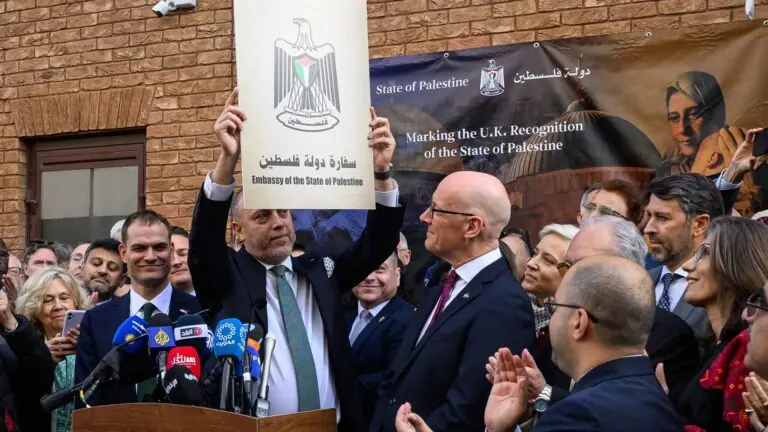
Photo by Leon Neal/Getty Images
When British politicians defend recognising a Palestinian state, they present it as the pragmatic, humane way out of a long-running border dispute. But this framing misreads what the Palestinian national movement has actually been about.
When five Arab nations declared war on Israel immediately after it was established in 1948, they assured the Arabs living in the land that once the Jews were defeated, the entire country would be theirs. From the beginning, the project was not about partition, compromise or two states, but about reclaiming the entire land.
Successive Palestinian leaders – from the PLO to the Palestinian Authority to Hamas – have followed that same path. To the West, they often speak the language of peace and negotiation. But at home, in Arabic, their rhetoric and actions tell another story: armed struggle, rejectionism, glorification of terrorism and the slogan of ‘throwing the Jews into the sea’. These are not the markers of a leadership preparing its people for coexistence, but of one committed to erasing Israel.
Palestinian nationhood itself is relatively recent, and remains fragmented. Before the British Mandate and the resurgence of Zionism, most Arab inhabitants of Palestine did not describe themselves as ‘Palestinian’. The name was imposed by outside powers, first by Greek and Roman invaders, later revived by the British in the First World War. Many of the Arabs living there had immigrated under Ottoman rule, especially in the nineteenth century, from Egypt, Syria, Lebanon, Transjordan and beyond.
Their primary loyalties were not to a putative Palestinian nation-state but to broader Arab identity, clan networks and religious community. A distinct Palestinian nationalism only began to coalesce in the 1920s and 1930s. Even then, it was expressed more through pan-Arabism than as a standalone state project. This explains why the notion of a distinct Palestinian nation-state was never the movement’s primary goal. Leaders consistently framed their struggle in terms of broader Arab unity and religious resistance, rather than building a functional, independent state alongside Israel.
The language of ‘Palestinian nationhood’ functions as a political tool to present a unified struggle to Western observers who expected to see familiar nation-state categories, while masking the true goal of Palestinian leaders. The Palestine Liberation Organisation (PLO), founded in 1964, reflected this clearly. Its original charter described Palestine as an ‘indivisible part of the Arab homeland,’ tying the movement to pan-Arab identity rather than independence.
Hamas, which seized Gaza in 2007, stripped away any remaining ambiguity. Its 1988 covenant calls the struggle a jihad and defines the land as an Islamic waqf, a religious trust, never to be surrendered. The covenant explicitly advocates violence against Jews, not just Israelis, framing it as a religious duty: ‘The Day of Judgement will not come about until Muslims fight the Jews…’
Despite how it is presented in the West, Hamas has always identified itself as part of the transnational Islamist Muslim Brotherhood, not as a national liberation movement seeking to live side by side with a Jewish state. Even when its leaders flirt with diplomacy, their sermons and texts frame resistance as a religious obligation. For Hamas, a Palestinian state is not a vehicle for coexistence but another stage in the sacred struggle against Jewish sovereignty altogether. Recognition here does not reward moderation. Instead, it blesses an ideology of an endless religious war.
Nor do the leaders of the Palestinian Authority (PA) represent a better alternative. They have rejected concrete two-state offers repeatedly. In 2000, Yasser Arafat walked away from the Clinton-Barak proposal; in 2008, Mahmoud Abbas declined Ehud Olmert’s even more far-reaching map. In recent years, the PA has avoided negotiations altogether. Each time, the sticking point was not borders or settlements but the refusal to recognise Israel’s permanence.
The pattern suggests Palestinian leaders do not seek two states side by side, but the eventual replacement of Israel with a single Arab-majority state ‘from the river to the sea.’
The West, however, persists in misreading the conflict as a solvable border dispute. For Hamas and its supporters, it is jihad. For much of the Palestinian leadership, it has been about a dream of reversing 1948. Western policymakers prefer to package it as a territorial conflict because that is morally palatable, but the actions of Palestinian leaders – rather than how they market their intentions to the West – reveal the truth.
None of this denies that many ordinary Palestinians long for peace and security, although a sizeable number do not, and more than a third support Hamas and its aims. Real statesmanship would have demanded that Palestinians first recognise the existence of Israel, give up armed struggle and adopt a genuine readiness to coexist. This requires a moderate leadership and a deradicalisation of a population that has been consuming antisemitic, terror-glorifying content from birth. Such a shift won’t happen overnight, and certainly not simply because Western leaders want it to.
By framing the conflict as a border dispute, Britain ignores what Palestinian leaders have declared for decades. To recognise Palestine in its current state is a recognition of what their struggle stands for: erasure of the Jewish state.

What explains prosperity? That is the most important question in economics. It was this question that led Adam Smith to write ‘The Wealth of Nations’. Before Smith, the physiocrats like Turgot explored it in works like ‘Reflections on the Formation and Distribution of Wealth’. It is this question that makes economics not only interesting, but […]

Just as there is a battle on the Right in Britain, so too is there a battle inside the Conservative Party for what the party should focus on. There are those who are concerned about the threat of political Islam, the damage to the social fabric of the Boriswave and other elements of mass immigration, […]

When William Buckley went on the front page of Time magazine, the title was simple: ‘Conservatism Can Be Fun’. That is what Kemi Badenoch has done at this conference. Conservatism can be fun, can be serious and can learn from its old mistakes. But most importantly, what makes it the world’s oldest party is its […]