The Price Mechanism
The private sector can take Britain back to the stars

24 September 2026
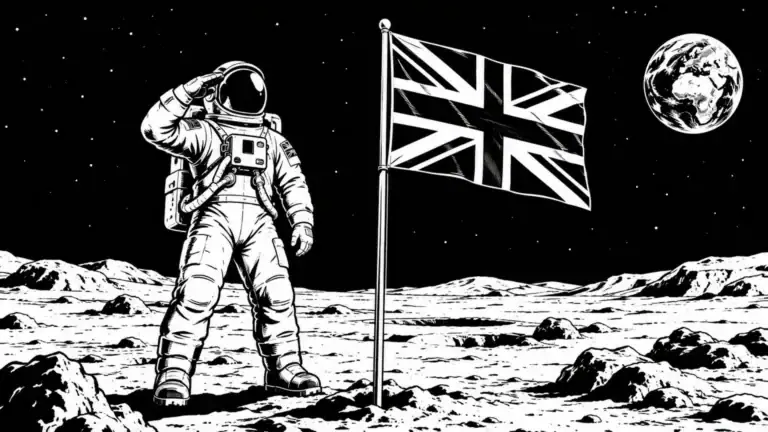
In the graphic novel ‘Ministry of Space’, an alternate history is imagined whereby Great Britain nabs the Nazi rocket scientists before the US or USSR. Churchill becomes, in addition to his other (real) accolades and achievements, the father of the British space programme that sees us win the space race.
There is a particularly poignant panel for any patriotic Brit. A British astronaut stands on the surface of the moon, saluting the Union Jack flag he has planted on the lunar soil. His speech bubble reads: ‘I claim this territory for Her Majesty Queen Elizabeth II and the British Empire. This is not the end of our mission. It is the beginning….’
Imagine if we encouraged entrepreneurs and dreamers to look to the infinite adventure of space, rather than have to worry about the tawdry realities of domestic politics
This wonderfully Anglofuturist alternate history is, sadly, little more than a wish upon a star at this point. As so often turns out to be the case, Britain did actually have a space programme, launching the amazingly well named Black Arrow rocket in 1971 to put a satellite into space. Around the same time we cancelled the project. Another crime to add to Ted Heath’s rap sheet.
Instead, it is our breakaway cousins across the pond who are focused on making humanity a spacefaring species, and Elon Musk, NASA’s Jared Isaacman and the US Space Force are determined to add red and white stripes to the stars.
Behind them sits the Chinese Communist Party, who are likewise hell-bent on achieving parity in the upper atmosphere and beyond. The CGI propaganda video forced upon every visitor to the Communist Party Museum features Chinese efforts in space very heavily.
I was more interested in the absurdity of a Communist Party Museum having a gift shop at the other end of the tour, but the point was clear that they intend to make space another domain of grand strategy and geopolitical competition. The shame that humanity might contaminate the galaxy with the evil that is communist ideology is more than I can bear.
But perhaps the national security imperatives can be the catalyst for a resurgence of private sector activity in space.
Just this month, Troy Meink, the US Air Force Secretary, said at a defence conference: ‘The United States now has on-orbit space control weapons capable of defending the joint force against hostile adversary action.’ This was obviously aimed at China, which has successfully demonstrated an ability to remove old satellites from space using a newer one. This was of course interpreted in Washington as a rehearsal for a more aggressive version of the same in the future.
Perhaps in response to the growing tensions in the firmament, the RAF this week has announced its first unit dedicated to ‘disrupting, degrading, and denying’ hostile activity in orbit. No. III Space Effects Squadron will conduct ‘both offensive and defensive space operations’. The first job will be to pick a much cooler name, one would hope.
Marketing aside, both the politicians and the military seem clear that this new frontier is now of supreme importance to our defence and prosperity. CapX readers will know that the only way to adequately provide any kind of sustainable offering in space will be if there is a competitive and advanced business ecosystem that can compete with the rest of the world. I need not rehearse Britain’s natural advantages, nor our many mind-forged manacles that hold us back.
Instead, we should focus on how bloody cool it would be for Britain to be a world leader in such an endlessly exciting sector. It can showcase the best of our scientific minds to build the future, while also harking back to the age of great explorers from this island like Sir Francis Drake, Dr Livingstone and Captain Cook.
Just for once, imagine if we slipped free the surly bonds of Earth and encouraged entrepreneurs and dreamers to look to the infinite adventure of space, rather than have to worry about the tawdry realities of domestic politics. JFK understood this inspirational quality with his moonshot pledge. And then the Americans went and did it.
Imagine the pride in seeing the Union Jack on the Moon, Mars or further afield. ‘Ah, but a man’s reach should exceed his grasp, / Or what’s a heaven for?’


Sam Altman, CEO of OpenAI, and Dario Amodei, CEO of Anthropic, have called for increased regulation of AI to slow down the pace of development. They warn in apocalyptic terms of the dangers their own technology poses. After Jacob Coxon, a researcher, resigned from Anthropic, stating that he could no longer justify working on AI […]

It’s been reported that officials in the Trump administration have given their UK counterparts a dressing-down over the Online Safety Act and the social-media ban for under-16s. As someone who previously worked on digital trade for the UK government, this does not surprise me. Both the Trump and Biden administrations have seen British laws such […]

The Victorian economist William Stanley Jevons was clearly a worrier. When, in 1863, the Tyneside arms-maker Sir William Armstrong calculated that Britain’s coal would run out in 212 years, Jevons checked the sums. Armstrong had assumed the country’s appetite for coal grew by the same tonnage every year. But it actually grew by the same […]