The IMF has fallen for Labour’s fiscal fiction
Ian Forsyth/Getty Images
The IMF has just published its biannual World Economic Outlook. The report appeared to be modestly good news for the UK, predicting higher-than-expected economic growth of 1.3% in 2026, up from a 1% forecast in July.
But one thing that caught my eye was the way that the IMF reported that the UK would see the biggest deficit reduction among the G7 industrialised nations. For example, Treasury Minister Torsten Bell tweeted that ‘the UK is doing more than anyone else in G7 to strengthen our public finances. We are delivering the fastest fiscal consolidation in the G7 and forecast to have the smallest deficit in 2031’.
The IMF Managing Director has said that ‘The UK is actually one country where action to reduce the deficit has been taken decisively.’
The BBC showed this graph:
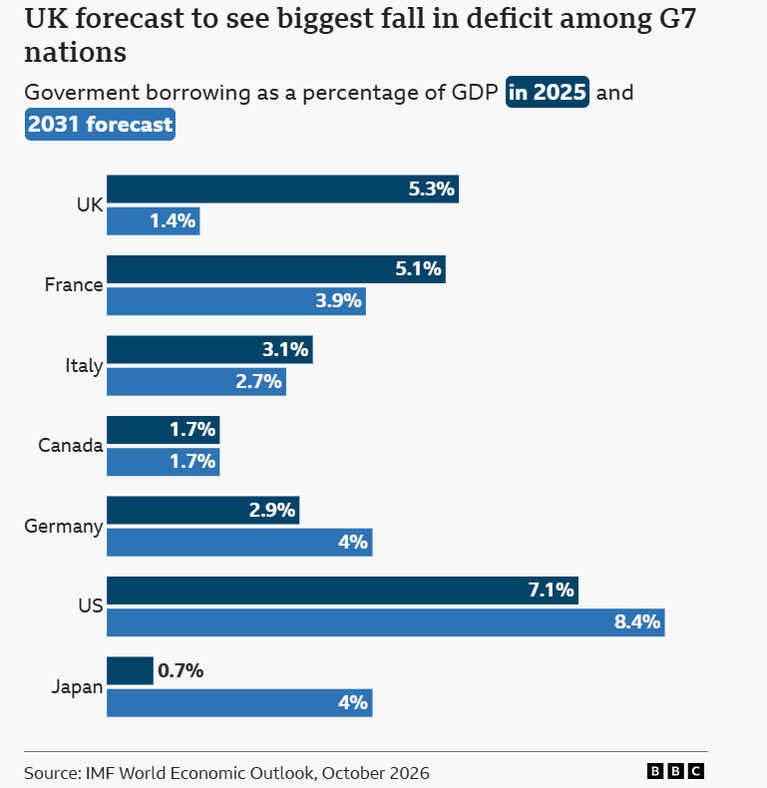
So what’s going on? Is it really the case that the UK can pat itself on the back for outstanding fiscal prudence?
I don’t think so, for four reasons.
You have to have somewhat heroic levels of trust to believe that Labour ministers will stick to these spending plans
The first is that all the IMF is doing is pointing to economic forecasts produced under this government. The Washington-based organisation is highlighting spending and taxation plans drawn up when Rachel Reeves was Chancellor, plans designed entirely to meet the fiscal rules.
As a reminder, the main fiscal rule is that the Office for Budget Responsibility (OBR) feels it can forecast a current budget surplus in three years’ time. But because the target rolls forward, we never get to see whether a government actually delivers this surplus. So there is always an incentive for the government to show ‘prudence’ in later years, while not having to cut spending today.
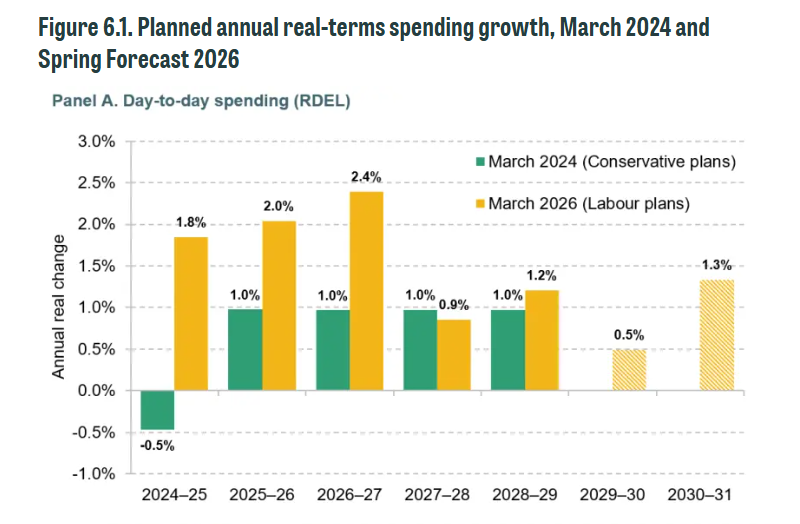
Look at the chart below from the Institute for Fiscal Studies. It shows that the Government plans to increase spending drastically in 2026-27, then cut back significantly at the back end of the forecast period leading up to the election.
But one thing we know about this Labour Party is that it hates cutting spending. Previous attempts to remove the winter fuel allowance or trim welfare spending were reversed after a backbench rebellion. And that was straight after, rather than in the run-up to, a general election. So you have to have somewhat heroic levels of trust to believe that Labour ministers will stick to these spending plans.
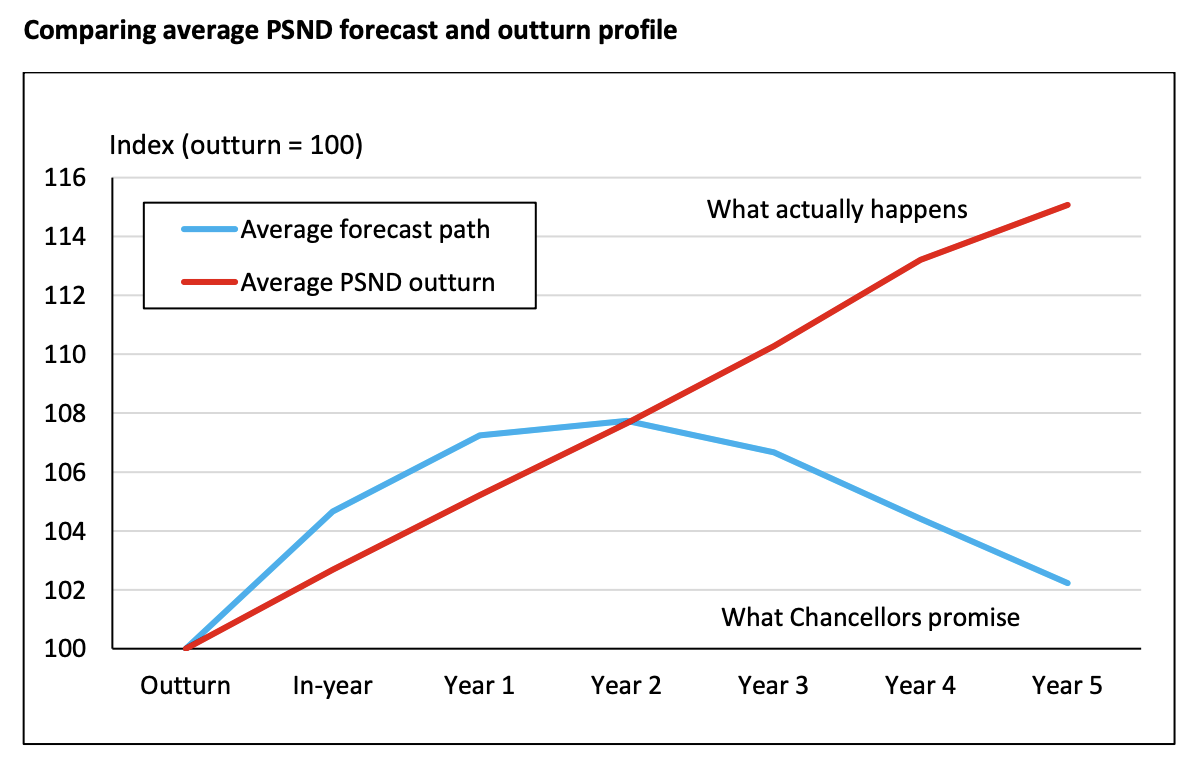
The second reason for scepticism is that no chancellor for a long time, of whatever party, has stuck to their fiscal rules. The chart below comes from OBR analysis looking at data from 2010 onwards. It shows that all chancellors promise to reduce spending and debt, but all chancellors just ramp up the spending when the time comes. The reason for this is the way the fiscal rules are designed: they don’t reward chancellors for actually delivering a budget surplus. All a chancellor has to do is promise to cut spending in the future. And promises are cheap – and involve expending no political capital.
This is a longstanding problem. In a report for the Centre for Policy Studies last year, I looked at 54 UK medium-term fiscal forecasts from 1990 to 2019. That analysis showed actual total managed expenditure was always above what was forecast in the final year. Even discounting extraordinary events like the Covid pandemic, there was not a single example of a year when government spending was less than had been forecast. So John Healey would have to be a pretty special chancellor to break that record.
The third reason the IMF is wrong to give the impression that Labour’s fiscal consolidation will definitely take place is the massive pressures on state spending coming from all sides.
Everyone agrees that there needs to be higher defence spending. Additionally, there are relentless demographic pressures in health and pensions. Working-age welfare is projected to continue increasing, and any savings from real welfare reform will be long term rather than immediate. In addition, Andy Burnham wants to create a new social care service, which will cost a lot extra. Many of these promises are unfunded.
Finally, the G7 is hardly a group of countries that we want to compare ourselves to. Four G7 members have net debt higher than the UK as a share of GDP. Germany, France and Italy are burdened by low growth and massive welfare states. The US has high growth but an eye-watering deficit. This is a club of the mediocre.
For these reasons I’m sceptical of the IMF’s praise, and even more sceptical of what Torsten Bell has said. So, what should the Chancellor do? I’d start with a real commitment for which he will be accountable. Perhaps Healey should promise that, by the next election in 2029, he will have delivered a current budget surplus, something that no Tory chancellor sustained in the previous government.
There is massive uncertainty about what will happen to the UK economy, and our national accounts, in coming years. Wars, pandemics, natural disasters and geopolitical posturing are the new normal. What the UK needs is greater resilience achieved through low government debt, strong growth and an effective defence force.
But we are in danger: a major shock will blow up these plans and expose the UK to the wrath of international lenders, who will demand radical cuts to public spending, which will hurt the people Labour are trying to help.

For the past 10 years, the European Centre for Entrepreneurship and Policy Reform (ECEPR) has been mapping Europe’s knowledge-intensive jobs in a recurring study, with a particular focus on how the geography of knowledge is shifting. The 2026 index shows the UK ahead compared to other large nations in Europe, but also reveals that smaller […]
‘Just when I thought I was out, they pull me back in,’ says Michael Corleone in ‘The Godfather Part III’. A decade after we voted to leave the European Union, much of the establishment is still in denial about the verdict that was delivered. Andy Burnham has been absolutely shameless. Campaigning in the Makerfield by-election, […]

What explains prosperity? That is the most important question in economics. It was this question that led Adam Smith to write ‘The Wealth of Nations’. Before Smith, the physiocrats like Turgot explored it in works like ‘Reflections on the Formation and Distribution of Wealth’. It is this question that makes economics not only interesting, but […]