The Great British meal deal should make you proud
Shoppers entering Tesco Express store, offering groceries and quick service in the UK.
I moved from New York to Britain and I keep getting asked when I’m going back.
Not by my family, or my friends back home, but by British people. They tell me about flat wages, looming youth unemployment and an air of decline throughout the country. But no one talks about lunch, because everyone here takes it for granted.
I used to work in retail in Manhattan, and I would bring my own sad sandwich for lunch every day. Sometimes I would splash out on a slice of pizza. After tax, a deli sandwich cost almost as much as my hourly wage. Buying that was out of the question.
John Healey has found the wrong scapegoat for the cost-of-living crisis. Squeezing supermarkets harder won’t make lunch cheaper
But here, at Tesco, £3.85 with a Clubcard buys three items, and the price on the shelf includes tax as well. The meal deal is varied, accessible and cheap. Thanks to its supermarkets, this is one area where Britain still leads the world.
Yet last month, the Chancellor warned supermarkets against taking shoppers ‘for a ride at the pump or the till’. John Healey has it the wrong way round, and meal deals are the clearest example.
To start, prices have fallen. In real terms they have dropped since 2012, against a background of food inflation.
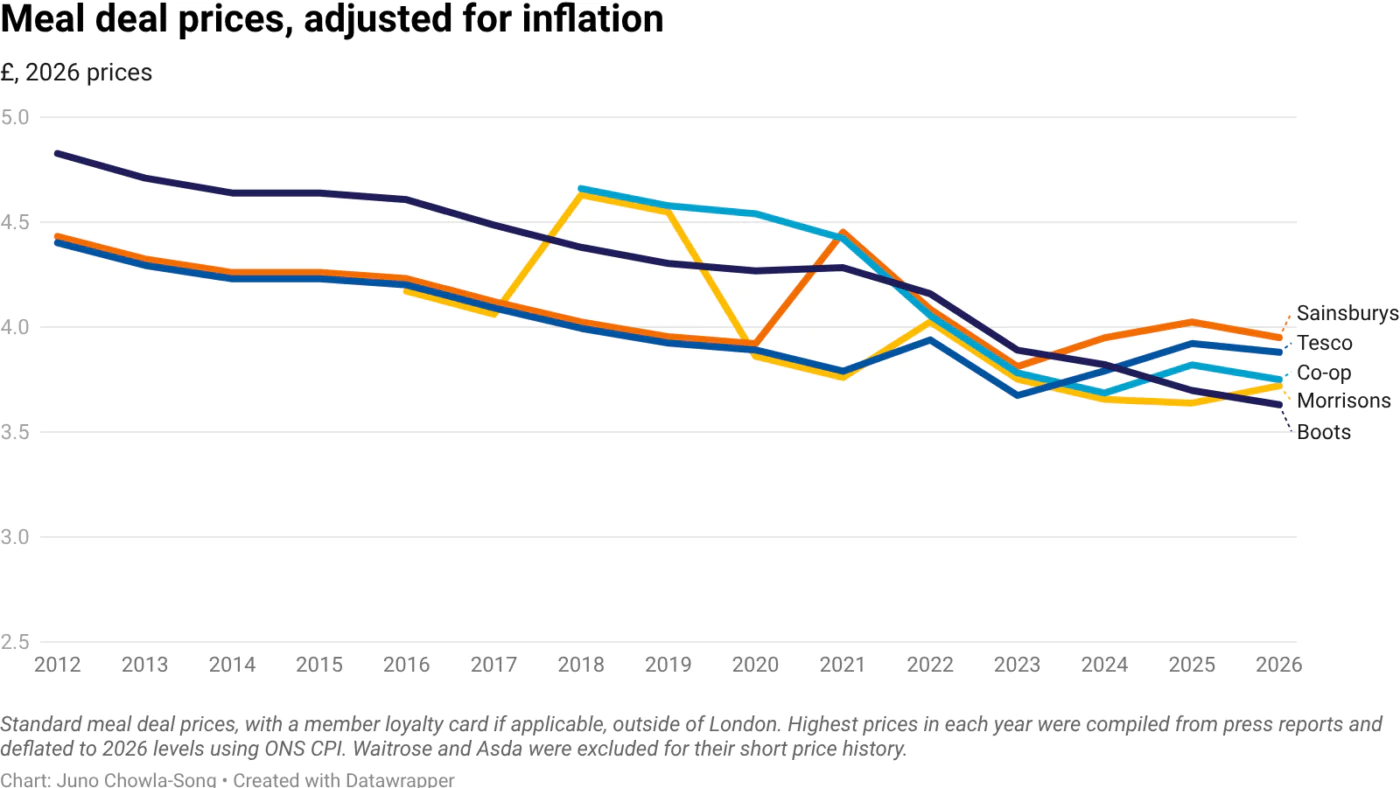
British pricing is also unrivalled worldwide.
The other main country with a huge convenience store meal culture is Japan, and even it can’t compare. On mean full-time earnings, a British worker needs about 10 minutes of work to buy a £3.85 meal deal, before tax. A Tokyo worker needs about 15 minutes to buy a bento from the convenience store. That bento doesn’t include a snack or a drink. When the snack and drink are included, the time-price bumps up to 19 minutes. Japanese convenience store food is generally fresher, delivered two or three times daily, which raises the cost. Still, Britain wins on price.
You might assume Britain’s low prices are a result of competition between food manufacturers. But actually, there are only a few firms making Britain’s lunch.
Greencore is the world’s largest fresh pre-packed sandwich maker, employing 28,000 staff across 36 factories. After its recent merger, it produces approximately one billion sandwiches, salads, sushi packs, and other food-to-go items a year. These are delivered to Tesco, Sainsbury’s, Asda, Waitrose and Marks & Spencer. Greencore’s main rival, Samworth Brothers, runs 15 bakeries and employs 12,500 people. It also supplies major supermarkets. A few smaller manufacturers compete for the rest.
The actual companies keeping the meal deal price down are the supermarkets. Most of the supermarkets running meal deals contract the same few companies. When they write up their contracts, they have the size and bargaining power to pressure non-name brand producers to share their costs. This usually happens in ‘open-book’ arrangements.
Then, when the supermarkets come back to renew contracts, they check to make sure that producers have lowered costs and raised efficiency. This is part of the reason why Greencore reports a 6% adjusted operating margin. The next leading sandwich producer, Samworth Brothers, reports a net operating margin of 3.6%.
Those are thin margins, leading to worries that producers will eventually go under. The market is no Wild West, though; Britain regulates these relationships with a code of practice and an adjudicator. In the meantime, Greencore has increased its productivity by 4% in the past year and Samworth Brothers set a new capital expenditure record of £87 million. The squeeze isn’t pushing producers out of business. It’s pushing them to be more efficient.
Supermarkets have less power over the snack and drink. The name-value of companies like Coca-Cola gives them more negotiating power, leading to generally higher profits.
Nonetheless, all of this happens because the supermarkets are competing with each other. Economies of scale help, of course, and so does the absence of VAT on cold meal deal mains. But the pressure supermarkets put on producers only exists because they are under pressure themselves.
This competition has kept millions of Britons loyal to the meal deal. More than a third of Britons buy at least one weekly, and the industry grows 3.4% year on year. This popularity is echoed by social media discussions on meal deal optimisation, a Channel 5 documentary and the expansion of meal deals to multiple retailers.
John Healey has found the wrong scapegoat for the cost-of-living crisis. Squeezing supermarkets harder won’t make lunch cheaper. Competition already keeps supermarket margins thin, and supermarkets pass that pressure on to producers. The end result is a meal deal that 7 million people buy each weekday, and one more reason I’m not going back to New York.


English rock fans are understandably thrilled over the announcement that Oasis will embark on another tour, including a stop in Manchester, where the band first got started in 1991. And while that may be good news, fans are still going to have a difficult time seeing them perform live – affording it, that is. Live […]
I’ll declare an interest. I sit on Reform UK’s Board and I’ve known Nigel Farage for a quarter of a century. So when Kemi Badenoch tells the country that Reform are ‘another left-wing party’, that we and Labour are arguing for ‘the same things, nationalisation, the two-child benefit cap’, that Farage is Jeremy Corbyn wrapped […]

Here’s a fun fact for you: Ireland, a country of just over 5 million people, is one of the top five largest exporters of pharmaceuticals on the planet. Ireland’s exports are estimated around 100 billion euros, with 19 of the top 20 pharmaceutical companies having a significant footprint employing roughly 50,000 people. This has translated […]


