The BBC and the death of ‘lanyardism’
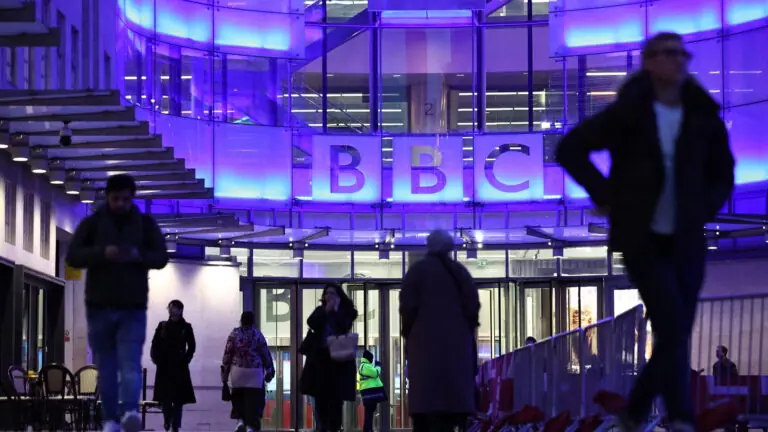
Photo: HENRY NICHOLLS/AFP via Getty Image
‘Trust is the foundation of the BBC. We’re independent, impartial, and truthful.’ This is taken from the first line of the ‘Trust’ section of the BBC’s code of conduct. Yet events over the last week have confirmed the suspicions of many that our national broadcaster is not as incorruptible as it would have us believe.
You would have to be living under a rock to have not noticed that the BBC is embroiled in a crisis over (among other things) its selective editing of Donald Trump’s speech on January 6, 2021, just before the Capitol Hill riots. In a documentary aired on Panorama in October last year, ‘Trump: A Second Chance?’, it was made to look like the President was explicitly urging protestors to storm the US Capitol.
The BBC’s Chairman Samir Shah has apologised for this ‘error of judgment’ and Tim Davie, the Director General, and Deborah Furness, the Head of News, have both resigned. Yet Trump is not yet satisfied, and appears to want the organisation brought to its knees before him. Unless the BBC offers a retraction, apology and compensation by this Friday, he is threatening to sue for ‘no less’ than £1 billion.
This is of course not the first time Auntie Beeb has let the mask slip. You’ll all remember the complaints about its coverage of the October 7 atrocity in Gaza and subsequent conflict, when it refused to describe Hamas – a proscribed terror group – as terrorists. BBC Arabic has also long been accused of having an anti-Israel editorial direction. One chap who said that Jews should be burned ‘as Hitler did’ appeared as a guest on BBC Arabic 244 times in 18 months.
In 2023, when Nigel Farage was de-banked by Coutts, the BBC journalist Simon Jack suggested that he had lost his account because his financial worth fell short of what the bank required. Farage uncovered documents proving that his account was in fact shut because his public positions did ‘not align’ with those of NatWest Group – Coutts’ owner. Both the BBC and Jack had to issue an apology.
Staff at the BBC are also said to be concerned that specialist LGBT reporters have effectively prohibited certain stories from being reported that might contradict their progressive, pro-trans agenda – one of the issues, along with Trump and Gaza, covered by Michael Prescott’s infamous leaked report.
Then again, it’s not just the right who are infuriated by the Beeb. Anti-leftism is supposedly rife in Broadcasting House, too. Laura Kuenssberg, who has been the BBC’s flagship political journalist for years, is forever being accused of being a secret right-winger. Towards the end of last year, Kuenssberg had to cancel an interview with Boris Johnson after she accidentally sent him briefing notes beforehand, which many a leftie claimed was a little too convenient to believe.
While leader of the Labour Party in 2016, Jeremy Corbyn called for her to be dismissed for her supposed right-wing bias – and don’t get me started on the whole furore about Jezza’s purportedly pro-Russian headwear. Separately, the media regulator Ofcom found that the BBC had breached impartiality rules for a broadcast on Radio 4’s ‘World at One’ show in 2021, in which the former leader of the Scottish Tories, Ruth Davidson, voiced ‘strongly critical’ views towards the Scottish government without enough airtime being given to alternative opinions.
The BBC’s ability to infuriate both Left and Right is often read as testament to its impartiality. The logic goes that in an increasingly polarised climate, the frank reportage of facts has become tricky to do without provoking an aggressive response. So when both sides are roughly equally annoyed by a story, you have probably reported it impartially.
I’m not convinced. What the various examples of anti-right and anti-left bias tell us is not that the BBC is impartial, but rather that it subscribes to a particular ideology that most people just happen to hate, albeit for different reasons.
The Beeb has become a vessel for ‘lanyardism’ – the school of thought preferred by the technocratic ‘lanyard class’ (a term coined by Maurice Glasman).
Interpretations differ, but the beliefs of this managerial elite seem to boil down to the most unimaginative form of modern liberalism going: diversity is unquestionably our strength; markets are important, but cannot be allowed to operate without sufficient red tape; whether or not there are such things as men and women is actually a deeply complex matter; a nation’s international standing is based on its commitment to Net Zero; DEI schemes are the price businesses have to pay for the sins of our fathers; and so on.
The appetite for this combination of social democracy and social progressivism has always been small, yet in the corridors of Broadcasting House and the government buildings of Whitehall, it has become the ideology de rigueur. From Tony Blair to Keir Starmer, it has been the defining belief system of our time, informing Westminster’s approach to the economy, social issues and migration – tying hapless politicians in knots as they explain why it is the duty of taxpayers to fork out for migrant hotels, while also justifying failing standards in critical public services like healthcare.
Lanyardism, in other words, is the intellectual foundation of our decline – and Britons are no longer buying it.
What the BBC is reckoning with, therefore, is much deeper than a standalone crisis, and is being replicated across our institutional landscape. An ideological shift is taking place, in which the social and economic conditions that would have allowed a taxpayer-funded media outlet to impose its values on the rest of us and get away with it no longer exist. And while ‘Strictly Come Dancing’ and ‘Antiques Roadshow’ may slip through the tectonic plates in their current form, it looks increasingly doubtful that BBC News will.
The UK-EU relationship must be viewed through the lens of the battle for the world’s operating system. There are three operating systems in the world. The first is a competition on the merits system where countries are free to engage in regulatory competition but inter-operate on the basis of mutual recognition and equivalence. This historically […]
In the mid-90s, you could save up a deposit for a house in a year; now it takes about a decade. That’s a really meaningful change. That’s a whole stage of your life where 30 years ago you might reasonably have expected to become a homeowner and now that is highly unlikely In a room […]
Even before he became Prime Minister in July, Andy Burnham had talked about the country in institutional, positively mechanical ways. He promised to ‘give Britain the circuit-breaker it needs’, and said that his Number 10 North, part of the Office for the Prime Minister and Cabinet based – where else? – in Manchester, would be […]