Don’t blame the water companies for hosepipe bans
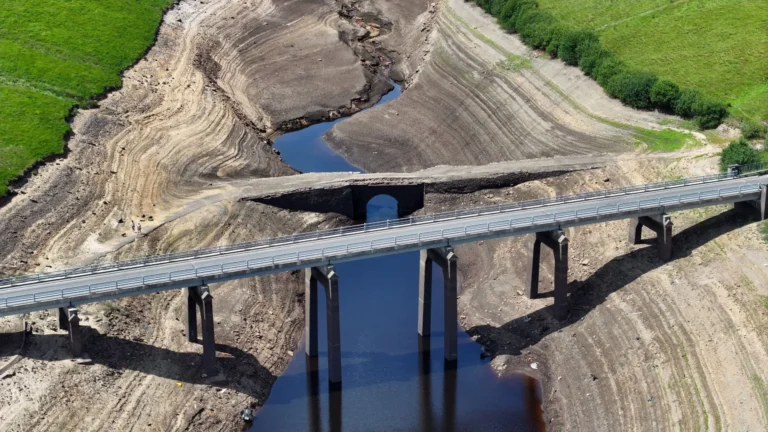
Low water levels at Baitings Reservoir, Ripponden. Christopher Furlong/Getty Images
More than 20 million people across England and Wales are currently under hosepipe bans. This should be no surprise following the driest July on record, with the Met Office provisionally recording just 5.6mm of rain across England, less than half the previous record, set in 1911. But how much of the blame can be laid at the door of private water companies?
First of all, let’s acknowledge the scale of the challenge: the Environment Agency estimates that England faces a public water supply shortfall of five billion litres a day by 2055, equivalent to a third of what we use today, thanks to population growth and climate shifts. That is a huge challenge for whoever provides our water supply. Is private ownership falling short?
Between 2010 and 2024, Ofwat kept prices 25% lower than if they had followed inflation, helpful for customers, but starving the system of necessary investment
Critics of water privatisation often fixate on the fact that we have not built a water supply reservoir since Carsington in 1992. This is technically correct, although as we will see, this is not for want of trying. What this complaint misses is that private ownership has delivered a remarkable unsung increase in England’s effective water supply, cutting leakage by 778,000 megalitres a year.
This is enough water saved to fill 22 Carsington reservoirs, with its capacity of 35,142 megalitres. Without this success, our current situation would be much worse.
The nationalised water system in England and Wales was losing an estimated 5,000 megalitres per day (Ml/d) to leaks. The private water companies rapidly reduced that. Ofwat estimates leakage in 2024-25 at 2,869 Ml/d: a reduction of 43% since privatisation, and the lowest level on record.
Private water companies have also expanded metering, meaning customers pay based on the amount of water they use. Around 60% of English households are now metered, and the average metered customer uses 122 litres a day against 175 litres for an unmetered one.
In contrast, Scottish Water, a publicly owned body, still loses around 25% of the water it puts into supply to leaks, against 19% in England. Barely 3% of Scottish households are metered.
This reduction in leakage, along with usage reductions thanks to improved metering, means that the actual input of water into the system today is lower than it was pre-privatisation despite population growth of 11.9 million since 1992.
However, this isn’t enough. By the Environment Agency’s own reckoning, only 60% of the coming shortfall can be closed by managing demand and cutting leaks further. The remaining 40% has to come from new supply.
These figures may actually understate the need for new reservoirs. Water companies have slowed their leakage reduction as they exhausted the easy wins, fixing obviously broken infrastructure and introducing pressure management (reducing water pressure and thus, strain on the system during times of lower demand). Further improvements would, in many cases, require costly and disruptive mains replacement, forcing companies to dig up residential streets. Leakage reduction has plateaued as companies reach the ‘Sustainable Economic Level of Leakage’, defined by Ofwat as the rate at which the cost of preventing the next unit of leakage exceeds the value of the water saved.
As helpful as leakage reductions have been, they cannot substitute for new supply forever. Recognising this, water companies have been trying to build new reservoirs and invest in increasing water supply for years.
Unfortunately, they have been repeatedly blocked by Ofwat’s pricing structures.
In 2014, the Environment Agency raised no objection to Bristol Water’s proposed second reservoir at Cheddar, and Sedgemoor District Council granted it planning permission, but Ofwat refused to let the company recover the cost through bills, on the grounds that the £125 million scheme had not been justified, despite increasing bills by only £7 a year. The reservoir was finally approved in 2024, and it will now cost £839 million, £700 million more than originally forecast.
Public ownership is often promoted as more capable of long-term planning and investment. As this example shows, the reality is just the opposite. The state focuses on keeping prices down for political gain in the short term instead of allowing the long-term investment needed to provide security of supply. Between 2010 and 2024, Ofwat kept prices 25% lower than if they had followed inflation, helpful for customers, but starving the system of necessary investment. Politicians always have urgent demands for spending to distract them from infrastructure projects. They will prioritise funding the triple lock, more money for the NHS or increasing child benefits over infrastructure unlikely to show any results before the next election.
By sticking to five-year price reviews, the Ofwat regulatory regime has made it impossible to build reservoirs, infrastructure projects that deliver results over decades. The Cunliffe Review of the water industry found that companies would not bother to submit projects they saw as beneficial because they knew Ofwat’s focus was on minimising bills.
Havant Thicket only went ahead because it had an exemption from the regular pricing regime. At the 2019 price review, the regulator set Portsmouth Water a bespoke ten-year price control running to 2030. As a result, the company was confident it could make the necessary infrastructure investments.
The Clean Water Bill is set to embed a longer-term pricing mechanism across the entire network and should be passed by Parliament before the end of this year.
Nationalisation is not a solution to the barriers faced by new reservoirs: a lack of secure funding, outdated abstraction licensing rules, regulators with overlapping mandates and planning delays. Despite their failings, the private water companies have a more impressive track record than they are typically given credit for. It is in fact those companies which have advocated increased investment in contrast to the short-term thinking of the regulators.
If the UK is to build the reservoirs it needs, with plans for ten in the pipeline, proposed reforms need time to be fully formulated and implemented. Andy Burnham, who entered Downing Street promising greater ‘public control’ of Britain’s utilities, has floated a ten-year plan to return water to public ownership. This would unnecessarily disrupt the industry, saddle the government with more debt and only increase the chances of you being forbidden to water your garden in the years ahead.


The Stanford Encyclopedia of Philosophy is not a publication most would be familiar with. It is meant as a repository of overviews of big topics in philosophy broadly defined, inclusive of political theory. As such, entries added to it are unlikely to generate strong responses by the experts deeply familiar with each individual entry. Every […]

In 1920 a Scottish Unionist MP Noel Skelton coined the term ‘property-owning democracy’, arguing that widening the base of property ownership among the working class would stabilise democracy and counter socialism. The term came to the forefront of political discourse when Prime Minister Anthony Eden used it at the Conservative Party conference in 1946. However, […]

I moved from New York to Britain and I keep getting asked when I’m going back. Not by my family, or my friends back home, but by British people. They tell me about flat wages, looming youth unemployment and an air of decline throughout the country. But no one talks about lunch, because everyone here […]